
Proper lubrication is essential to maintaining reliable valve operation, extending service life and preventing leaks, spills and unplanned downtime. This guide outlines best practices for selecting and applying lubricants across a variety of industrial valves and actuators in plant settings.
Learning objectives
- Identify the different types of industrial valves and their key components that require lubrication.
- Select appropriate lubricants based on valve type, process fluid compatibility and operating conditions.
- Apply maintenance and lubrication best practices to extend valve life, reduce wear and ensure safe, reliable plant operation.
Valve operation insights
- Valves are a critical component, and they need to be properly maintained with lubrication.
- Industrial valves control fluid flow, but there are many different types – and each type has special lubrication considerations.
- A valve maintenance schedule can help plants avoid unplanned downtime and keep equipment running at maximum efficiency.
Valves are critical for controlling fluid or pneumatic processes, and when they are not properly maintained, failures are most likely to occur at the worst possible time. The inner workings of a valve, such as stems, O-rings, lip seals, seats packing and actuators, rely on lubricants for sealing, corrosion protection and wear control. Without proper lubrication and compatible seal materials, valves lose effectiveness and longevity, increasing operational downtime and repair costs.
But proper lubricant selection and best lubrication practices can ensure a variety of industrial valves in plant and industrial settings are well-maintained to prevent unplanned downtime.
It is important to note that lubricants are not used to support process fluid flow restriction in most valves, because prolonged exposure of a lubricant to a process fluid (including water) would result in dissolved lubricant and a compromised seal. Flow blockage is usually mechanical and based on the valve internals positioning and the surface roughness of the valve seat and internal interfaces.
How to identify lubricated valve types by application
The internal geometry and operating components of industrial valves are designed to control fluid flow in specific ways. Each valve type has unique lubrication requirements. Here is a summary of valves for which lubricants are required:
- Gate valves: Primarily used for on/off service
- Outside screw and yoke (OS&Y) valves: Usually gate valves; stem movement is visible and easier to lubricate and maintain
- Ball valves: Use a rotating ball to control flow, providing quick operation and tight shutoff
- Globe valves: Use a movable disc for throttling and flow regulation
- Butterfly valves: Rotate a disc on a shaft to regulate flow; lightweight and common in large-diameter piping
- Plug valves: Rotate a cylindrical or tapered plug to control flow; suited for on/off or limited throttling applications
- Needle valves: Provide precise control with a slender, tapered needle; common in instrumentation or low-flow applications
- Diaphragm valves: Use a flexible diaphragm to control flow while isolating the mechanism from the process fluid; ideal for corrosive or sanitary service
- Actuators: Devices that open, close or position valves using mechanical force; may be manual, pneumatic, electric or hydraulic and are key for automated or remote operation
All valve types and their actuators contain moving components such as stems, threads and packing. Proper lubrication ensures:
- Reduced wear and friction
- Lower operating torque
- Longer service life
How to select a valve grease
Process fluid compatibility is critical to grease longevity. For high-pH fluids, alkaline calcium sulfonate complex greases are commonly used. Calcium-based, calcium sulfonate and calcium sulfonate complex greases are also suitable for water service, remaining stable in wet environments and providing corrosion protection. For low-pH fluids, slightly acidic lithium complex greases are preferred. Greases with highly refined mineral oils orpolyalphaolefin (PAO) synthetic base oils are generally compatible across both acidic and basic pH ranges. Temperature is another key factor. PAO-based greases remain mobile in arctic conditions, ensuring valve internals move freely. They are suitable for service up to approximately 350°F. For higher temperatures, sealing may rely on the process fluid or specialty greases that leave behind solid lubricants like graphite or molybdenum disulfide.
What to consider when relubricating a valve
Always follow manufacturer-recommended regreasing procedures. Frequency and quantity depend on valve type, cycle count, process fluid chemistry, ambient and operating temperatures and pressure.
Most large valves include a stem thread lubricatorand a packing gland, which is the primary seal against fluid leaks. Inspect packing gland regularly; tighten to stop leaks and replace when necessary.
Valve stem and body lubrication often involves purging old grease with fresh grease. For manually actuated valves, stem grease points can usually be serviced while the valve remains in operation, but a proper work permit should always be obtained.
Whenever possible, isolate, depressurize and drain the valve before replacing packing or purging grease to minimize exposure to process fluids or high-pressure water.
More specific relubrication practices are addressed in each valve description below.
Gate valves
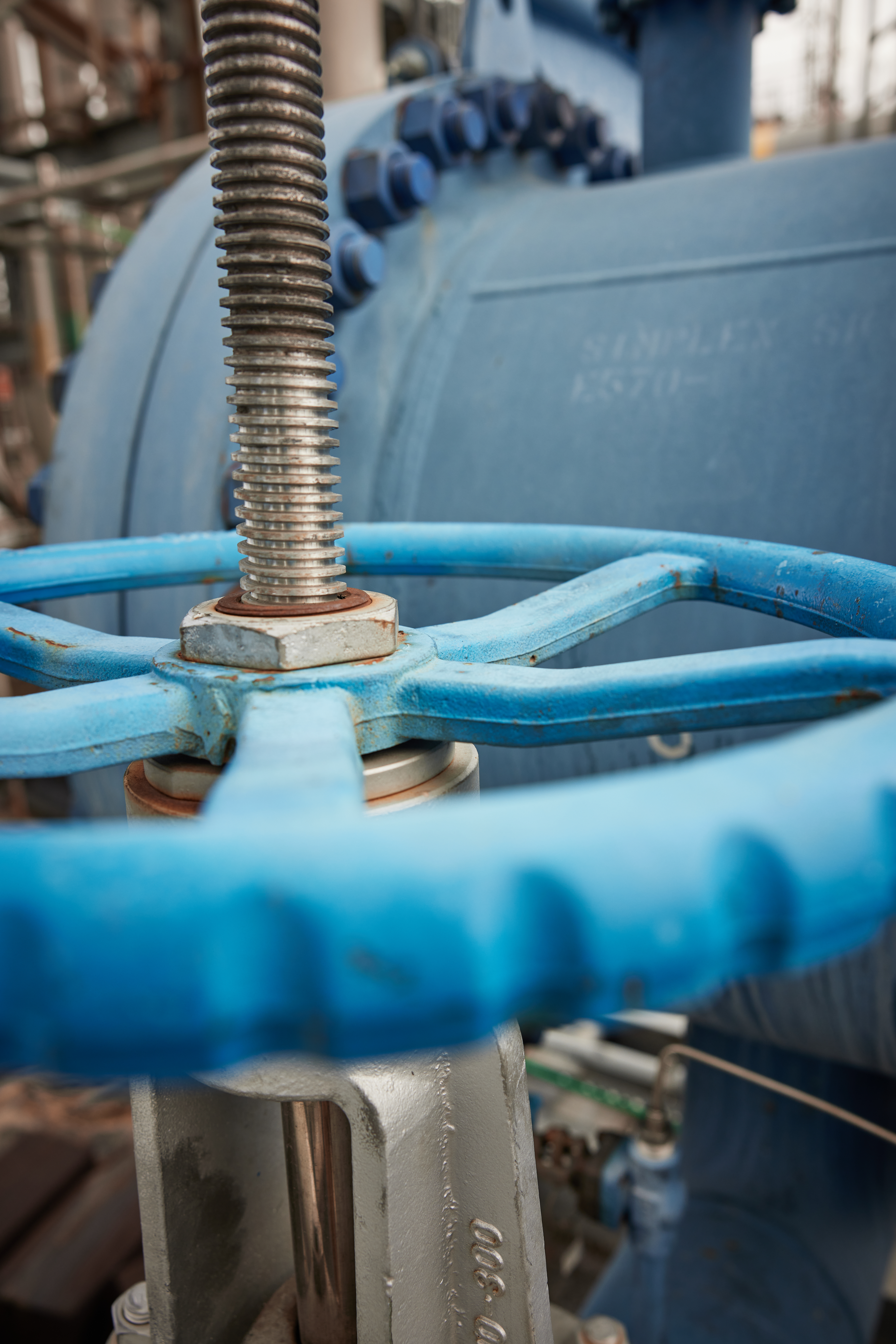
In OS&Y gate valves, the upper portion of the stem is threaded and moves through the handwheel, while the lower, non-threaded portion passes through lubricated packing and connects to the gate that controls flow. The actuating handle on standard gate valves is affixed to the top of the stem and away from the valve body with the stem.
Gate valves are typically serviced every 60 operating cycles or quarterly. In applications with highly caustic or acidic process fluids, valves should be inspected daily and serviced weekly. For most services, the packing is impregnated with a silicone-based lubricant to resist washout from process fluids or water. Valves with long stems may include a grease zerk at the top of the yoke to reduce operating torque.
When maintenance is required, lubricated packing should be replaced, often after back-seating the valve where applicable. Stem threads should be lubricated through the grease fitting at the actuator. If no grease fitting is provided, the valve should be cycled and the stem hand-lubricated until the threaded portion is fully coated.
High-pressure valves
Depending on service temperature, high-pressure flanged valves used in plant process and industrial steam service, as defined by American Society of Mechanical Engineers (ASME) B16.34, may operate at maximum allowable working pressures up to approximately 500 psi. As operating pressure increases, tackified greases are often required to limit grease displacement caused by high internal contact pressures.
Extreme-pressure valves, such as ASME B16.34 Class 4500 designs, can operate at pressures up to 7,500 psi and feature thicker bodies and welded connections. Valves designed for oil and gas service may operate at pressures up to 15,000 psi and are constructed with heavy-wall bodies, robust flanged connections and grease-filled cavities to allow internal components to move under extreme contact loads.
Routine lubrication practices for high-pressure valves generally follow the same procedures used for lower-pressure valves of similar design, with grease selection adjusted to accommodate higher contact pressures.
Ball valves
Ball valves are commonly used in gas service because they provide positive shutoff when closed. Unlike gate valves, ball valves rely on lubricated seats to accommodate the sliding motion required to rotate the ball between open and closed positions. When ball valves are used in liquid service, seat grease compatibility becomes especially important, as the lubricant is continuously exposed to the process fluid and may be subject to washout. In general, liquid service is more demanding on seat grease than natural gas service.
Service intervals for ball valves vary with operating conditions and may range from daily to monthly. When maintenance is required, both the valve body and stem should be purged with fresh grease. Ball valves should be placed in the fully open position during servicing to ensure proper grease distribution.
Plug valves
Plug valves are designed for quick on/off service and high flow capacity, using a quarter-turn motion. The stem is lubricated through a grease fitting, while a lubricated packing assembly is compressed to provide process fluid containment.

Service intervals for plug valves depend on operating conditions and may range from daily to monthly. When maintenance is required, both the valve body and stem should be purged with fresh grease. The valve should be in the fully open position during servicing to ensure proper grease distribution. Plug valve lubrication practices are like those used for ball valves.
Needle valves
Needle valves are used for precise metering and fine control of very low flow rates and require multiple turns to position the tapered needle relative to the seat. Needle valve lubrication and sealing practices are like those used for gate valves, with lubricated stem threads and packing providing smooth operation and effective sealing.
Globe valves
Globe valves use a circular disc or plug that seals against a beveled orifice in the valve body to control or throttle flow. They can also function as check valves when a spring-loaded shaft closes the disc against the orifice during reverse flow.
Lubrication is required for the stem packing and actuator, whether the valve uses a manual handwheel or a hydraulic actuator with a gearbox. Globe valve lubrication practices are like those for gate valves, focusing on maintaining the packing gland and valve stem threads.
Diaphragm valve
Diaphragm valves isolate moving components or the valve from the process fluid, making them well suited for caustic or acidic service where metal components are prone to corrosion. In these applications, the valve body internal fluid passage and system piping will be coated or lined for additional protection.
The valve stem is driven by an actuator and pushes a disc that transmits force to the diaphragm, which seals against a raised surface at the inlet and outlet junction. While diaphragm valves can provide flow control and throttling, doing so may reduce diaphragm life due to erosion.
Diaphragm valves do not use stem packing, but a grease point may be present at the actuator base for stem thread lubrication, when required. Diaphragm valve stem thread lubrication requirements are like gate valve stem thread lubrication.
Special lubricants for valve actuators and gear boxes
An actuator is any device that opens or closes a valve by applying kinetic energy. Actuators can be manual, electric, pneumatic or hydraulic. Unlike solenoids, which send an electric signal to start an actuator, actuators perform the actual movement. Lubrication is typically applied to manual and hydraulic actuators.

Pneumatic actuators operate within an air-line system that includes a lubricator containing low-viscosity, arctic-stable fluids with good oxidation resistance. Hydraulic actuators are usually powered with International Organization for Standardization (ISO) 15–32 arctic-grade fluids or, in some systems, water-glycol emulsions, providing wear protection and oxidation stability.
Aside from maintaining fluid performance in extreme temperatures or sunlight, actuator lubrication is generally not severe duty. Systems should be inspected and serviced at least quarterly, with more frequent attention for valves in critical service. Hydraulic and air-line fluids should be replaced at least annually to prevent degradation from moisture or contamination.
Worm gearboxes (see Figure 4) are commonly used on large, high-pressure valves as part of a manual or remote-controlled actuator. They provide slow, controlled movement of valve internals, which is useful for precise flow control. Gearboxes are typically lubricated with grease due to high loads and slow operation.

Gearboxes should be inspected at least quarterly to check for leaks. Grease should be purged annually to maintain a uniform and effective lubrication layer.
Thoughts for developing a valve maintenance schedule
When developing valve maintenance schedules, plant operators should consult valve manufacturers to ensure recommended practices are followed for the expected operating conditions. Using the correct grease for the service, applying the proper amount and performing maintenance at the appropriate intervals helps extend valve life and prevents leaks, process fluid spills, gas releases and other safety hazards.