
Lubricant viscosity plays a critical role in maintaining the performance, efficiency and longevity of manufacturing equipment. By understanding viscosity measurement, classification and selection, maintenance teams can ensure optimal lubrication, minimize wear and prevent costly equipment downtime.

Learning objectives
- Define viscosity and explain how it affects lubricant flow, friction reduction and energy efficiency in manufacturing machinery.
- Identify how viscosity is measured and classified using International Organization for Standardization (ISO) and Society of Automotive Engineers (SAE) standards and understand the significance of viscosity index (VI).
- Select appropriate lubricants based on equipment design, operating conditions and environmental factors to optimize performance and extend equipment life.
Viscocity insights
- Viscosity is a fluid’s internal resistance to flow.
- Viscosity Index (VI) is a measure of the change in viscosity of an oil in relation to temperature.
- Protecting moving parts is always an important factor to consider, so it’s critical to be sure that the viscosity is correct for the equipment, for the application and for the operating conditions.
Machinery and equipment are the backbone of most manufacturing plants and must be maintained to keep the facilities running at peak efficiency without unplanned downtime. That means all parts of the equipment and machinery should be checked to ensure successful runs happen, including the lubricants used in the equipment. Lubricants are a necessary component of day-to-day maintenance. Lubrication is used to reduce friction, reduce energy consumption and reduce wear. Choosing the right lubricants can make a world of difference in how smoothly a manufacturing plant operates, but to do that, it’s critical to use the correct viscosity for the equipment.
What is viscosity?
Viscosity in its simplest definition is a fluid’s internal resistance to flow. The more viscous a lubricant, the more resistance the lubricant has to flow. The opposite applies as well. The less viscous a lubricant is, the less resistance the lubricant has to flow. Viscosity can be measured in a variety of ways, but the two most common are kinematic viscosity and dynamic viscosity. Dynamic viscosity is the measurement of viscosity under an applied force. When dynamic viscosity is converted to kinematic viscosity, the applied force is taken out of the equation and the only force on the fluid is gravity.
How to measure oil viscosity
The most common viscosity measurement used by lubricant manufacturers is kinematic viscosity. It is measured by timing how long it takes for the fluid to flow a certain distance through a capillary tube under gravity. The kinematic viscosity is generally measured at 40º Celsius and 100º Celsius and has units of centistokes (cSt). In International System of Units (SI), centistokes have the fundamental units mm2/s. This standardizes the way people discuss viscosity. Two organizations have defined the main industry standards for viscosity. The first is the International Organization for Standardization (ISO). Industrial products are generally referenced by their ISO viscosity grades, which are equivalent to the kinematic viscosity measurement at 40º Celsius, plus or minus 10%. The ISO scale runs from 2 cSt up to 6800 cSt and sometimes much higher. Industrial hydraulic oils will generally be on the lower end of the scale, corresponding to ISO grades 22, 32, 46 and 68. Industrial gear oils will generally run higher, usually at ISO grades of 150, 220, 320, 460 and 680. Products at the higher end of the scale are very thick and products around 2 cSt are closer to the viscosity of water.

The second organization which defines viscosity standards is the Society of Automotive Engineers (SAE). These are often seen in engine oils and gear oils. Instead of referring to the viscosity measurement, SAE designates numbers that correspond to the viscosities in ranges. Unlike ISO viscosities, these viscosities are defined at 100º Celsius. For instance, an SAE 30 engine oil has a kinematic viscosity between 9.3 and 12.5 cSt at 100º Celsius. This is where a viscosity approximate equivalency chart is helpful. It compares different viscosity grades. For example, the ISO 150 grade is comparable to a SAE 40 crankcase oil or an SAE 90 gear oil.
What is Viscosity Index?
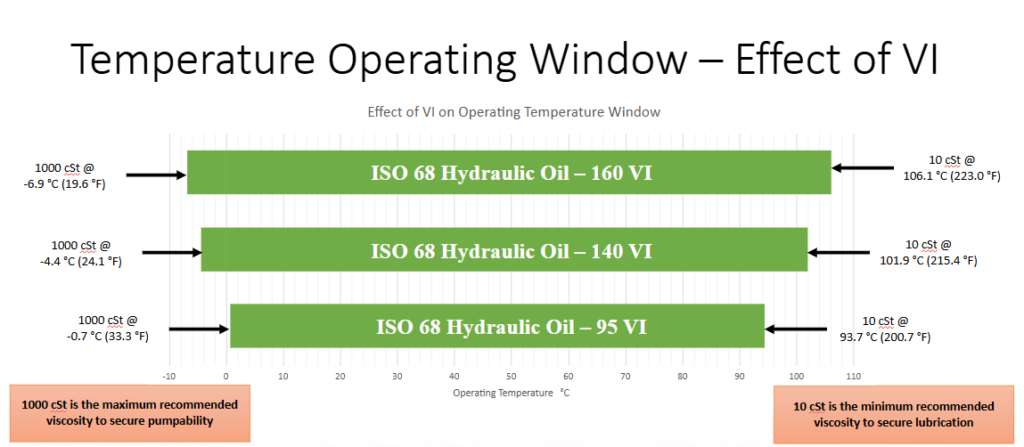
Viscosity Index (also called VI) is a measure of the change in viscosity of an oil in relation to temperature. All oils tend to get lower in viscosity as the temperature goes up. How much change occurs is determined by the molecular structure of the oil. Viscosity index was originally defined on a 0 to 100 scale, with 0 representing Gulf Coast naphthenic oil and 100 representing Pennsylvania paraffinic oil. Today, the scale can go below 0 in the case of some aromatic extracts and well above 100 in the case of some synthetic fluids. Viscosity Index is a unitless value that is calculated from two viscosity measurements, typically the viscosities measured at 40º and 100º Celsius. A product with a high viscosity index has a wider operating temperature window, since it maintains viscosity better over a wider temperature range. High VI oils are preferred in many applications where the operating temperature can vary widely.
Exploring oil viscosity nomenclature
When viscosity requirements are mentioned, you may hear terms such as monograde, multigrade, high VI or 10W-30, but without understanding the nomenclature, the meaning of the terms is not obvious. Monograde oils are oils with low or moderate viscosity index, typically less than 120. Examples of monograde lubricants are an ISO 32 hydraulic oil or an SAE 30 engine oil that has no viscosity modifier to raise the VI or to be a multigrade oil. These lubricants generally have very small temperature operating windows but can be useful in certain pieces of equipment or work well in certain climates where a multigrade oil is not necessary. Equipment used only in the summer months, like residential lawnmowers, can operate using a monograde oil. In environments closer to the equator and the southern United States, monograde oils often work great in many pieces of equipment year round because these areas do not experience a lot of the extreme cold temperatures. In addition, equipment operated indoors in a more temperature-controlled environment often does not require oils with a high VI.

A multigrade oil is simply defined as a lubricant that provides both good cold-temperature start up and the required viscosity for high-temperature operation. These oils are engineered to have a high viscosity index, which allows these oils to have a wider temperature operating window. Often, multigrade oils are designated with the letter W in the SAE viscosity grade. The lower the number before the W, which stands for winter, the lower the cold temperature properties of the lubricant. Engine oils with viscosities such as SAE 5W-20, SAE 0W-20 and SAE 10W-30 are multigrade oils.
On the industrial side, it’s antiquated to use the term multigrade. Now, the common term is high VI, which stands for high viscosity index, but you may run into older pieces of equipment at a facility that have tags calling for a 5W-20 hydraulic oil. Nowadays, the industry has moved away from the term multigrade because there is a different set of testing required to define SAE multigrade lubricants. The same tests that are run on engine oils to meet the SAE multigrade requirements are not performed on industrial lubricants, even though the cold temperature properties that we are describing are very similar in industrial oils.
Products with higher viscosity index maintain viscosity over a wider temperature range and oftentimes you can use a single product with a higher VI in place of two products with adjacent viscosity grades. For example, you may have a need for an ISO 32 and an ISO 46 hydraulic oil, but you may be able to use a higher VI ISO 32 that maintains the viscosity well enough that can cover the ISO 46 grade as well so that you can use a single product instead of two. This simplifies lubrication needs and allows for lubrication consolidation. A rule of thumb is that lubricant consolidations should only be made plus or minus one viscosity grade. Consolidations beyond one adjacent viscosity grade may reduce energy efficiency and can also increase potential damage to the equipment. For the machine parts to work properly it is recommended that consolidations never go beyond an increase or decrease of one viscosity grade.
Why does oil viscosity matter?
The first consideration when selecting a lubricant should always be the manufacturer’s recommendation. Equipment components, like bearings and gears, are designed for specific viscosity grades based on typical operating conditions, so the first action should always be to consult the equipment manual. In certain instances, you may need to modify the lubricant recommendation based on factors like temperature, speed or other operating conditions. A thicker lubricant may be required for equipment operating at higher temperature, higher loads or lower speeds. Conversely, a thinner lubricant may be necessary at low temperatures, lower loads or higher speeds. Protecting moving parts is always an important factor to consider, so it’s critical to be sure that the viscosity is correct for the equipment, for the application and for the operating conditions. Lubricants with viscosities that are both too thin or too thick can cause detrimental wear and reduce the life of the equipment.
Why thicker isn’t always better?
Just because an oil is thicker, doesn’t mean it provides better protection. Newer equipment is made much more intricately, and equipment lubrication requirements have started to move towards lower viscosities. For example, pumps, hoses and reservoirs have become smaller, with lower tolerance. That means that a lower viscosity lubricant is likely going to be required. If a lubricant that is too thick is used, it could cause too much strain on the parts and may lead to equipment failure. Equipment speed is also a factor to consider when selecting the lubricant’s viscosity and higher speed may require the use of a lower viscosity lubricant. If the equipment is running gears or bearings at high speeds, an oil with too high of a viscosity may result in higher internal friction, causing an increase in temperature and increased wear.
If a fluid’s viscosity at its operating temperature gets too thin, it will not provide sufficient film thickness to adequately lubricate the machine parts. The lubricant will be unable to reduce metal-to-metal contact, which will accelerate wear and generate heat. If a fluid’s viscosity is too thick you may start observing over-heating of the circulation pump, possible cavitation or other issues. If you have an oil that has too high of a viscosity, you’re also going to start to see higher power consumption. Operational efficiencies are greatly reduced when incorrect lubricant viscosities are selected.
Lubricant viscosity is key to efficient operations
Understanding and selecting the right lubricant viscosity is key to maintaining efficient, reliable and long-lasting manufacturing operations. Lubricants not only reduce friction, but they also ensure that machinery runs smoothly, energy is used efficiently, and wear is minimized over time. The right viscosity allows lubricants to form a proper film between moving parts, preventing metal-to-metal contact and protecting vital components from damage. An incorrect viscosity can lead to excessive heat, increased energy consumption and premature equipment failure, resulting in expensive repairs and costly downtime.
The measurement and classification of viscosity such as ISO and SAE provide manufacturers and maintenance teams with a consistent way to select the most appropriate lubricant for each application. Understanding viscosity index and the differences between monograde and multigrade (or high VI) oils gives operators the ability to match lubricants not only to the type of equipment but also to environmental and operational conditions. This ensures that the lubricant performs optimally across temperature ranges and load demands.
Ultimately, lubricant selection should always begin with the equipment manufacturer’s recommendations and then be adapted based on specific operating environments. Factors such as temperature, speed and load all affect the ideal viscosity for maximum performance and protection. The goal is to achieve a balance — an oil that is not too thin to lose its protective properties and not too thick to restrict flow and efficiency. When this balance is achieved, the result is improved equipment reliability, reduced maintenance costs and extended life. By giving proper attention to viscosity and its effects, manufacturing plants can enhance productivity, minimize unplanned downtime and maintain a competitive edge.