
Effective lubrication is required to properly maintain the reliability and longevity of rotating equipment in demanding industrial environments. Today’s technologies help optimize lubrication performance while minimizing downtime and maintenance costs.

Learning objectives
- Understand key considerations when upgrading lubrication systems in heavy-duty industrial applications including flowmeter selection, system controls and feedback and alarms.
- Learn the benefits of integrating advanced monitoring technologies to refine lubrication accuracy, thereby extending machinery life and reducing downtime.
- Realize the importance of cross-functional collaboration, considering all viewpoints to design a system upgrade that fully supports optimal machine operation.
Lubrication insights
- Consider these upgrade considerations for lubrication systems: flowmeter selection, system controls and feedback and alarms.
- Managing all lubrication points within a heavy-duty manufacturing facility can require precision monitoring.
Lubrication systems can benefit any facility by extending machinery life and reducing operating costs. However, heavy-duty operations, such as steel, pulp and paper and mining, often have a high number of lubrication points, which can be difficult to manage.
Furthermore, many facilities still depend on legacy equipment that was not designed for modern add-ons like automated lubrication and predictive maintenance technology. Rotating equipment is especially vulnerable to these challenges, increasing the risk of unplanned downtime and higher costs. Bearings, gears, rotors and other rotating components all require the right amount of lubrication at the right time.
Considering an upgrade can be daunting. Beyond the cost factors, decisions must be made regarding controllability, electronic control interfacing, system sensors and feedback, visual and electronic event verification, data logging, component placement and downtime required to install and commission — the list is long.
Lubrication flowmeter selection
In any oil lubrication system for rotating equipment, controlling the flow rate to the lubrication point is a fundamental requirement. Flow rate control can be achieved through various means, from a simple inline adjustable orifice to a complex bank of meters equipped with electronic monitoring, feedback and alarms (see Figure 1).
Changes in oil temperature, affecting viscosity, must also be considered. If the system viscosity is constantly changing due to temperature variation, selecting a flowmeter device that compensates for viscosity changes will help maintain accurate, metered flow to the lubrication point.
Variable-area flowmeters that are simply designed and commonly used in many of today’s systems have a typical accuracy range of about 1.6% to 5% with changes in temperature and viscosity. If your lubrication requirement demands tighter accuracy, consider a different type of device.
Oval gear flowmeters and turbine designs are commonly used to maintain tighter flow accuracy over a broad range of temperature and oil viscosity changes. These devices can deliver a very tight accuracy over oil viscosity changes ranging from 30 to 1,000 centistokes.
Cost is relative to accuracy; the higher the accuracy over a range of viscosity changes, the higher the initial investment. Key questions are: What flow range does your system require and what level of per-point accuracy is needed to provide efficient lubrication and maximize life for the rotating component?
System controls
Plant engineers have many options of advanced system controls to incorporate into a new system or system upgrade. The days of relying solely on buttons, manual adjustment and visual indication are far behind.
By combining flow banks and software, we can provide a user interface for the centralized system. These systems allow users to monitor and control the metering system in real time — displaying flow rates, adjusting flow rate alarm limits and collecting flow rate, oil and alarm trends in the system.
Interface controls range from simple human-machine interface controllers and programmable logic controller-based systems to more complex industrial solutions that can integrate with factory systems, such as supervisory control and data acquisition, for enhanced oversight.
Controllability via Bluetooth mobile devices is also a growing trend with many lubrication system manufacturers.
Feedback and alarms for lubrication
The demand for real-time flow feedback and system alarms continues to increase. The ability to monitor any given flow rate to a lube point provides great reliability in a system. Coupled with flow alarming, a machine operator, maintenance technician or reliability leader can be instantly notified of a system problem that requires attention.
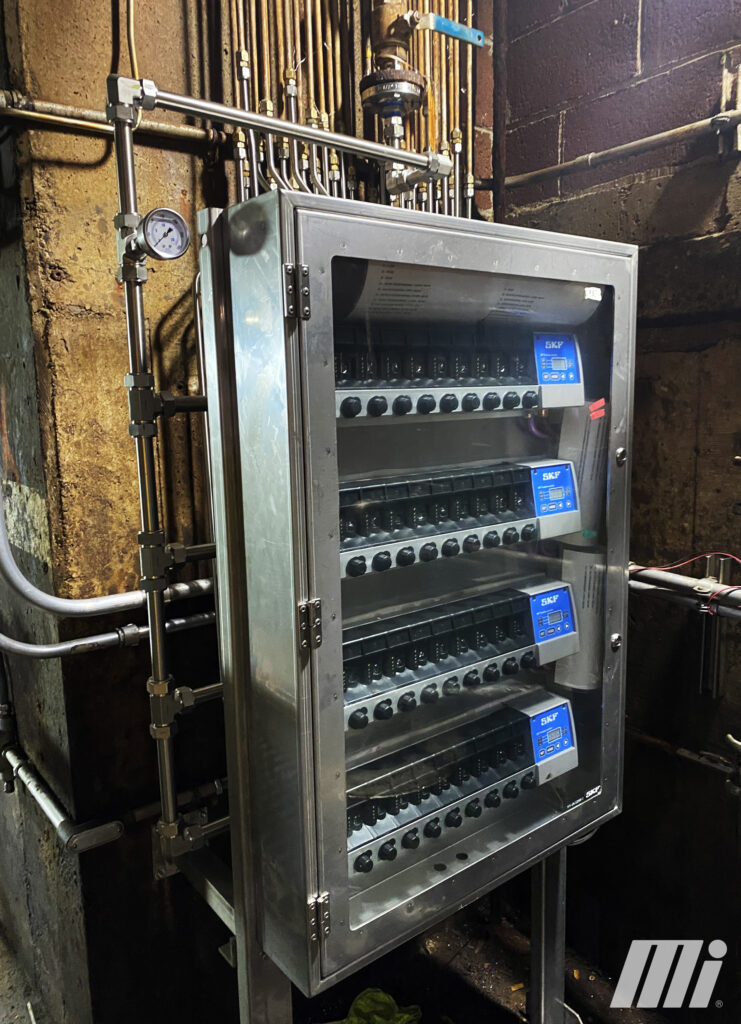
Real-time feedback is a valuable tool in avoiding insufficient lubrication, which can cause heat from increased friction, and wear, which can lead to component damage.
These types of devices provide real-time, continuous monitoring and alerts for lubrication system issues, helping to prevent component/equipment failure, reduce downtime and ensure optimal system performance. Notifying operators or other plant personnel before a problem becomes severe allows for timed and planned maintenance.
Importance of collaboration
Whether you choose oil or grease or complex or simple systems, there is a lubrication solution to fit your demanding industrial applications. Collaboration among all machine stakeholders is vital. Operators, engineers and reliability and maintenance teams each have different needs in a lubrication system.
All viewpoints must be considered to design a system upgrade that fully supports optimal machine operation. Discuss these points with your plant engineers and consult a qualified third party to explore all possible solutions to optimize your lubrication processes and keep your operation running smoothly.