
By strategically deploying advanced analytics and AI to existing systems, users can increase plant reliability, operational efficiency and production uptime via predictive maintenance.

Learning objectives
- Differentiate between traditional time-based (or reactive) maintenance and predictive maintenance strategies in the process industries, identifying the specific operational, financial and safety benefits of shifting to a data-driven and condition-based approach.
- Understand the three primary ways that modern advanced analytics and AI platforms enable predictive strategies.
- Recognize the role of the SME in applying AI to real-world industrial use cases, as well as why human-in-the-loop considerations are critical for sustainable AI-based predictive maintenance that scales asset health indicators and reduces unplanned downtime.
Predictive maintenance insights
- Process manufacturers can strengthen uptime, safety and performance by breaking down data silos and using advanced analytics and AI to turn scattered operational information into actionable predictive maintenance insights.
- Predictive maintenance helps plants shift from calendar-based repairs to condition-based interventions, enabling earlier detection of degradation, fewer unplanned shutdowns and measurable gains in reliability, efficiency and cost control.
In the process industries, there is often a thin line between reliable production and costly disruption — and many plants are required to run nearly continuously with limited windows to take equipment offline for maintenance. As asset fleets age, product portfolios expand and regulatory expectations around safety, emissions and reporting increase, manufacturers face several challenges in the pursuit of maximizing uptime.
With this backdrop in mind, one of the key differences between a plant that runs reliably and one that struggles with unplanned downtime is how effectively it uses its available data. That information can exist in multiple places and if it is siloed or buried in spreadsheets, it can be difficult to know where to start.
When the data is available for proper analysis, it unlocks the ability to apply a predictive maintenance strategy that empowers plant personnel to address potential issues before they become outright failures and sources of downtime.
Conventional data wrangling challenges
As analytical technologies have matured, engineers in the process industries are approaching data challenges differently than in the past. Previously, 80% or more of analytics software time was spent on manual tasks within spreadsheets, such as collecting, cleansing and preparing data, which left minimal time for meaningful analysis (see Figure 1).
Automated analytics platforms and artificial intelligence (AI) are reversing that ratio, handling significant portions of the data preparation automatically and enabling engineers to focus on interpreting insights and driving action. As a result, these subject matter experts (SMEs) can now quickly begin analyzing new datasets and they are scaling insights across entire enterprises using AI. Processors are leveraging this shift to strengthen predictive maintenance, which is accelerating the transition from understanding past events to anticipating future risks and determining optimal responses.
AI’s growing role in the process industries
Meanwhile, AI is increasingly optimizing process conditions, improving production quality and enhancing asset reliability. Its most relevant applications related to predictive maintenance are machine learning (ML) and generative AI and these technologies learn patterns from both historical and real time data. The most successful and only sustainable models, however, also consider the SME who understands the process details and imparts their wisdom to elevate the analysis, where AI amplifies the human in the loop. It then uses these patterns to forecast future operational behavior, detecting subtle signs of degradation that would be difficult or even impossible to manually spot.
When it comes to leveraging AI, the process industries have taken a cautious approach overall, recognizing that safety, product quality and regulatory compliance cannot be compromised. AI must be deployed on a solid foundation of robust processes, clear governance and high-quality data and most manufacturers are focusing on narrow, high-value use cases where models are well bounded, behavior is explainable and benefits are measurable.
The shift to predictive maintenance
At its core, predictive maintenance is a shift from servicing equipment based on a calendar date — or because something has already failed — to servicing it based on its need, according to the data.
However, this data spans far beyond a handful of present sensor readings on equipment like a pump or compressor, also encompassing high-resolution time series information from process historians, condition monitoring systems, lab and quality information and more. It may also live buried in maintenance reports, as well as in minor trips or issues.
When these sources are contextualized and analyzed together, it becomes possible to estimate both the likelihood and timing of failure and then schedule interventions when they provide genuine value to throughput, quality and safety — not simply because a preset interval has elapsed.
Predictive maintenance sits at the intersection of asset reliability, process performance and margin protection and it is a key component of operational excellence that plants strive for. Furthermore, the same patterns that signal an impending equipment issue are often the patterns that quietly erode yield, increase rework and push a plant off its emissions and sustainability targets.
For example, a pump operating off its curve, a fouled heat exchanger or a control valve that is sticking does not merely threaten the maintenance budget; it threatens the stability and economics of the entire unit. These production threats create the risk for off-spec products and other negative outcomes.
In continuous and batch operations alike, a single unplanned shutdown can translate into millions of dollars in lost production, off spec material and emergency work. Because plants are designed to run for long stretches and typically shut down at most only a few weeks each year for major turnarounds, there is limited room to absorb additional unplanned downtime. Time-based maintenance is expensive and conservative by design, yet it still leaves producers exposed to unexpected failures and it consumes resources that could be redirected to higher-value reliability improvements.
The diversity of assets inside a single complex further complicates matters. For example, this can include pumps, compressors, control valves, actuators, heat exchangers, furnaces, reactors, distillation columns, filters, membranes and supporting utilities. Each plant has its own unique failure modes, which were historically managed via original equipment manufacturer (OEM) guidance and local experience through periodic route-based inspections, but these are difficult to standardize and scale. Fortunately, there are much more reliable ways.
Advanced analytics platforms provide for predictive maintenance
For many processors, data fragmentation is the primary obstacle to predictive maintenance, with critical signals spread across disparate systems. Without a unified, contextual data model, engineers must spend significant time manually consolidating information to answer even basic operational questions.
Modern analytics and AI platforms address this challenge by integrating and aligning data from multiple sources, automatically identifying anomalies and inconsistencies. They present insights through intuitive visualizations, including trends, heat maps and scatter plots, making emerging risks easier to detect (see Figure 2). As more labeled data becomes available, ML models continuously improve to deliver increasingly accurate failure predictions and more effective maintenance recommendations.

These platforms are built for high-stakes, data-rich environments and instead of replacing workflows, they augment and layer on top of existing process historians, laboratory information management systems, computerized maintenance management systems, manufacturing execution systems and other data sources to create a single contextualized view of asset and process behavior. This means connecting the dots between asset performance and product quality, equipment degradation and energy intensity and control component behavior and batch cycle times in an all-in-one environment that engineers, operators and reliability teams can use without the need for custom coding or information technology-intensive workloads.
On the predictive maintenance front, advanced analytics and AI platforms help move plants from time-based to condition-based and predictive strategies in three key ways:
- Cleansing and contextualization: These technologies help engineering teams remove noise, segment data by operating state and align equipment signals with batch, grade or campaign structures. This transforms raw tags into rich, contextual datasets suitable for ML and advanced analytics.
- Producing asset-specific health models at scale: SMEs can build asset health indicators that reflect real world failure patterns, such as deviations from pump and compressor curves, declining U-values in heat exchangers, control valve stiction signatures, membrane resistance trends and more. Because these platforms support asset hierarchies and templated analytics, these models can be applied across hundreds or thousands of similar assets with consistent logic and key performance indicators, turning scattered information into enterprise scale programs.
- Providing closed-loop execution with maintenance systems: The predictive insights created within these platforms do not live in isolation. Integrations with existing systems allow emerging health events to generate structured notifications and work orders automatically, converting model output into planned interventions, rather than emergency repairs and empowering maintenance teams to focus on high-value work. Feedback from completed work orders then flows back into the platform, refining models and reducing false positives over time.
Use cases prove effectiveness
These two examples show how AI-enabled analytics turn predictive maintenance from a concept into real and measurable value.
Control valve predictive maintenance at scale: At one chemical manufacturing facility, engineers suspected control valves were contributing to reliability issues and process instability, but maintenance teams largely relied on OEM guidance and operator feedback to service components.
To drive the transition to a predictive approach, the team deployed Seeq — an analytics and AI platform — to integrate valve, process and maintenance data, enabling detection of issues like stiction and excessive cycling, along with collection of benchmark performance data across critical assets.
After initial success, the team scaled models across thousands of valves using asset hierarchies and visual tools to identify underperforming sites and equipment. This transformed isolated issues into a coherent, fleetwide program, enabling targeted maintenance, reducing control problems and minimizing manual analysis.
As a result, the company reported significant reductions in unplanned valve-related downtime events and measurable improvement in overall equipment effectiveness and process stability. All improvements were achieved without replacing existing hardware, demonstrating how predictive maintenance can deliver measurable operational improvements at scale with only small upfront investments.
Pump health indicator and condition-based maintenance: Another industrial chemical producer sought to reduce the cost and disruption of time-based maintenance on critical pumps and reactors, which often led to unnecessary overhauls and unexpected failures.
Using Seeq, the company’s reliability team developed an equipment health indicator from existing operational data, including flow, suction and discharge pressure, temperature, power draw and more. They cleansed the data to remove periods of recycling and abnormal operation, then assessed performance against pump curves and defined conditions to detect when assets were operating in each state.
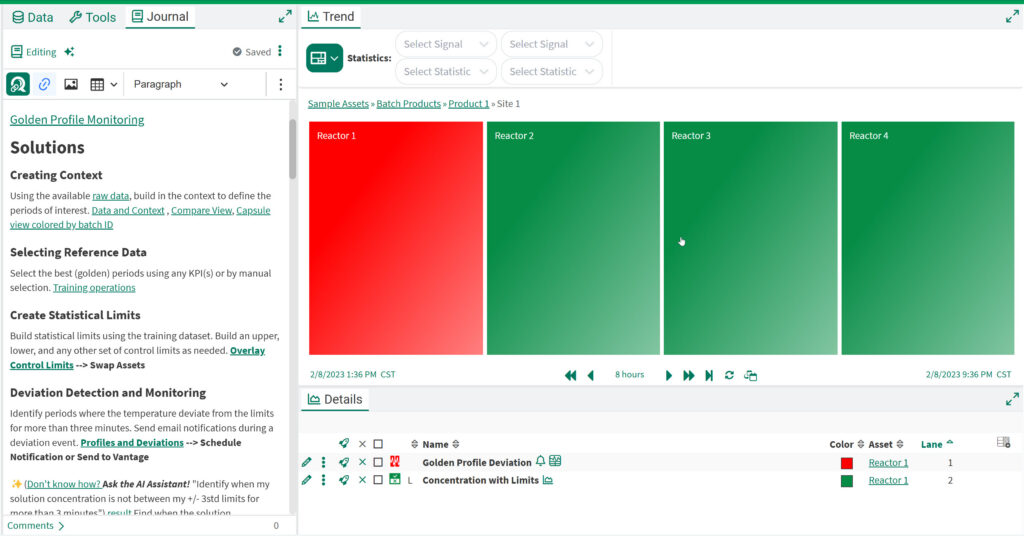
With health scores and daily profiles in place, the team transitioned to condition-based maintenance, servicing pumps based on actual performance trends rather than fixed schedules. Fleet-level views enabled prioritization of underperforming assets and standardization of best practices (see Figure 3).
This approach delivered approximately $200,000 in annual operational savings by reducing unnecessary maintenance and unplanned interventions, which improved equipment availability and process stability.
Empowering people with predictive maintenance
In manufacturing, effective predictive maintenance hinges on continuous data acquisition and access to contextualized equipment and process performance insights. This requires empowering the people who understand the processes by placing advanced analytics in their hands — without requiring them to become expert coders — which enables teams to resolve more plant issues prior to failure.
This shift is not just about adopting new tools, but about changing how organizations think, collaborate and improve. When time-series analytics, institutional knowledge and AI are combined, organizations unlock predictive insights, along with the ability to make smarter and faster decisions. The next era of industrial performance will be powered by data and AI, but driven by the people who know how to apply it.