Manufacturers have more visibility into their operations than ever before, yet many still struggle to convert identified opportunities into measurable savings. The strongest returns are achieved when automation, operations and asset expertise work together to turn recommendations into sustained operational improvements.
Automation project system integration ROI insights
- Learn to find opportunities for manufacturing return on investment during ongoing operations.
- Discover why a business case for automation should downtime reduction, production gains, maintenance effectiveness, environmental or safety risks, labor utilization and the cost of doing nothing.
- Determine how to build improvement roadmaps rather than pursue isolated projects.
Manufacturers rarely struggle to identify opportunities for improvement. Modern automation systems, historians, maintenance platforms and analytics tools provide more visibility into operations than ever before. The larger challenge is determining which opportunities will create meaningful return and then putting the right systems, people and processes in place to capture that value over time.
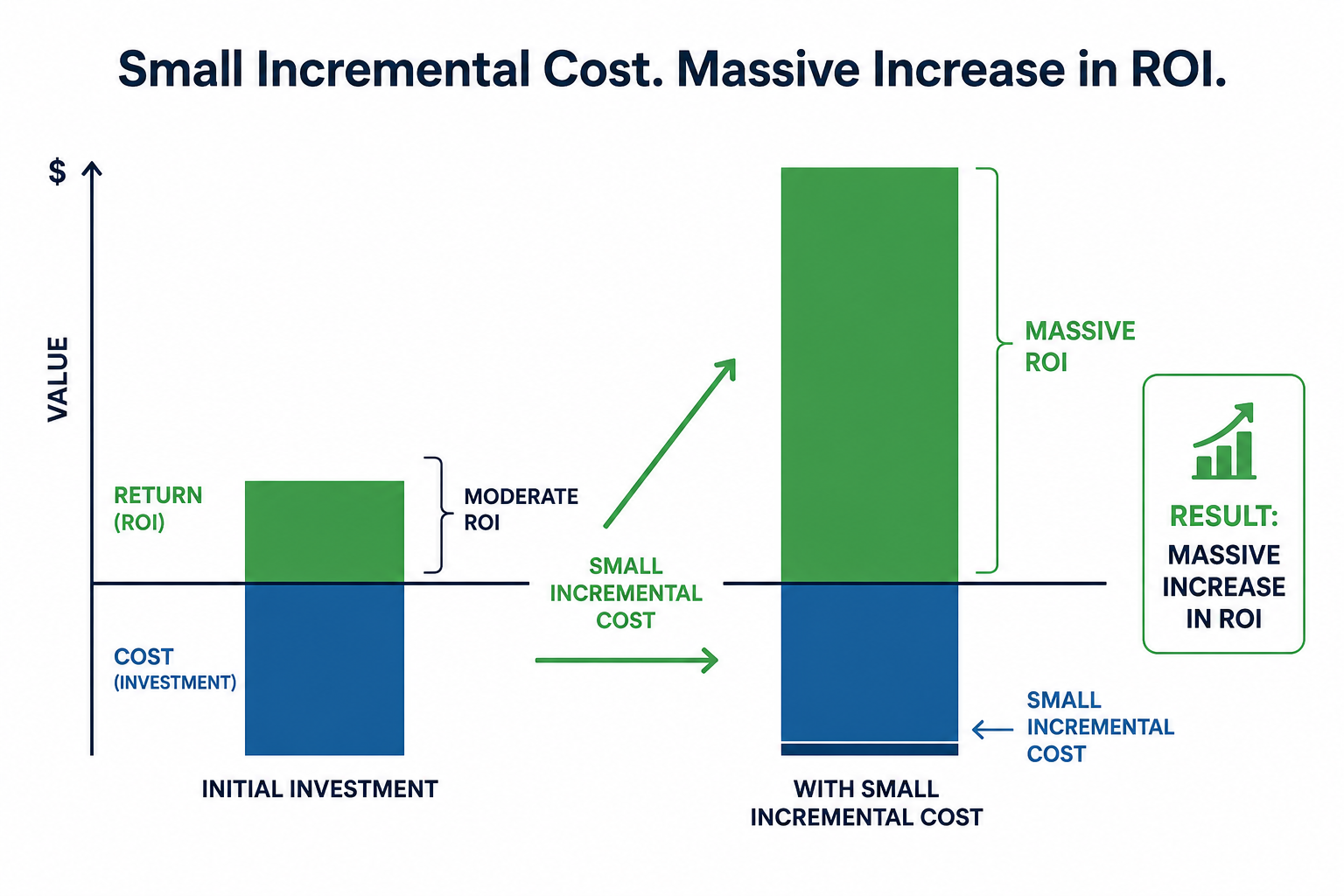
That distinction is important because industrial facilities already represent major capital investments. A new plant can require tens or hundreds of millions of dollars to build and in some cases significantly more. Once the facility is operating, the investment continues through personnel, maintenance, utilities, raw materials, compliance and ongoing operational support. Against that scale, the cost of improving reliability, throughput, maintenance effectiveness or operational visibility is often relatively modest. Not implementing these projects is like ending a marathon at the 26-mile marker just before the payoff of the finish line.
A targeted automation, controls, data or maintenance initiative typically requires tens or hundreds of thousands of dollars, which can be a small fraction of what the facility already spends each year on operations and maintenance. The challenge is not always whether investment money exists somewhere in the budget. More often, it is whether the organization has the business case, roadmap and execution plan needed to justify the investment, sustain the improvement and convert recommendations into lasting operational improvements.
For system integrators and manufacturers alike, maximizing return on investment (ROI) is no longer limited to design, startup and commissioning. Many of the greatest opportunities emerge during ongoing operations, where automation, data, maintenance practices and operational expertise can be combined to improve performance throughout the life cycle of the facility.
Start with data-driven decisions
Many ROI conversations quickly move toward artificial intelligence (AI), machine learning, predictive analytics, robotics or other advanced digital tools. Those technologies can provide value, but they depend on a more basic capability: reliable data that supports informed decision-making.
In many process industries, that foundation is well-established. Facilities collect process data, analyze trends and use that information to improve production and maintenance performance. In other manufacturing environments, particularly some discrete manufacturing operations, that foundation may still be incomplete. When a facility is not collecting and analyzing data from its operations, it becomes difficult to understand where production losses occur, or which constraints have the greatest impact on performance. When maintenance activity is not being tracked and reviewed, it becomes difficult to understand whether maintenance resources are being deployed effectively or whether recurring issues are being addressed.
Organizations struggle to improve what they don’t fully understand. Reliable data helps teams identify where production is being lost, which assets are creating reliability challenges and where operational effort should be focused first. In many cases, the initial opportunities uncovered through better visibility and analysis can generate returns quickly enough to support the next phase of improvement.
One advantage system integrators offer is visibility into how different industries solve similar problems. Technologies that are common in one industry are often underutilized in another. Advanced process control (APC) is one example. The refining industry has used APC for decades to improve process stability, increase throughput and optimize operations while staying within safety and environmental constraints. Similar opportunities exist in other industries, but many organizations have never evaluated whether those applications could provide comparable benefits in their facilities.
Recently, a client’s facility management team asked our reliability experts to weigh in on suggested equipment changes to improve production line performance. However, this client was not collecting process data from the equipment to monitor hold/stop causes and durations, had minimal handwritten shift logs and limited maintenance activity tracking. In this environment, we were unable to offer data-backed equipment investment recommendations. While we could make general observations and relay suggestions from their plant floor personnel, we did not recommend moving forward with any “solutions” until the problems could be better identified.
That does not mean every facility should immediately pursue APC, AI, robotics or another advanced technology. In many cases, greater value can be created by addressing foundational issues before introducing more sophisticated tools. The most successful organizations first identify where value exists and then determine which technologies are best suited to help capture it. Technology should support an operational strategy rather than become the strategy itself.
Build the business case for automation upgrades
Every significant plant decision requires a business case, whether the team is adding a production line, replacing aging equipment, upgrading a control system or investing in a software platform. The same discipline should apply to optimization and digitalization initiatives.
The business case should include more than the direct cost of the technology. It should account for downtime reduction, production gains, maintenance effectiveness, environmental or safety risks, labor utilization and the cost of doing nothing. In some cases, the data may show that the right answer is not simply reducing cost. A facility may need to add a maintenance technician, adjust staffing or change operating practices to reduce unplanned downtime. That may increase spending in one area while creating greater savings somewhere else. If one or two avoided downtime events pay for the added resource, the full business case may support the investment by evaluating the likelihood of downtime events before and after the project.
A staged front-end loading (FEL) process can help define that path. At an early FEL-0 level, teams can use interviews, available data and operational experience to estimate cost, savings and payback at an order-of-magnitude level. That early work helps identify the most practical starting points. As the program advances, the estimates become more detailed, and the roadmap becomes more defined.
Organizations that consistently achieve strong returns tend to build improvement roadmaps rather than pursue isolated projects. Early successes create momentum, generate savings and often help fund future initiatives, allowing performance improvements to build on one another over time.
Learn from automation projects that don’t perform as expected
Not every initiative produces the expected result. A software platform may not fit the application. Technical challenges may appear during implementation. The team may not be prepared to support the new process. Operators or maintenance personnel may not adopt the change. A project may look successful at startup and then be turned off, bypassed or ignored a year later.
When initiatives fall short of expectations, the objective should be understanding why. Was the opportunity properly defined? Was the solution appropriate? Were the necessary operational changes implemented? Were those changes sustained? Answering those questions often reveals whether the issue was technical organizational or related to long-term ownership of the improvement.
If the opportunity is still valid, the organization should adjust the approach and try again. That may mean selecting a different technology platform, improving training, involving operations and maintenance more deeply or solving foundational issues before reattempting the original initiative. If the review shows that the savings were not what the team expected, the roadmap should change accordingly.
A recent discrete manufacturing engagement illustrates the point. The facility had invested in a computerized maintenance management system (CMMS) but was not realizing the expected value from the platform. The initial question was whether the software itself was the problem or whether the organization was not using it effectively. The evaluation showed that the new CMMS already contained the capabilities needed to support the facility’s objectives. The larger opportunity was improving how maintenance and operations teams used the new platform to support day-to-day decision-making.
In this case, the opportunity was not a new software purchase or exotic technology. The opportunity was capturing greater value from an investment that had already been made. Achieving that outcome required better alignment between maintenance and operations, clearer processes and stronger adoption of tools the organization already owned.
Organizations that consistently improve performance recognize that implementation is only one stage of the process. Sustaining the improvement is equally important and lessons learned from previous efforts should strengthen future initiatives rather than discourage them, even if the previous effort was not successful.
Turn insight into field execution, automation justification, results
Organizations often succeed in identifying opportunities for improvement and developing recommendations to address them. The greater challenge is translating those recommendations into operational changes that deliver measurable results. Analysis can reveal where production is being lost, which assets are creating reliability challenges or where capacity constraints exist. Capturing the value requires organizations to move beyond identifying the opportunity and take action to address it.
Dashboards, key performance indicator (KPI) screens, analytics tools and AI-generated recommendations do not create ROI on their own. They help organizations understand what needs attention and where improvement opportunities exist. Some technologies, such as APC, can directly influence performance through closed-loop control. But most depend on people changing how equipment is operated, maintained or improved. In those cases, success depends not just on identifying the problem, but on implementing and sustaining the operational changes needed to solve it.
A recommendation may show that a process should be redesigned, that a maintenance interval should change, that a line is not being used effectively or that a recurring failure mode needs to be addressed. Capturing the value requires operational ownership, clear procedures, training and follow-through. This is where many organizations struggle. The opportunity is identified, but the changes required to realize the value are never fully implemented or sustained.
Closing that gap often requires more than controls expertise alone. Automation teams are frequently the first to identify where value exists because they sit closest to the data. Identifying the opportunity, however, is only part of the process. Operations and maintenance teams ultimately determine whether the recommended changes are implemented and sustained. The strongest results occur when those disciplines work together toward a common objective.
While visiting a client site this year, I saw something I have seen at more than one facility. There was a mallet left in the field next to a banged-up feed hopper. The mallet had not been mistakenly left behind. This was clearly where the mallet lived. Operations had identified a recurring process issue, but this insight had either not been communicated to or acted upon by the right levels in the organization for a proper solution. Therefore, the client continued to deal with persistent material flow problems that impacted line performance. This is likely an issue that an automation engineer couldn’t solve on their own, but good automation could have highlighted the flow issue and if presented to the right personnel, the reliability team could have addressed it.
Use the capacity already in place; optimize existing assets
When production requirements increase, discussions often shift quickly toward capital projects and additional equipment. In many facilities, however, the first question should be whether existing assets are being utilized as effectively as possible.
As part of an onsite client operations study, we noted that equipment sat idle for significant portions of the day and week. The lowest-cost path to additional capacity was not immediately purchasing more equipment. It was understanding why existing assets were not running more often and determining what operational changes would allow the facility to make better use of the capacity already available.
That analysis rarely points to a single cause. Idle time may be tied to maintenance practices, staffing levels, scheduling constraints, shift structures, changeovers, upstream bottlenecks, downstream limitations or other operational factors. Understanding those constraints is often the first step toward increasing output without making a major capital investment.
The least expensive capacity is often the capacity a facility already owns. Capital investments remain an important part of long-term growth strategies, but operational improvements frequently provide a faster and less expensive path to performance gains while helping fund future initiatives.
Expand the role of the automation engineer
The work of maximizing ROI also changes the role of the automation engineer. Traditional programmable logic controller (PLC) and distributed control system (DCS) programming remain important, but the value of automation increasingly extends beyond writing code and commissioning systems.
Automation engineers are well-positioned to connect process knowledge, controls expertise, operational data and business objectives. As AI tools become more capable and some routine programming tasks become more efficient, engineers have more opportunity to focus on broader operational challenges and help organizations identify opportunities to capture value. This means leaning more heavily on their general engineering talents and less on their programming skills.
That shift is valuable for plant managers and business leaders because it helps connect technology investments to measurable operational outcomes. Automation teams can identify where data is missing, where control strategies can improve performance, where maintenance practices need better feedback and where technology can support meaningful improvements across the organization.
The most effective ROI strategies are not built around technology alone. They bring automation, operations, maintenance and asset expertise together around a practical roadmap. Manufacturers have already invested heavily in their facilities, systems and people. As noted above, the opportunity may not be to find another technology to deploy. The opportunity is capturing more value from assets and systems that are already in place.
Organizations that consistently maximize ROI do so by integrating automation, operations and asset expertise to translate recommendations into measurable performance improvements. Technology can identify opportunities, but capturing value requires organizations to act on those opportunities and sustain the resulting improvements over time. Closing the gap between insight and execution is ultimately what turns identified opportunities into realized value.
Heath Stephens, PE, is the automation solutions director at Hargrove Controls & Automation, a certified member of the Control System Integrators Association (CSIA). Edited by Sheri Kasprzak, executive editor, Control Engineering, Plant Engineering, [email protected].
Keywords
Automation projects, system integration, ROI
Consider this
How are your automation justification and optimization projects going?
You also might like
Global System Integrator Database
https://si.arrowfly.com/integrators/hargrove-controls-and-automation