Modernizing a high-volume home appliance manufacturing line frequently involves navigating a fine line between increasing throughput and safeguarding human workers from physical strains and ergonomic injuries. Robotics, machine vision and pneumatics help.
Robotic assembly productivity insights
- Learn how vision-guided multi-robot coordination can be designed within highly restrictive physical footprints to meet aggressive takt times without modifying existing building infrastructure.
- Understand the deployment of layered hardware and programmable software safety measures, such as cubic safety zones and synchronized barrier storage, to eliminate operator ergonomic hazards.
- Examine how closed-loop machine vision verification optimizes assembly precision and automates defect handling on a high-throughput discrete manufacturing line.
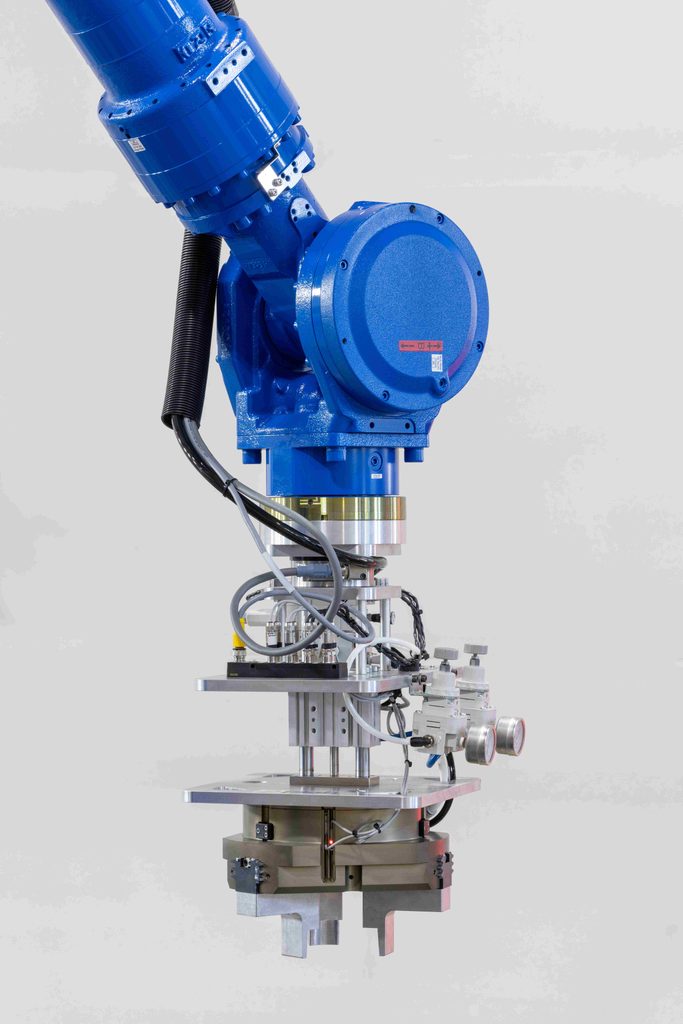
In a recent automation deployment, a major home appliance manufacturer sought to completely eliminate manual installation hazards on a washing machine component assembly line. Beyond mitigating workplace safety risks, the operational goal required the newly automated cell to achieve a strict 22-second takt time per unit. This mandated that each washing machine tub seamlessly branch into an automated spur, receive precision components, undergo quality verification, and rejoin the main assembly line within the cycle threshold. Compounding the challenge, the facility’s existing layout left minimal floor space for an enclosed robotic cell, requiring a tightly engineered, vertically optimized integration strategy.
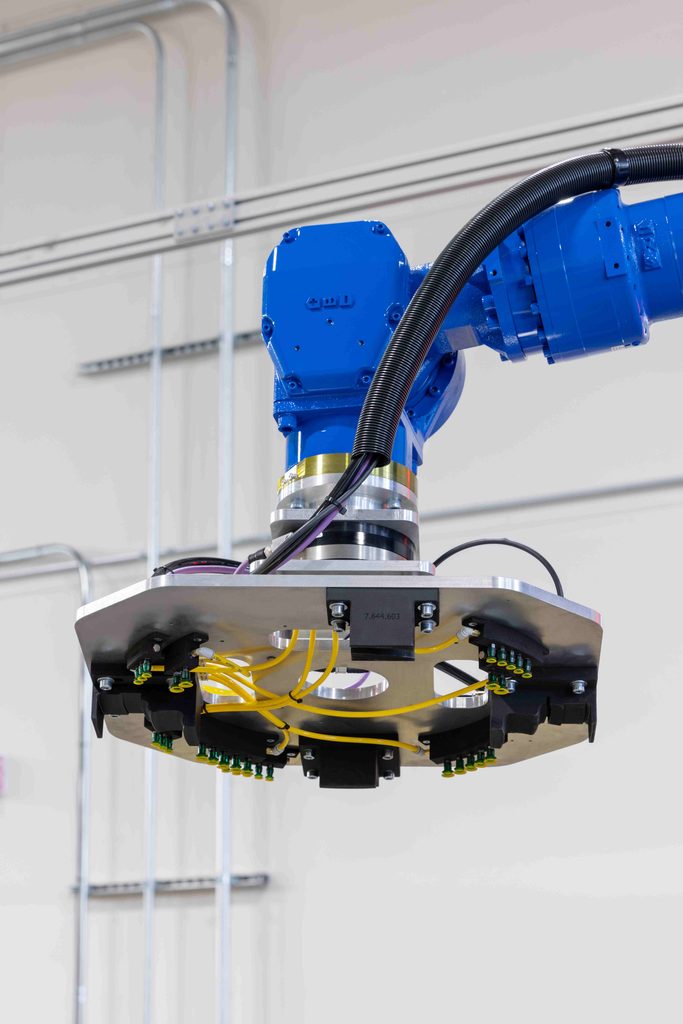
Navigating strict workcell spatial constraints
To overcome the physical floor space limitations without altering the building’s structural infrastructure, the integration team utilized an “inside-out” mechanical design. Engineers lowered the baseline conveyor paths and elevated the automation machinery on structural risers. This layout maximized the operational reach of the equipment while maintaining an incredibly compact horizontal footprint.
To transport components into the cell efficiently, the design features a machine-driven roller conveyor system synchronized with pneumatic chain lifts. These lifts are positioned beneath the main line rollers; whenever the product stream hits a 90-degree turn, the pneumatic lifts elevate to smoothly push the washing machine tub into the automated cell spur.
Multi-axis synchronization, robotic vision guidance
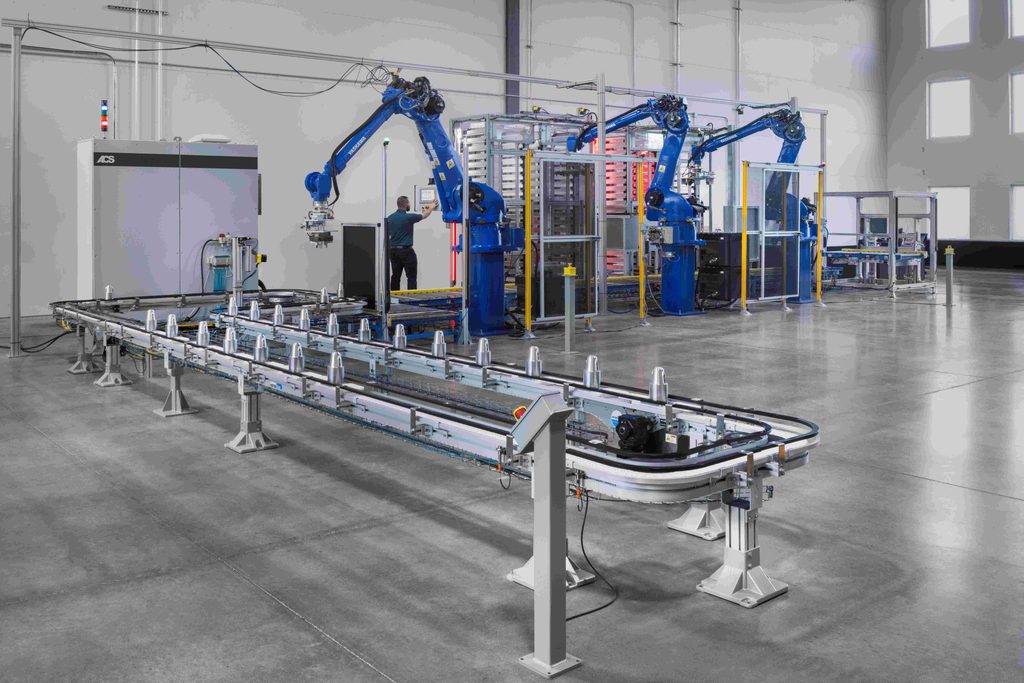
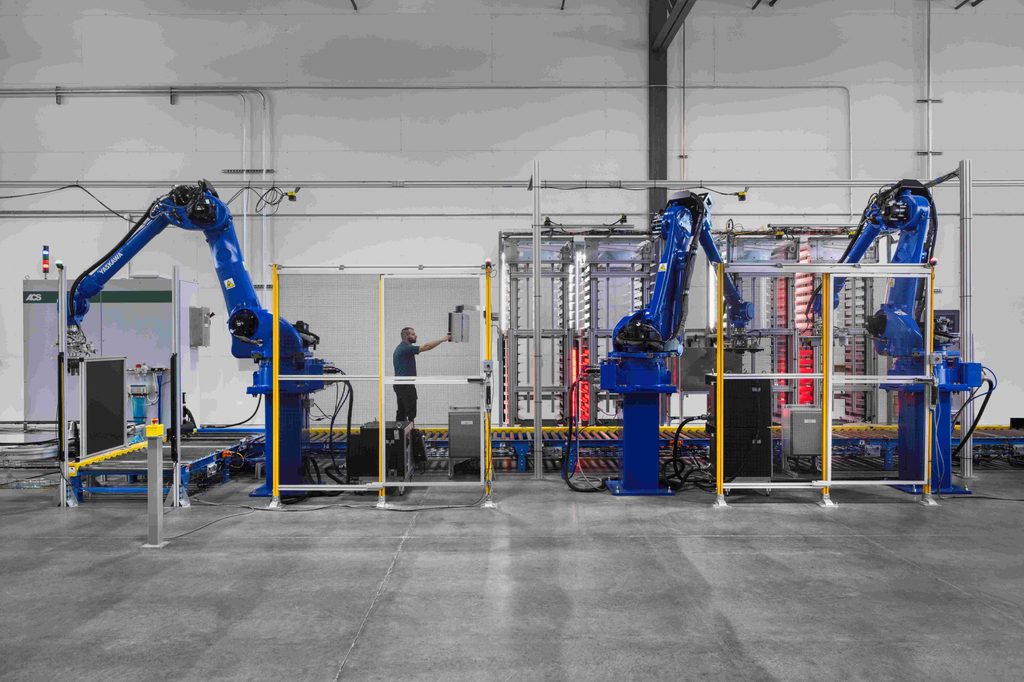
The core of the cell relies on three synchronized articulated robots operating in highly coordinated parallel cycles to satisfy the 22-second takt time requirement. The integration leverages specialized control logic running on a high-performance programmable logic controller (PLC) to manage concurrent motion pathways seamlessly.
- Station 1: Tubs enter the automated loop, where the first robot retrieves a structural balance ring from a custom-engineered vertical storage tower and positions it onto the tub.
- Stations 2, 3: Parallel robotic units perform rapid, high-precision component installations.
To guarantee defect-free manufacturing at high speeds, a network of 10 industrial cameras provides real-time vision feedback to the control system. These vision systems function as an in-line quality checkpoint, verifying precise alignment and part placement. If the vision logic detects a non-conforming assembly, the PLC overrides the standard pathway, directing the robots to route the flawed component immediately to a designated reject bin while the system seamlessly advances the next unit to prevent downstream line stoppages.
Designing a layered safety architecture, integrated into motion
Because worker health and safety were central drivers of this capital project, the system features deeply integrated physical and programmable safety mechanisms designed into the initial concept rather than treated as an afterthought.
First, programmable “cubic safety zones” are configured within the software controls to govern the multi-robot workspace. Because the first two robots share a unified physical boundary for error handling and reject manipulation, real-time positional awareness tracking prevents mechanical collisions within the shared reject space. Virtual boundaries are programmed directly into the motion controllers to restrict mechanical reach within safe structural limits, preventing damage to the cell’s frame or surrounding facility assets.
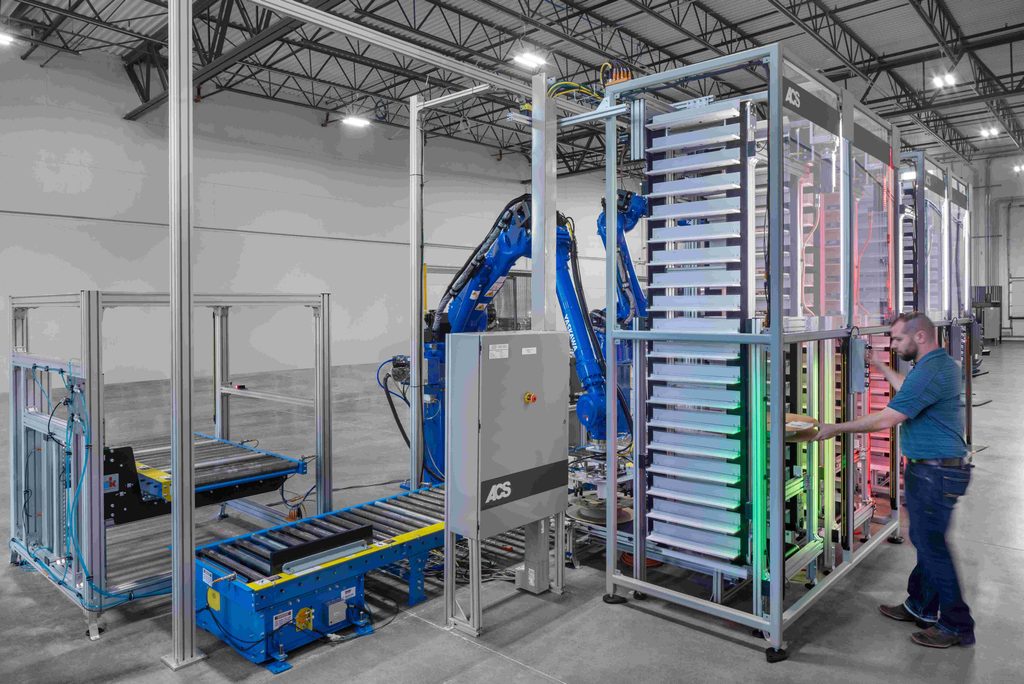
Second, the structural layout minimizes human exposure through smart physical barriers. Dual pairs of vertical part-storage towers double as safety walls, forming a rugged physical enclosure around the high-speed robotics. Each vertical tower holds up to 20 balance rings for continuous batch loading.
This layout establishes an ergonomic loop: as a robot pulls a component from the internal side of tower A, a human operator can safely restock tower B from outside the active cell boundary at an ideal physical height. Once a tower is depleted, the system switches active sides automatically. Interlocked safety doors protect the remainder of the perimeter, immediately dropping system power and arresting motion if physical breach occurs while the cell is active.
Robotic workcell implementation results
Through centralized human-machine interfaces (HMIs), plant operators retain complete oversight—monitoring real-time production flow, tracking cycle diagnostics and executing manual adjustments safely.
By transitioning manual component handling to an orchestrated, vision-guided robotic infrastructure, the facility successfully eradicated the targeted workplace strain and ergonomic injury hazards. Concurrently, the tight synchronization between the high-speed robotics and vision inspection systems achieved the mandatory 22-second takt time, reducing variability, optimizing floor space efficiency and boosting overall product yield.
Noah Bougie is director of business development/automation and controls, and Austin Levin is senior automation engineer, both with ACS. Edited by Sheri Kasprzak, executive editor, Control Engineering, Plant Engineering, [email protected].
Keywords
System integration, robotics, machine vision
Consider this
Are integrated robots, vision and motion control improving your assembly times?
You also might like
https://www.acscm.com/projects/automated-assembly-line-boosts-productivity-and-safety/
Video: https://youtu.be/08-7NUGqWvw?si=ehLafgV5BJIS3iEV
https://si.arrowfly.com/integrators/acs-affiliated-construction-services-inc
https://www.controleng.com/global-system-integrator-report/