
Robots can significantly boost manufacturing efficiency by automating demanding tasks, optimizing workforce deployment and future-proofing operations with modular, centralized control systems.
Learning objectives
- Analyze the multifaceted benefits of robotic automation beyond just labor replacement, including improved safety, increased production consistency and enhanced workforce flexibility.
- Evaluate the strategic importance of a robotic control system in achieving long-term efficiency, scalability and simplified management for plant operations.
- Identify key features of a successful robotic implementation, such as custom-engineered end effectors, integrated safety mechanisms (like geofences and light curtains) and user-friendly, modular programming.
Robot insights
- Robots are emerging as essential tools in modern manufacturing, where labor shortages and demand for higher output make automation critical for efficiency and safety.
- By deploying a robot for tasks such as palletizing, companies can reduce physical strain on workers, streamline operations and achieve scalable growth.
In a manufacturing environment defined by persistent labor shortages and the demand for increased output, plant managers are continuously seeking new ways to boost efficiency. While the promise of robotics has been a part of this conversation for years, modern robotic solutions, particularly when paired with advanced control systems, are no longer just a luxury — they are a critical tool for operational success. By automating strenuous, repetitive tasks, companies can not only improve throughput but also enhance safety and cultivate a more flexible, skilled workforce.
The case for robotic palletizing
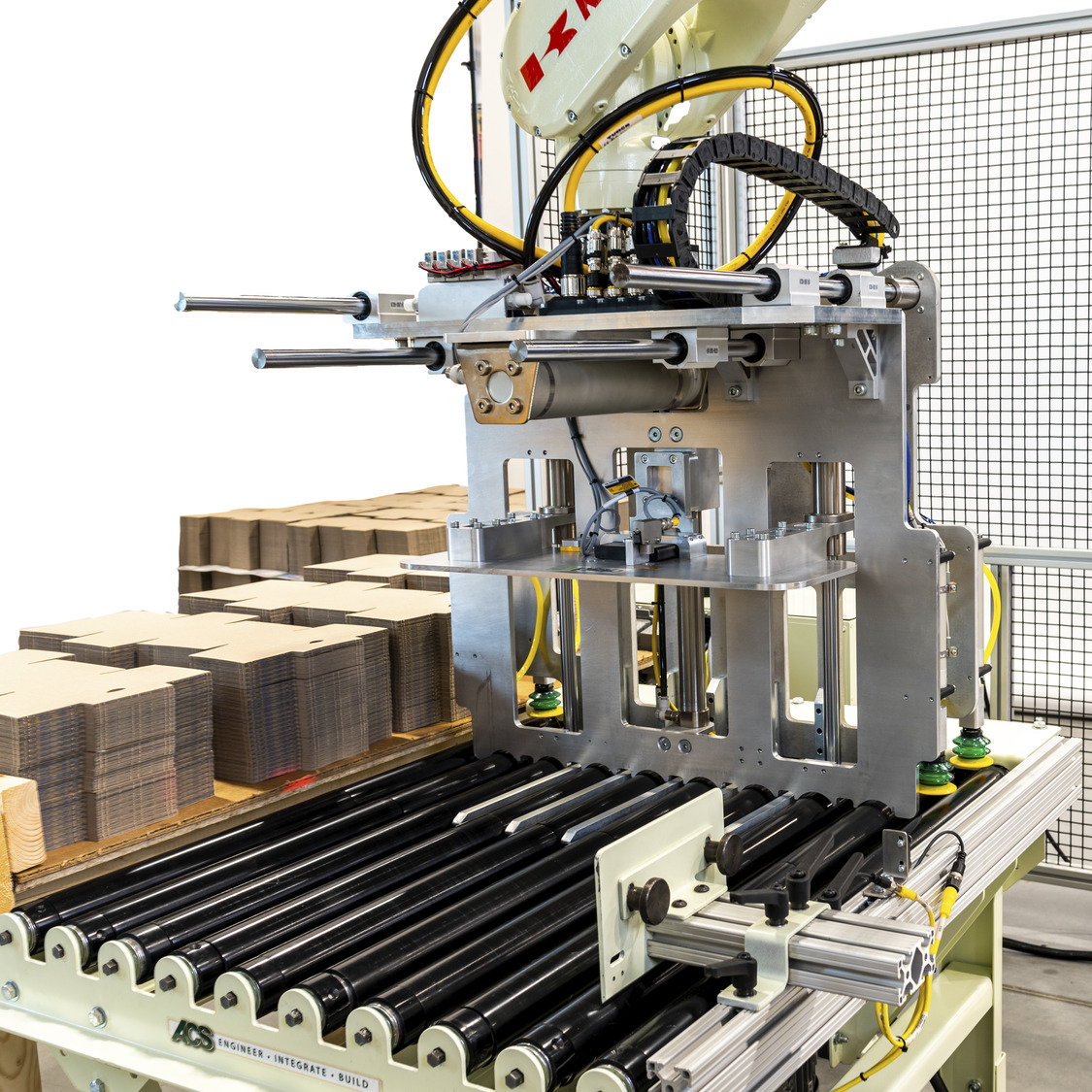
A corrugated box manufacturer recently faced a common industry challenge: a physically demanding task at the end of a collator line that required workers to palletize stacks of flat-pack boxes. The job was so physically taxing that employees had to be rotated in 90-minute shifts, leading to recruitment and retention difficulties. The company needed an automated solution that would free up labor for other tasks while ensuring the utmost safety for its employees.
The solution was a custom-engineered robotic palletizer. The system, designed to handle seven different box sizes, was built around a robot with a custom end effector. This “hand” of the robot was crucial; it was specifically designed with programmable pressure and depth settings to lift and stack cardboard without causing dents. To handle thin slip sheets between layers, the end effector was also equipped with programmable suction cups, demonstrating the level of customization required for a truly efficient system.

The results of this implementation were immediate and impactful. The company was able to reduce the labor needs on the line from three workers to two. The robotic palletizer took over the physically intensive role, allowing the company to reassign its workforce more strategically and improve overall efficiency. The system’s success was so evident that the client purchased a second robot for another line, confirming the clear return on investment.
The role of intelligent control systems
While the physical robot does the work, the brain behind its efficiency is the robotic control system (RCS). Unlike traditional setups where each robot operates with its own separate controller, an RCS centralizes control of multiple robots and all peripheral devices into a single, unified system. This approach offers several advantages that directly contribute to long-term efficiency:
- Simplified management: An RCS makes it possible for plant controls engineers, who are fluent in programmable logic controllers, to manage, adapt and troubleshoot the entire system. This reduces reliance on niche robot programmers and makes robot integration more accessible.
- Space optimization: Centralized control eliminates the need for separate control cabinets and programming space around each robot, enabling tighter layouts and saving valuable floor space. This is a measurable financial benefit that directly impacts a plant’s bottom line.
- Modularity and flexibility: RCS architecture is inherently modular and “future-proof.” When manufacturing needs change, new components can be added or reconfigured with minimal disruption to the existing control logic. For the palletizer, this meant the system could be easily programmed to handle new product profiles simply by adding dimensions and stacking configurations into the controller, which can be done in under 30 minutes.
Integrated safety with robots
Any discussion of industrial robots must prioritize safety. The successful palletizer implementation included a robust combination of physical and programmable safety mechanisms. The robot’s work area was secured with a physical fence with proximity switches and door locks. On the fourth side, a light curtain provided a protective barrier that would automatically shut down the system if breached.

Perhaps most critically, the robot was programmed with an internal geofence that enforces spatial limits on its movement. This dual-layer approach — combining physical barriers with software constraints — is essential for protecting workers and creating a safe, collaborative environment.
Robots: a path to scalable manufacturing
Ultimately, using robots to improve efficiency is not about simply replacing a worker. It’s about strategically deploying automation to solve critical operational problems, enhance worker safety and create a scalable, flexible manufacturing process. By leveraging turnkey solutions and the power of intelligent control systems, manufacturers can simplify complex processes, optimize their workforces and remain competitive in a rapidly evolving market.