
Frequent product changeovers are costing manufacturers valuable production time, but automation is changing the economics.
Learning objectives
- Identify changeover bottlenecks: Understand where manual changeovers create the most delays, from repeatability issues to parts management and how these inefficiencies compound across production runs.
- Recognize automation tools that accelerate changeovers: Learn which technologies, from recipe-based control systems to servo motors and MES integration, to deliver the fastest improvements in changeover speed and consistency.
- Assess return on investment through multiple lenses: Explore how automated changeovers generate value not just in time savings, but through improved OEE, reduced waste, better scheduling flexibility and planning and enhanced sustainability.
Changeover insights
- By replacing inconsistent manual processes with recipe-driven automation and smarter planning, manufacturers are transforming the changeover from a costly source of downtime and variability into a faster, repeatable and strategic competitive advantage.
- Recipe-based control systems, servo motors and MES integration are cutting changeover times from hours to minutes, allowing plants to say yes to smaller orders and customized products that were once unprofitable.
The manual changeover process remains one of manufacturing’s most persistent sources of inefficiency. But better planning and automation are changing that. By making changeovers faster, more consistent and less dependent on individual skill sets, automated systems are turning what was once a necessary drain on productivity into a competitive advantage.
To understand why this shift matters, consider what’s happening on the floor. A typical packaging facility during a format change reveals operators searching for change parts, mechanics adjusting guide rails by eye and production managers watching valuable runtime slip away. When the line restarts, there’s often a lengthy ramp-up period as operations staff fine-tune settings that weren’t quite right to reach the projected line overall equipment effectiveness (OEE).
The root of this inefficiency is repeatability. Even in well-managed facilities, without mechanical jigs or adjustment blocks to standardize guide rail openings and machine settings, each changeover becomes a new interpretation, leading to bridging or fallen containers or excessive pressure that could damage containers. Even with detailed procedures, the process remains prone to individual judgment.
Warehousing and market constraints are pushing manufacturers toward run-to-order production with smaller batches and more frequent format changes. Meanwhile, experienced operations personnel, mechanics and electricians are retiring and new staff often lack the hands-on experience that once made manual changeovers manageable. These pressures make the cost of inefficiency impossible to ignore.
The high cost of inconsistent changeovers
Before exploring automation solutions, it’s important to understand what’s truly at risk during a changeover. In high-speed packaging operations, especially in breweries and beverage facilities, clearing an entire line from depalletizer to palletizer can take more than an hour of runtime. Many plants have adapted by inserting gaps in production — pausing the front of the line while the back end continues processing the previous product — reducing that window to about 20 minutes. However, even in the best-case scenario, significant capacity is lost when changeovers happen multiple times during a shift.
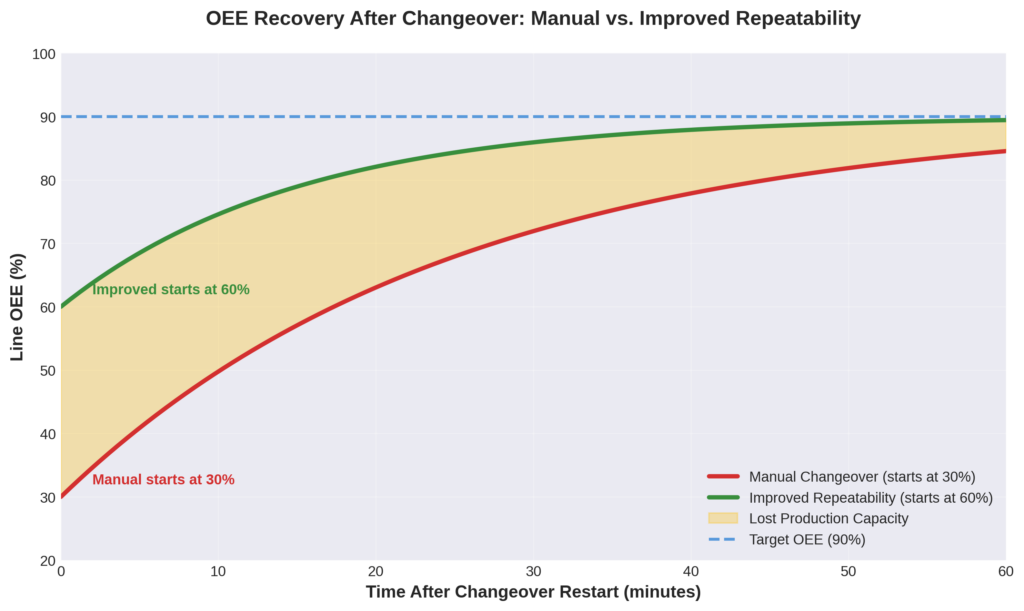
The less obvious cost occurs during the restart. After a manual changeover, lines rarely reach full target efficiency right away. Instead, there’s a ramp-up period where operators and maintenance staff find a missed adjustment, a guide rail that’s slightly misaligned or an inspection system or coder not configured for the new product. Overall line efficiency might start at a low level and take significant time to climb back to the targeted line efficiency. Every minute spent in that ramp-up phase is production capacity lost and it pushes scheduled runs later into shifts that are already short-staffed.
This efficiency drag becomes especially painful when manufacturing is driven by customer orders instead of building inventory. The global economy has prompted many manufacturers to produce in various countries or shift production between facilities to control costs. This flexibility demands the ability to change formats quickly and confidently, knowing that the line will perform as expected from the moment it restarts.
Automation tools that make a difference
The most significant automation improvement for changeover comes from recipe-based conveyor control systems and machine configurations. These systems automatically adjust conveyor speeds and machine parameters based on the selected product format. Programmable logic controller (PLC)-based conveyor speeds, using sensors and real-time speed data from upstream and downstream equipment, can be modulated to meet machine and conveyor requirements.
Instead of operators manually adjusting each section of the conveyor, the entire line synchronizes to the new format with a recipe selection. This prevents overpopulation and jams while guiding accumulation and mass conveyors to operate at optimal speeds for the product being run. Newer equipment (and some older equipment) can also be equipped with methods (both automated and manual) to achieve repeatable changeovers, greatly reducing the ramp-up time.
The engineering behind these systems involves calculating conveyor widths to find the optimal operating condition to satisfy all formats. This is a mechanical setup that works well across all format variations, avoiding the need for constant physical adjustments. By maintaining fixed widths for mass conveyors and reserving manual guide adjustments for sensitive areas near single-file operations, plants can significantly reduce the number of points during a changeover.
Recipe systems also offer verification before production begins. By assigning the conveyor PLC as the master control, engineers can program the system to verify that all equipment on the line — fillers, packers, inspectors and coders — are set for the same format. This prestart check identifies mismatches that could lead to costly waste, reducing hours of production errors to just a few minutes of troubleshooting before any product is at risk.
Servo motors are a major advancement, especially in packaging equipment like case packers. Where manual changeovers once required operators or mechanics to physically adjust star wheels, guide rails and positioning devices, servo-driven systems now automate these adjustments according to the selected recipe. This eliminates variability caused by individual operators preference — and supports consistent changeovers.
The integration with manufacturing execution systems (MES) advances this process by directly sending recipes from production scheduling to line equipment. Instead of operators manually choosing formats and risking errors, the MES automatically configures the line based on the production order. This direct data transfer prevents manual entry mistakes that could be costly to fix.
Optimizing production through strategic changeovers
With faster, more reliable changeover mechanics in place, attention can shift to using that speed strategically to further reduce downtime. Automation does more than just make individual changeovers quicker; it enables smarter production scheduling that minimizes the number and complexity of changeovers needed.
In food and beverage production facilities handling multiple flavors or product types, the order of production runs can significantly influence cleaning requirements between products and, consequently, downtime. Additionally, planning more complex changeover tasks, such as a seamer format change during nonproduction time (e.g., on the weekend), although more costly per hour, could save valuable production time.
The principle is simple but often overlooked: organize changeovers to reduce cleaning and changeover times between products. For example, in facilities making rum or other spirits, this means starting with unflavored white products, then progressing through stronger flavors before switching to amber and finally dark varieties. Each step in that sequence requires minimal cleaning because the previous product will not affect the flavor of the new product. Running in reverse — starting with dark rum and switching to white — would need extensive cleaning of the filler and process equipment, causing additional loss of time and using considerable water, chemicals and energy.

This approach from the food and beverage industry applies to other industries. By grouping compatible products and planning changeover sequences that move from lighter to heavier flavors or from similar-size packages, plants can reduce many of the time-consuming cleaning cycles and changeovers that otherwise disrupt production. When automation enables quicker mechanical changeovers, this strategic sequencing becomes even more important because the main remaining delay — cleaning — can be minimized through better planning.
Considerations for changeover automation
Implementing automated changeover systems requires assessment of existing equipment and production needs. What skill level is currently required to perform a changeover and can automation reduce that requirement? The aim on older or difficult areas to changeover is to transfer changeover tasks from mechanics and electricians to operators who can work with color-coded change parts, mechanical jigs and servo-driven adjustments to simplify these tasks.
This doesn’t mean removing the need for skilled workers. Instead, it means freeing those valuable staff from repetitive changeover tasks so they can focus on troubleshooting, optimization and maintaining more complex automated systems. When operators can manage routine format changes with clearly marked parts and automated positioning systems, maintenance staff can devote their time to higher-value activities that truly require their expertise, which will pay off in higher OEEs.
Color coding and engraving of change parts act as a simple yet effective link between manual and automated systems. Parts that can be inserted in an incorrect orientation or position should have “positioning keys” or guiding pins to enable correct installation. By marking all change parts for a specific format with the same color and engraving them with format specifications, plants create visual cues that are accessible even for color-blind operators. This reduces the time spent searching for parts and makes sure the correct components are installed together.
Equally important is inspecting change parts as part of the changeover procedure. They should be fully inspected at the completion of the changeover. Detecting damaged parts immediately after removal allows maintenance to repair or replace them before the next run on of that format, preventing costly discoveries of damaged parts during the next changeover.
For equipment that requires heavy or complex change parts, such as blow molder for plastic bottle production, robotics can manage the physical changeover of the heavy molds. These molds are large castings with water jackets for cooling, often weighing more than 50 pounds. Having operators lift and position these parts introduces safety hazards and risks damaging expensive, precision tooling. A robotic changeover system handles the weight, precisely positions the mold every time and removes ergonomic concerns associated with operators manipulating heavy equipment.
The appropriate level of automation depends on the specific application, but most successful implementations share common features: control over conveyor speeds, recipe-based setup, communication among all PLCs on the line and minimizing operator intervention to facilitate repeatability of changeovers. These core elements offer the flexibility to handle various products while supporting consistent performance that builds reliability.
Where ROI shows up
The return on investment from automated changeovers appears in several areas. The most obvious is time, as shorter changeover windows free up significant production capacity, especially in facilities that perform multiple format changes per shift. However, the financial benefits go far beyond just reducing downtime.
Improved efficiency: When each piece of equipment operates at high individual efficiency, but the line as a whole runs at a reduced efficiency due to induced faults between equipment and poor accumulation management, the bottleneck is in the system design and/or the controls. Properly designed accumulation with recipe-based control can increase line efficiency by masking individual machine faults with accumulation and controlling machine speeds to allow for accumulation regeneration, allowing the same equipment fleet to produce significantly more output per hour. This efficiency improvement directly reduces the cost per unit, making the operation more competitive.
Quality improvements: Automated verification systems identify recipe mismatches before any product reaches the equipment, preventing waste caused by running with incorrect settings. Reliable changeovers reduce the ramp-up time after format changes, enabling the line to return to target OEE more quickly. Additionally, by ensuring date coders and track-and-trace systems receive correct information directly from production scheduling, plants can avoid waste generated by incorrectly coded product.
Flexibility: Perhaps most importantly, automated changeovers allow manufacturers to accept smaller orders and more specialized products that manual changeover economics would otherwise make unprofitable. When format changes take an extended time and returning to the line’s normal OEE is difficult, plants naturally lean toward longer production runs of fewer formats. When changeovers occur at a predictable time and restart performance is consistent, the economics of smaller batches improve significantly. In markets where customers increasingly expect customization and variety, this flexibility can be the difference between winning and losing business.
Mass customization is already here
Manufacturers that can quickly adapt to diverse customer needs while keeping efficiency and quality will gain market share from those that can’t. Automated and predictable changeover systems and methods lay the groundwork for that agility, transforming what was once a necessary evil into a true competitive advantage. The investment case is straightforward: identify where manual changeovers cause the most significant delays and quality issues, select the appropriate tools that address these specific problems and implement systems to enhance both speed and consistency. The plants that make this shift successfully will develop the flexibility to succeed in a market where customer demands are increasingly varied and traditional economies of scale matter less than the ability to switch formats quickly and confidently.