
Since 2011, industrial robot technology has rapidly advanced, offering manufacturers a clear way to improve efficiency and profitability.

Learning objectives
- Understand why you can’t talk about robotics and efficiency improvements without also talking about flexibility and safety.
- Learn what it means to have greater flexibility on the plant floor.
- See how robotics can create a broader safety net for less obvious risks and concerns.
Robot insights
- Robots help manufacturing plants improve efficiency and profitability while also achieving two key byproducts in the process — more manufacturing flexibility and broader safety improvements.
- A collaborative robot, or “cobot,” can help human workers complete more work safely and effectively.
When you think about robots on the plant floor, you may likely still picture the large, expensive orange and yellow robotic arms used by auto manufacturers. While there is still a place for such machines, the industry has evolved quite a bit since those robots were first introduced in the 1960s.
But they have never evolved as quickly as they have over the past 14 years. According to a report from the International Federation of Robotics, robotics usage across industrial and manufacturing settings has recently reached record highs. As of 2024, more than 4 million robots were installed in factories across the globe, a 10% increase from the previous year.
That unprecedented level of adoption and engagement has driven manufacturers of all sizes to more closely consider how they can incorporate robotics in their operations. Identifying opportunities to glean new efficiencies is often the top priority, given the challenges that exist across the manufacturing landscape — most notably thin margins, skilled labor shortages and supply chain uncertainties. Robots have an obvious role to play when it comes to improving efficiency, but you cannot talk about the role of robotics in manufacturing without also talking about the impact they have on plant flexibility and worker safety.
Here’s how robots can impact efficiency, flexibility and safety in today’s manufacturing environment.
Efficiency is an advantage
Over the past 10 years, robots have become faster, more efficient, more user-friendly and available in a variety of form factors, many of which can be easily customized to a specific user. They can integrate with other advanced technologies like automation software, sensors and artificial intelligence, creating a more cohesive factory that can proactively address issues, mitigate production concerns and alleviate staffing deficiencies.
This level of operational intelligence and innovation is exciting but understanding where and how robots can bring an immediate impact is often the first step to deployment — and the ability to justify a broader rollout. As such, a common initial objective is to significantly increase throughput by extending the active hours of the facility and supplementing human workers to make them more efficient.
For example, using a collaborative robot or “cobot,” can empower human workers to complete more work during a single shift. This capability can allow manufacturers to deliver better margins, enhance overall output and improve profitability.
Product quality and reducing defects also impacts the ability to enhance overall plant efficiency. Robots also can be implemented to help improve product quality by ensuring precise and repeatable manufacturing processes, crucial elements for producing high-quality parts consistently.
For example, welding is a precise function that requires significant attention to detail. By deploying robots designed specifically for welders, manufacturers can use easy-to-use robotic arms with joystick controls to create the exact same lines, circles and weaves and do so with the same level of speed control that is required to deliver the final product. These robots also cater to the needs of welders by eliminating the need for programming experience. The applications are incredibly user-friendly and can be up and running with precise, accurate control in less than 2 hours.
As an added benefit, the cost to implement robots has come down significantly. While still an investment, incorporating robots is typically cheaper today than it was several years ago.

Flexibility via robots: an understated byproduct
Robots can also deliver one thing that has often been elusive to manufacturers — flexibility. Instead of deploying dedicated machinery for each specific piece of the manufacturing process — often requiring a costly investment — many robots are now highly customizable.
For example, a food processing plant may use robots to fill bags of different sizes and weights. Those products can then be packaged and shipped in appropriately sized boxes, eliminating the need for multiple machines. This customization and flexibility allow the manufacturer to switch between different packaging requirements easily and deliver the finished product no matter the specifications. These robots can be programmed at the outset to weigh, label and package the product and can also be easily modified or updated with a few clicks of a button.
This also can be valuable in a pharmaceutical environment. In the past, perhaps the medication was processed on a conveyer belt, flowed downstream to quality control and then to packaging. Each step was carefully choreographed, each moving at the same pace and if something went wrong the entire process could be held up. With advanced robotics, the products can be taken in groups to their specific stations and come back together at the end, guided around the facility by a robot.
There is no more waiting for specific parts or challenges upstream to be addressed, and no more halting production until one process is fixed. Instead, the manufacturing process can be flexible and yet maintain operations with the necessary quality controls.
Using robots to enhance safety
One of the most common examples of robots impacting safety on the plant floor involves minimizing human exposure to hazardous areas. Robots can enter dangerous sections to perform critical yet high-risk tasks such as taking temperature readings in extreme heat and cold or limiting human exposure to hazardous fumes. This is incredibly valuable, as safety is a key component to a profitable operation.
Deploying robots also offloads the repetitive tasks that can lead to ergonomic injuries or pose other safety risks. These hazards often aren’t quite as obvious, but repetitive stress injuries for these workers can have a big impact.
While ergonomic injuries may seem minor at first, their impact on joints, tendons, nerves and muscles builds up over an extended period of time. Research shows that these injuries can have a lasting effect. According to research from the Bureau of Labor and Statistics, nearly 33% of “days-away-from-work” cases are due to ergonomics-related injuries and worker compensation claims tied to this issue cost U.S. employers more than $20 billion per year. By minimizing ergonomic injuries and preventing workers from going on autopilot, robots can contribute to a safer working environment, even as they deliver the efficiency gains manufacturers are after.
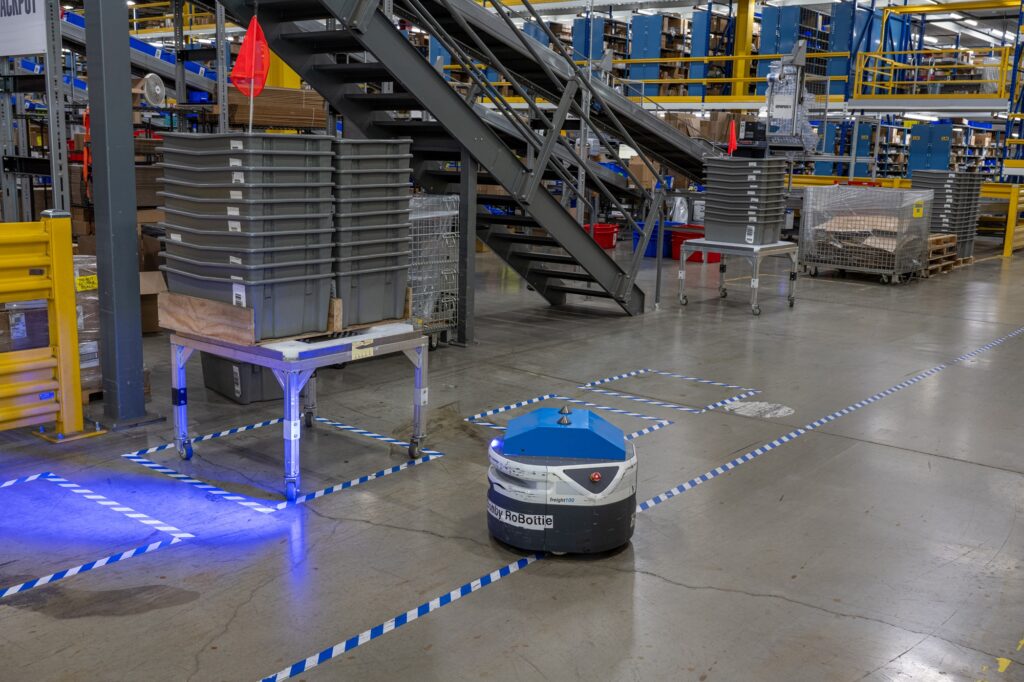
Industrial-sized robots specific to only one task are phasing out of the plant floor. Instead, many manufacturers are now looking for smaller-scale robots that take up less floor space, offer greater flexibility and provide a greater range of benefits.
While efficiency may be the jumping-off point, robotics inherently bring even more value to the plant floor through their ability to provide more flexibility and impact broader safety concerns. And, as overall costs have come down, robots can often be much more affordable today. If you haven’t looked at how robots can enhance your operations — or if you haven’t done so recently — now might be the time to start.