
As factories integrate advanced automation, AI and connected technologies, operations become faster — but also more fragile.
Learning objectives
- Identify where and why advanced technologies such as automation fail to scale beyond the pilot stage.
- Explore how resilience is achieved through systems design, not heroic interventions.
- Learn how regulatory frameworks (like OSHA and NFPA 70B) are evolving to support digital safety strategies.
Automation insights
- The gap between technical capability and organizational readiness is widening, making modern plants highly efficient until they meet limits they weren’t designed to handle.
- Success isn’t just about adopting automation technology — it’s about being structurally prepared to absorb it.
Advanced technologies are fundamentally reshaping how factories operate. From predictive maintenance to automation, these tools can drastically improve safety, uptime and productivity.
But despite the promise, the gap between what’s possible and what’s practiced is growing. And most of the time, it’s not because the tools are flawed.
Look at adoption. Many companies jump into advanced manufacturing with high expectations, but most don’t get far. According to the State of U.S. Manufacturing Report 2024, more than 70% of firms investing in technologies like artificial intelligence (AI), advanced analytics or 3D printing never move past the pilot stage. Not because the technologies fail, but because the organization wasn’t ready for what success required.
In fact, an ABB global survey of 3,600 industrial leaders found that only 55% have a strategic, proactive plan to modernize their facilities and even those with plans often struggle to execute. Among companies experiencing weekly downtime issues, only about one in five had implemented a modernization strategy despite almost all recognizing the need.
It’s easy to treat complexity as the problem or cast technology as either a silver bullet or a looming threat. But neither is inherently good nor bad; both act as amplifiers. Their impact depends entirely on the system they land on. In well-prepared environments, they drive exponential value. In fragile ones, they multiply risk. And in tightly coupled systems, even small oversights can ripple into major disruptions.
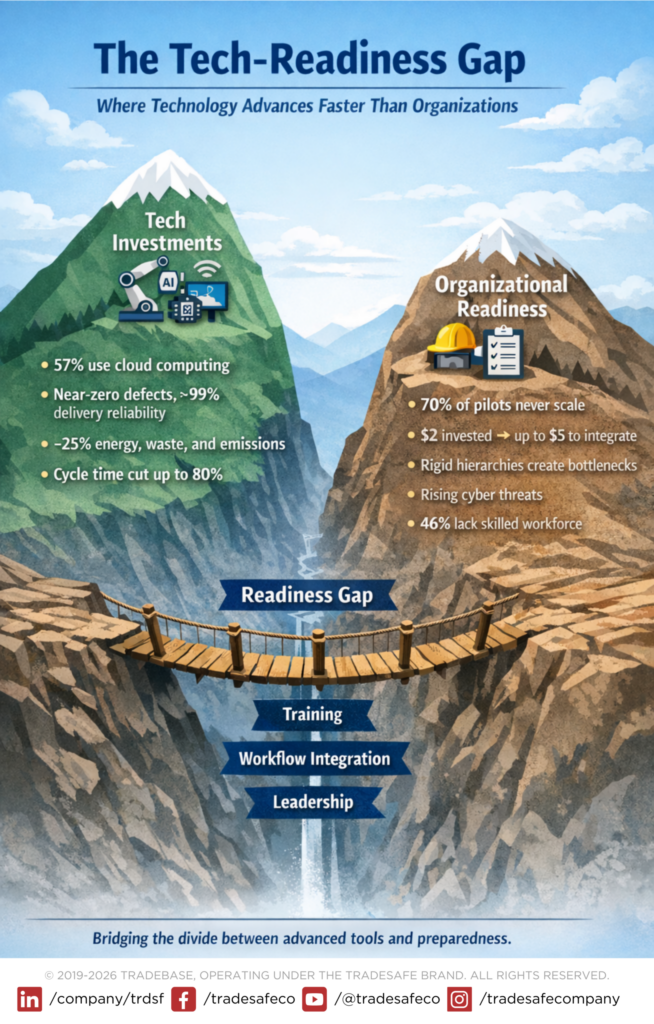
The result is a growing readiness gap: factories may own cutting-edge technology, but without structure and support, its value is left on the table. In many cases, technology is moving faster than the systems meant to absorb it.
What distinguishes technologies that deliver measurable impact is how they combine physical execution, system visibility and decision support. Deployments that align automation and robotics with industrial internet of things (IIoT), analytics and targeted digital tools report cycle-time reductions, fewer false rejects, predictive maintenance gains and compressed tooling lead times, as shown in the table below.
The most prepared organizations aren’t relying on heroic fixes when things go wrong. They’re structured not just to withstand disruption but to learn from it and adapt. Resilience, in this sense, is built into the design. Performance doesn’t come from ambition alone (see Table 1).

Implementing automation
The challenges tied to integration are industrywide. Automation, cloud-based analytics and connected equipment have become standard operating tools across U.S. manufacturing. Deloitte reports that 57% of surveyed manufacturers are using cloud computing in their operations, 57% are leveraging data analytics and nearly half (46%) have deployed IIoT technologies.
But there is a widening distance between technological advancement and organizational readiness. According to data cited in the 2024 State of U.S. Manufacturing report, nearly half of manufacturers say they lack the skilled workforce to stay competitive over the next year. In the U.S. alone, the manufacturing skills gap is projected to leave as many as 2.1 million jobs unfilled by 2030, with a potential economic impact of $1 trillion in that year, according to analysis from The Manufacturing Institute.
Technology is advancing faster than the labor pool can absorb,a reality that can hinder the safe and effective implementation of innovations.
Where readiness breaks down
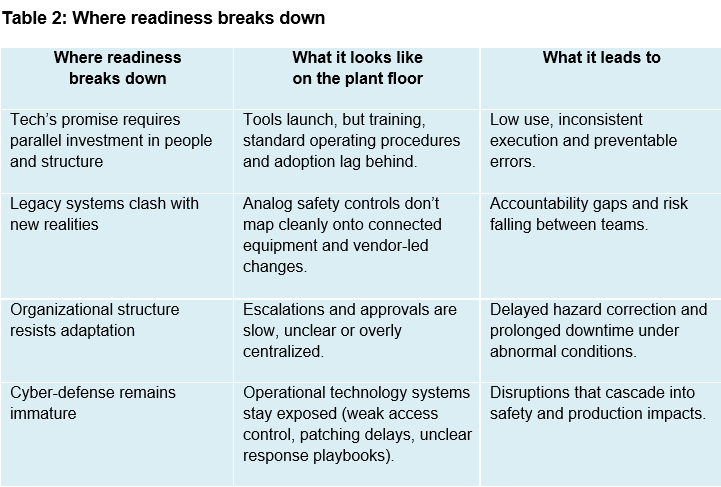
Manufacturing readiness can break down in four ways:
- Technology’s promise requires parallel investment in people and structure: Nearly half of manufacturers regret recent software purchases due to slow, difficult rollouts and low user adoption. The World Economic Forum has noted that for every $2 spent on new technology, up to $5 may be spent later just to scale or integrate it into daily operations.
- Legacy systems clash with new realities: Safety protocols built for analog environments don’t always translate to connected systems. As factories rely more on contractors and vendors for advanced tech, questions of accountability multiply and risks fall through the cracks.
- Organizational structure resists adaptation: Hierarchies designed for stability become bottlenecks when agility is needed. Without rethinking roles, workflows and authority lines, even the best tools stall inside outdated decision-making models.
- Cyber defense remains immature: Despite rising threats, few manufacturers consider themselves “mature” in cybersecurity. Traditional safety protocols struggle to keep up with network-connected systems and many firms have already experienced costly disruptions with no clear response infrastructure in place.
Table 2 translates each structural weakness into its operational signal and the consequence it creates when left unaddressed.
When these problems persist, the outcome is predictable:
- Underused systems
- Frustrated employees
- Latent risks.
Closing this readiness gap requires more than investment. Manufacturers are boosting workforce development programs, redefining decision-making structures and cultivating a culture of continuous learning to keep up with the tools at their disposal.
Figure 1 illustrates this imbalance directly; while technology investment climbs steadily — driven by cloud adoption, automation and measurable efficiency gains — organizational readiness rises more slowly, constrained by workforce shortages, structural bottlenecks and scaling friction. The gap between the two is clearly structural.
Safety recommendations for high-tech facilities
To close the tech-readiness gap, safety must be treated as systems design: clear ownership, standardized workflows and measurable leading indicators that show whether the organization can absorb new tools.
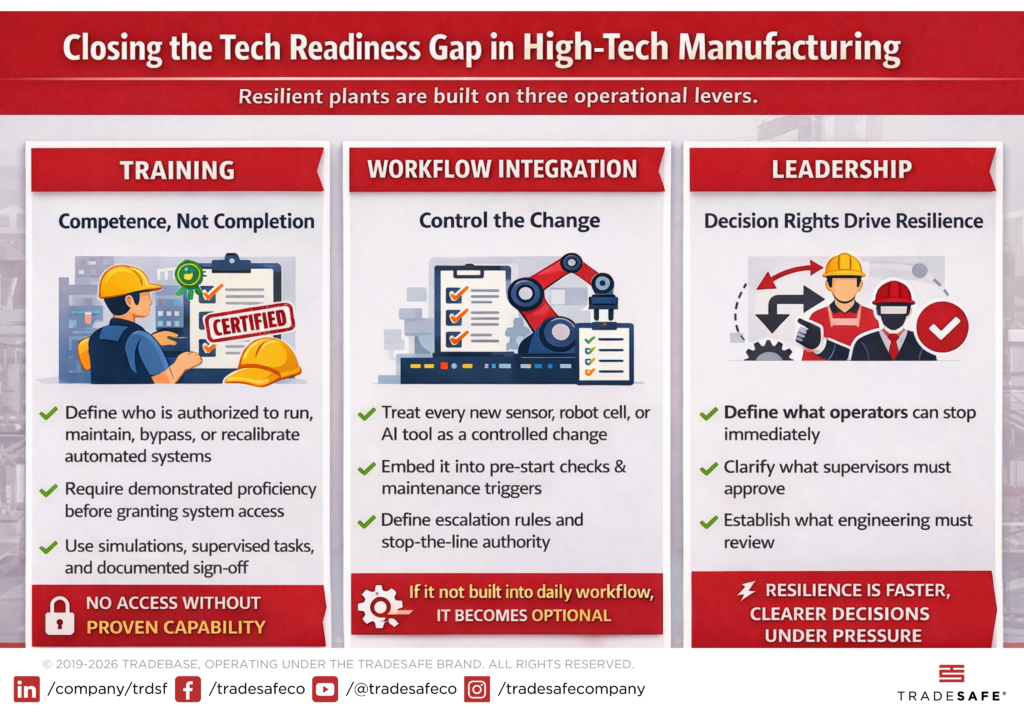
In high-tech plants, Occupational Health and Safety Administration (OSHA)-aligned programs become most useful when they translate into three operational levers:
- Training that proves competence
- Workflow integration that controls change
- Leadership structures that remove decision bottlenecks
The use of advanced industrial technologies has pushed many companies toward systems-thinking approaches, viewing safety not just as the absence of accidents, but as the outcome of well-designed, adaptive operations.
Most large manufacturers now track traditional metrics like total recordable incident rate and lost time injury frequency. They are also seeking more nuanced ways to evaluate whether their initiatives are truly working.
This includes measuring:
- Role-based qualification rates: Who is certified for which tasks and systems.
- Workflow adoption: Percent of shifts using digital checklists/escalation paths as designed.
- Near-miss and anomaly reporting: Including cyber/automation anomalies, not only physical hazards.
- Time-to-correct: How fast hazards, miscalibrations or control deviations are closed.
- Preventive maintenance compliance: Especially for safety-critical assets and electrical systems.
The logic is straightforward: if a company claims to have a “strong safety culture,” there should be tangible evidence such as high employee participation in safety programs, fast correction of reported hazards and consistent reporting of minor incidents.
- Training (competence, not completion): Move from “training done” to role-based qualification. Define who is authorized to run, maintain, bypass or recalibrate automated systems and require demonstrated proficiency (simulations, supervised tasks, sign-off) before access is granted.
- Workflow integration (control the change): Treat every new sensor, dashboard, robot cell or AI model as a controlled change. Build it into daily routines: prestart checks, maintenance triggers, escalation rules and stop-the-line authority. If it isn’t embedded into the workflow, it will remain optional — and stall.
- Leadership (decision rights and response speed): Reduce bottlenecks by defining decision thresholds (what operators can stop, what supervisors must approve, what engineering must review). Resilience is faster, clearer decisions under pressure — not heroic improvisation.
Regulators and companies are encouraging the use of leading indicators. Lagging indicators (like injury rates or lost workdays) measure outcomes after something has happened, which is useful, but they don’t prevent accidents. Leading indicators measure proactive safety activities (inspections completed, hazards reported, workers trained, near-miss corrections) that provide insight into how effectively risks are being controlled in the moment.
According to OSHA guidance on improving safety and health outcomes, the agency strongly encourages employers to use leading indicators as part of their safety programs, calling them “proactive and preventive measures that can shed light about the effectiveness of safety and health activities and reveal potential problems.”
A good safety program now tracks things like:
- The number of safety suggestions employees submit
- The response time to repair a reported hazard
- Compliance with preventive maintenance schedules
This concept aligns with modern standards such as ISO 45001, which require worker participation and iterative risk assessment and fosters a safety culture in which everyone actively looks for early warning signs. The standards include:
- Internal leadership (especially finance executives and operations directors) has become more metrics-focused, often under initiatives like Six Sigma, Lean or ISO management systems that require tracking of key performance indicators.
- External pressures such as environmental, social and governance reporting, investor demands and customer audits mean that manufacturing plants must publicly disclose aspects of their safety and environmental performance.
- The availability of data through digital systems makes it feasible to measure things that were once hard to quantify —so the bar of evidence is naturally rising. In essence, if you can measure it, you will be expected to.
Maintaining continuous digital records helps meet and exceed regulatory standards. OSHA and NFPA 70B: Standard for Electrical Equipment Maintenance requirements — such as equipment maintenance schedules and documentation — can now be supported through automated logging and real-time interventions.
This is especially true for lockout/tagout (LOTO) procedures, where digital platforms enable timestamped verifications, electronic sign-offs and centralized control over isolation steps.
By integrating digital elements into standard LOTO protocols, companies reduce human error, strengthen compliance and ensure safer interventions during maintenance or emergency scenarios.
Predictive maintenance, for example, leverages AI and analytics to anticipate equipment failures before they occur. Real-time visibility helps reduce the risk of injury by simplifying how issues are addressed under pressure.
Overall, safety management is shifting from a clipboard to the cloud: inspections, work permits and checklists are increasingly digitized, enabling trend analysis and faster response to any deviation.
Digital safety tools reduce risk only when ownership is clear: assign accountable system owners and enforce consistent change-control and lockout discipline across all teams. Resilience is an engineered capacity built through proven competence, embedded workflows and clear decision rights.
Integrating automation
The themes discussed — rising complexity with lower failure tolerance, the tech-readiness gap, dynamic safety management and outcome-based accountability — do not exist in isolation. They intersect in the daily reality of plant operations, creating both opportunities and tensions that industrial professionals must manage.
On one hand, new technologies (from advanced automation to AI-driven analytics) offer the promise of safer, more efficient and more sustainable manufacturing. On the other hand, implementing these technologies is not trivial: it brings challenges in workforce adaptation, requires robust change management and can introduce new failure modes.
The journey of modernizing a plant is therefore a careful balancing act.
Every innovation must be accompanied by training, revised procedures and sometimes a cultural shift in how work is done. It’s not enough to install a technology; the organization must be ready to use it effectively.
In essence, the modern industrial plant is a socio-technical system that must continually learn and adapt. Complexity isn’t going away; in fact, it will increase as supply chains, technologies and regulations become more intricate. The key is developing resilient systems and a culture that is prepared for new changes. This includes investing in workforce development, as the data strongly suggests (a lack of skilled workers will undercut any high-tech initiative).
The plants that thrive will likely be those that go beyond the status quo narratives. They won’t just say “more automation equals more productivity” or “more complexity equals more risk.”
Instead, they will dig into the nuanced reality: automation requires upskilling and vigilant risk management; innovation demands smarter simplification and robust contingency planning. They will support every claim with tangible evidence, whether it’s training hours delivered, sensors installed, incident rates reduced or dollars saved.