
Delivering ROI in automation, controls and instrumentation requires expertise in industrial processes and the ability to align advanced technologies with business objectives. System integrators enable this alignment by applying standards, best practices and domain experience to optimize system performance across industries.
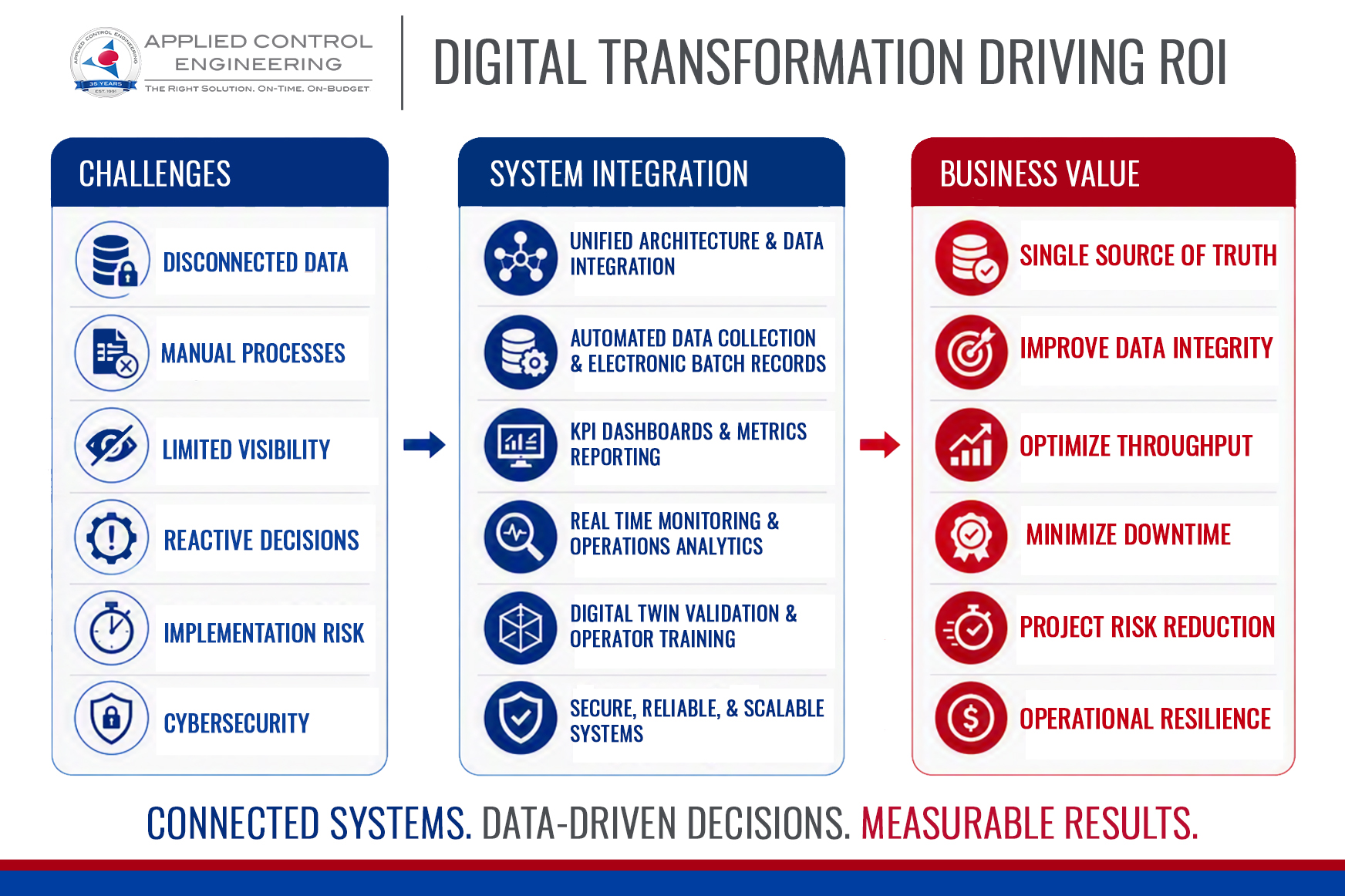
Control system integration ROI insights
- Understand how system integration serves as the foundation for successful digital transformation by connecting operational technologies, business systems and data processes to improve enterprise-wide decision-making.
- Identify strategies for transforming operational data into actionable business intelligence that improves productivity, reduces risk and delivers measurable return on investment.
- Evaluate the role of technologies such as digital twins, electronic batch records and cybersecurity in reducing project risk, accelerating implementation and supporting sustainable manufacturing performance.
Digital transformation has become one of manufacturing’s most discussed initiatives, yet many organizations still struggle to realize meaningful returns from their investments. While companies often focus on adopting new technologies, the true value of digital transformation lies in something much more fundamental: connecting people, processes and systems to create actionable information that drives better business outcomes.
For many manufacturers, the challenges haven’t changed. They continue to face pressure to increase throughput, improve quality, reduce downtime, manage labor shortages and control operating costs. What has changed is the availability of technologies capable of addressing these challenges. However, technology alone doesn’t produce results. Without thoughtful system integration, even the most advanced automation platforms become isolated tools that fail to deliver enterprise-wide value.
Successful digital transformation begins by creating a connected manufacturing environment where operational data becomes a strategic business asset (see Figure).
Breaking down data silos for control systems
Despite significant advances in automation, many facilities continue to rely on spreadsheets, paper records, disconnected control systems and manually compiled reports. Critical production information often exists in multiple locations or is held under lock and key by one department, making it difficult to gain an accurate, real-time picture of operations.
These disconnected systems create more than inconvenience. They introduce inefficiencies, increase the likelihood of human error and limit management’s ability to make informed decisions. Production managers may struggle to determine whether additional labor is needed to meet demand, maintenance teams lack visibility into optimal downtime windows and executives are forced to make capital investment decisions based on incomplete information.
Digital transformation is not simply about collecting more data. Manufacturers are already generating enormous amounts of data. The challenge is to ensure that data is turned into information and actional insights. It must be accurate, contextualized and accessible to the people responsible for making operational and business decisions.
System integration creates that foundation by connecting programmable logic controllers (PLCs), Supervisory Control and Data Acquisition (SCADA) platforms, historians, Manufacturing Execution System (MES) applications, Enterprise Resource Planning (ERP) systems and other operational technologies into a cohesive ecosystem. Rather than viewing each system independently, organizations gain a single source of truth that supports decision-making across the enterprise.
How to turn operational data into business intelligence
One of the greatest benefits of integrated systems is the ability to transform operational data into business intelligence.
Real-time visibility allows organizations to move beyond reactive decision-making. Instead of responding after problems occur, manufacturers can identify trends, detect process deviations and intervene before quality or production suffers.
This shift changes the role of data. Production metrics are no longer limited to engineering analysis. They become business metrics that influence scheduling, maintenance planning, inventory management, workforce allocation and investment priorities.
Just as financial leaders rely on accurate accounting data to guide strategic decisions, manufacturing leaders require trustworthy operational data to optimize plant performance. When production information is fragmented or delayed, every business decision becomes more difficult.
How integration improves more than efficiency
One misconception surrounding digital transformation is that its primary objective is operational efficiency. While efficiency is certainly important, integrated systems also reduce organizational risk.
Manual data collection introduces transcription errors. Disconnected systems delay problem identification. Limited visibility makes troubleshooting more difficult. Valuable operational knowledge often remains trapped in individual spreadsheets or with experienced personnel approaching retirement.
Integrated systems address each of these challenges by creating standardized, accessible information that supports both day-to-day operations and long-term continuous improvement. By allowing information rather than assumptions to drive improvement efforts, manufacturers can prioritize projects that deliver the greatest business impact.
Modernizing electronic batch records
The value of system integration becomes particularly evident when replacing manual processes that have evolved over many years.
One manufacturer relied on an elaborate Excel workbook to maintain electronic batch records. Operators manually entered production data, copied historical process samples, calculated process values and tracked each production batch through multiple spreadsheet tabs. While functional, the system depended heavily on manual data entry and offered limited visibility into process performance.
By integrating production data directly from the PLCs and SCADA system into an automated electronic batch record solution, the manufacturer fundamentally changed how information flowed throughout the operation.
Instead of waiting until production was complete to identify quality issues, the integrated system continuously evaluated process conditions in real time. Out-of-spec conditions could be detected early, allowing operators to adjust before an entire batch required rework.
Automated data collection also eliminated manual transcription errors, improved data integrity and reduced the time engineers spent gathering information for investigations.
The benefits extended well beyond the production area. Downstream operations gained visibility into material availability and batch status, while engineering teams could compare production runs more effectively to identify sources of process variability. Rather than simply digitizing an existing workflow, integration transformed how the organization managed quality, production and continuous improvement.
How digital twins reduce the risk before startup
As manufacturers pursue increasingly complex automation projects, digital twins are becoming another powerful example of how integrated systems deliver measurable value.
As a digital transformation tool, digital twins provide incredible value throughout a plant’s lifecycle. That could be in design, training, testing and validation, among other activities. One of their greatest impacts frequently comes from solving practical engineering challenges.
During control system modernization projects, digital twins allow engineers to validate control strategies before implementation, reducing commissioning risk and shortening startup schedules. Operators can train on new interfaces without interrupting production, while engineering teams can safely evaluate abnormal operating scenarios that would be impractical or unsafe to recreate in a live facility.
In one modernization project involving multiple chemical reactors and an exothermic process, a digital twin enabled operators to become familiar with a new control system before installation. Engineers simultaneously tested application software against the virtual process, increasing confidence that the system would perform as expected during startup.
The result was more than improved engineering efficiency. It translated directly into reduced downtime, faster commissioning, lower project risk and a quicker return to production. These are tangible business outcomes that extend well beyond the automation system itself.
Integrating cybersecurity into every project
As manufacturing systems become increasingly connected, cybersecurity can no longer be treated as a separate initiative.
Operational technology environments present unique challenges compared to traditional IT systems. While confidentiality remains important, manufacturing operations place equal, if not greater, emphasis on system availability. A production interruption lasting only a few minutes can result in significant financial losses, product waste, or regulatory concerns.
Effective system integration therefore requires cybersecurity to be incorporated from the earliest stages of project planning. Secure network architecture, appropriate segmentation, lifecycle management and adherence to industry best practices should be considered foundational design requirements rather than optional enhancements.
Digital transformation succeeds only when organizations can trust both the availability and integrity of the data supporting their operation.
Progress through incremental investment
Manufacturers often assume digital transformation requires a large-scale modernization initiative with significant capital investment. Many organizations achieve meaningful returns by starting with targeted projects that solve specific operational problems.
Adding instrumentation to improve process visibility, integrating production reporting, connecting isolated control systems or developing meaningful KPIs can each deliver measurable value. These incremental successes frequently build organizational confidence while creating the foundation for broader digital initiatives.
The most successful manufacturers view digital transformation as an ongoing business strategy rather than a one-time technology project. Every integration effort expands visibility, strengthens decision-making and improves operational resilience.
The role for the modern system integrator
As manufacturing becomes increasingly data driven, the role of the system integrator continues to evolve. Today’s system integrators are no longer focused solely on implementing automation hardware or programming control systems. They serve as strategic partners who connect operational technology with business objectives, helping manufacturers improve productivity, reduce risk, strengthen cybersecurity and maximize return on investment.
Technology will continue to evolve, but the objective remains constant: helping manufacturers make better decisions with better information.
Organizations that recognize system integration as the foundation of digital transformation will be better positioned to adapt, compete and grow in an increasingly connected industrial landscape.
Ian Burns, PE, CFSP, is the president of Applied Control Engineering. Edited by Sheri Kasprzak, executive editor, Control Engineering, Plant Engineering, [email protected].
Keywords
System integration, digital transformation
Consider this
Does your digital transformation include system integration of previously unconnected systems?
You also might like
Global System Integrator Database
https://si.arrowfly.com/integrators/applied-control-engineering-inc-delaware-valley