The real value of an emergency drill lies in its ability to reveal performance data and expose operational weak points rather than just recording basic participation numbers.
Learning objectives
- Learn which drill metrics reveal actual emergency readiness instead of paperwork compliance.
- Understand how to identify performance gaps in evacuation, accountability, communication and supervision.
- Know how to turn drill findings into corrective actions with clear ownership and follow-up.
Drill insights
- Emergency drills often prove only that a drill occurred, not that employees responded well; this article will show plant leaders how to measure emergency training through observable performance.
- While many organizations treat an emergency drill as a mere compliance checkbox, a truly effective program uses behavioral readiness metrics to evaluate whether employees recognize alarms, select safe evacuation routes and maintain accurate accountability under simulated conditions.
Many emergency drills end with a sign-in sheet, evacuation time and a “completed” status, but a successful emergency drill should prove more than participation. It should show whether people recognized the emergency, made the right decisions, moved safely, communicated clearly, accounted for everyone, included visitors and contractors and corrected weak points afterward. The real value of a drill is not the event itself, but the performance data it reveals.
Know the drill operational details
Emergency drill records focus on basic compliance data: date, time, number of participants, evacuation completion time, observer names, general comments and signatures. Those details are useful, but that record often misses harder operational questions:
- Did employees recognize the alarm?
- Did they move without waiting for informal confirmation?
- Did supervisors sweep assigned areas?
- Were contractors included?
- Was the headcount accurate?
- Did communication reach high-noise, remote or outdoor work areas?
A drill that does not answer those questions may end with a completed form, but it does not expose the weak points that determine emergency performance.
Compliance versus readiness metrics
Emergency drills, measured using basic administrative indicators, help demonstrate that the drill was planned, conducted, observed and recorded. However, they rarely explain whether the workforce responded correctly.
Readiness metrics assess what happened during the drill, measuring observable behavior and decision-making under simulated emergency conditions. Readiness metrics measure observable performance:
- Alarm recognition
- Route selection
- Evacuation flow
- Accountability accuracy
- Contractor and visitor inclusion
- Communication quality
- Supervisor execution
- Corrective-action closure
What makes a drill metric useful?
A drill metric is useful only if it helps leaders make better decisions. Strong metrics have five qualities:
- Observable: Someone can see, time, count or verify the behavior.
- Behavior-based: The metric measures what people did, not what the procedure says.
- Risk-based: The result connects to delayed evacuation, missing personnel, poor communication, command confusion or exposure to a hazard.
- Repeatable: The same metric can be used across shifts, departments and drill scenarios.
- Actionable: A poor result leads to a specific corrective action with an owner and verification method.
Use this format:
Expected action + observation point + acceptable standard + correction owner
For example, packaging employees begin evacuation within 30 seconds of alarm activation at Line 3 without waiting for supervisor confirmation. Delays caused by alarm confusion, poor audibility or informal confirmation are assigned to the packaging manager and verified during the next drill or spot check.
Occupational Health and Safety Administration (OSHA)’s guidance emphasizes that emergency action plans should be site-specific, including emergency conditions, evacuation policies, reporting mechanisms and alarm systems. A metric turns that requirement into evidence: not “the plan exists,” but “the plan worked at this location, with these people, under these conditions.”
Eight drill metrics to pay attention to
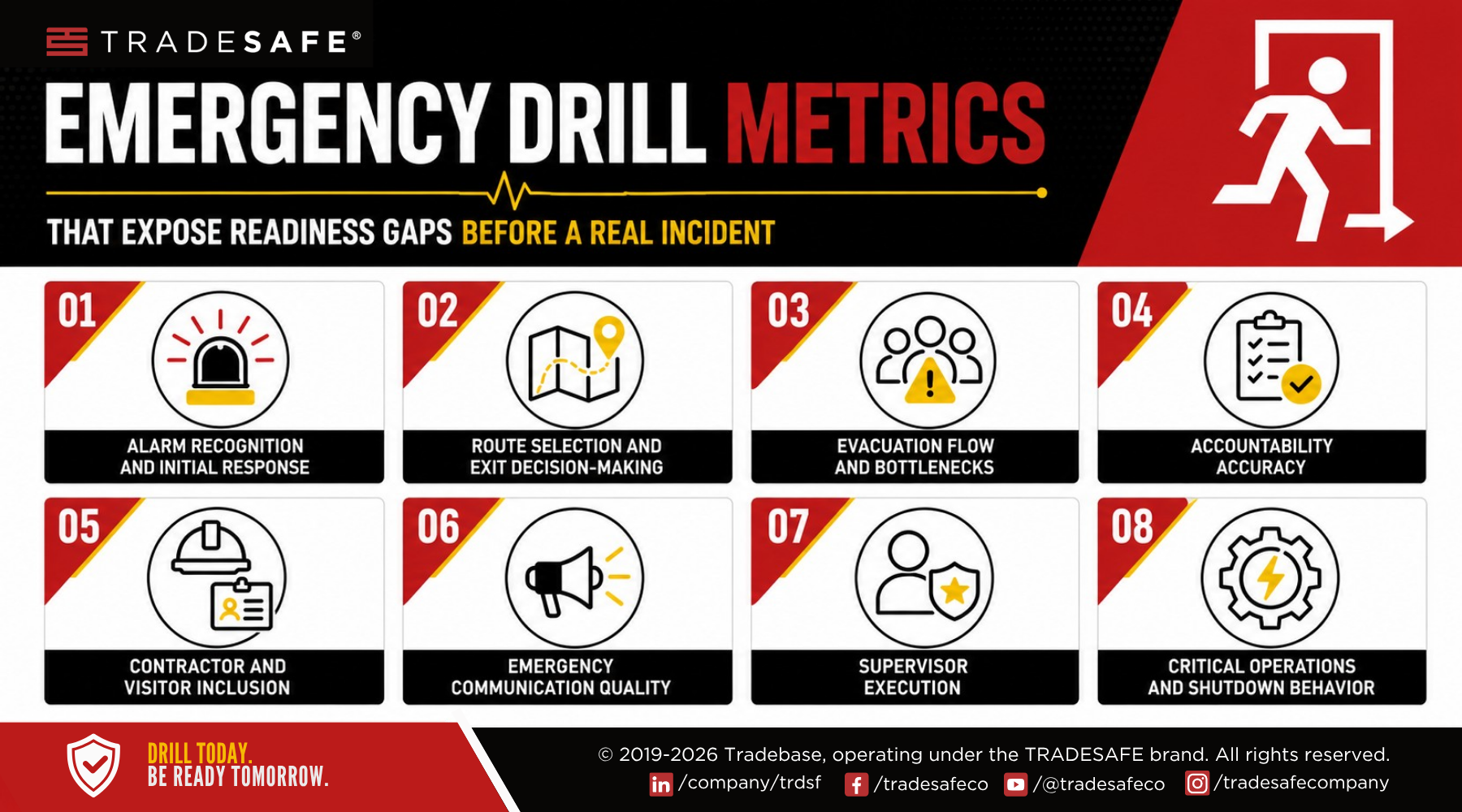
Once leaders define what good performance looks like, they can measure the parts of the response most likely to break down under real conditions. The following metrics target common points of failure in industrial emergency response and give plant leaders a clearer view of actual drill performance (see Figure 1).
Metric 1: Alarm recognition and initial response
The first readiness gap often appears before anyone starts moving. OSHA’s Employee Alarm System rule requires alarms to be perceivable above ambient noise or light levels and distinctive enough to signal evacuation or other emergency actions under the plan. Translated into plant language: employees must hear or see the alarm, understand what it means and know what action to take.
Measure:
- Time from alarm activation to first visible response
- Number of employees who continue working
- Number who wait for a supervisor or coworker
- Number who ask what the alarm means
- Correct response by alarm type
An acceptable standard should define the expected response by area. Employees in each observed area should begin the correct protective action within a defined time, such as 30 seconds, without waiting for supervisor prompting or peer confirmation.
In a packaging area, alarm recognition may fail because employees rely on visual cues from line leads. In a maintenance shop, grinders, compressed air and hearing protection may mask the alarm. In a yard, tank farm or outdoor utility area, distance, weather and radio coverage may determine whether the alarm is perceived.
Metric 2: Route selection and exit decision-making
Evacuation time alone can hide route failure. A facility may report a four-minute evacuation, but that number does not show whether employees used assigned exits, avoided the simulated hazard, selected safe alternate routes or moved through congested areas.
Measure:
- Percentage using assigned routes
- Wrong-exit use
- Movement toward the hazard
- Use of shortcuts
- Confusion at intersections, gates or stairwells
- Correct alternate-route selection when a primary route is blocked
An acceptable standard should require employees to use assigned routes unless the scenario blocks that route. When a primary route is unavailable, employees should select the correct alternate route without moving toward the simulated hazard or waiting for a supervisor to redirect them. Observers should be placed at intersections, stairwells, gates and exterior routes where wrong turns are most likely.
Metric 3: Evacuation flow and bottlenecks
If the last person reaches the assembly area in seven minutes, leadership still needs to know why. Did employees delay at workstations? Did one exit carry most of the traffic? Did a turnstile, badge reader, gate, stairwell or narrow corridor create a choke point?
Measure:
- Time to first movement
- Time for last person out of each area
- Bottleneck location and duration
- Exit use by group
- Pedestrian conflicts with vehicle routes
- Assembly-area congestion
An acceptable standard should identify both movement time and obstruction points by area. For example, the drill may require the last person to leave each department within a defined time while also confirming that no exit, gate, turnstile, stairwell or assembly-area entrance creates uncontrolled congestion.
Metric 4: Accountability accuracy
Accountability is not complete when someone says, “Everyone is here.” It is complete when that statement is verified.
Measure:
- Time to reconcile headcount
- Missing-person errors
- Extra-person errors
- Roster accuracy
- Visitor and contractor inclusion
- Supervisor reporting format
- Escalation time for discrepancies
An acceptable standard should require accountability to reconcile employees, visitors, contractors, temporary workers and known off-area personnel before an all-clear is considered. The process should also define how supervisors report missing-person information, who receives it, how discrepancies are escalated and how re-entry is controlled.
Metric 5: Contractor and visitor inclusion
Contractors are often missed because they sit outside normal department rosters. They may enter through security, report to a maintenance planner, work under a permit or move between areas. Visitors, truck drivers, inspectors, vendors and temporary workers create the same challenge.
Measure whether:
- Contractors hear and understand the alarm
- They know the assembly area
- Hosts or escorts confirm their status
- Sign-in logs match muster-area counts
- Remote contractor work areas are checked
- Truck drivers and yard personnel are included
The risk increases during shutdowns, outages, construction, confined space work, electrical work, roof work, hot work or tank cleaning. These jobs often place people away from normal employee traffic and outside supervisor visibility.
Contractor orientation should assign emergency routes and muster points before work begins. Sign-in records should identify the host, work location, accountability group and expected crew size. Assembly-area leads should have access to contractor and visitor information during the drill, not after the event is over.
Metric 6: Emergency communication quality
A message was not communicated because it was sent. It was communicated when the right people received it, understood it and acted correctly (see Table 1).
Measure:

- Time from alarm to first official instruction
- Message clarity
- Consistency across supervisors
- Public address audibility in high-noise areas
- Radio discipline
- Text or phone alert delivery
- Communication to remote areas
- Language comprehension
Drills should test whether communication works under actual plant conditions: machinery noise, hearing protection, radio congestion, outdoor work, poor reception, shift change and multilingual work groups. The goal is controlled communication.
An acceptable standard should require instructions to be specific, location-based and consistent across PA announcements, radio communication, text alerts and supervisor direction: “Evacuate through the north exits. Do not use the south corridor. Report to assembly area 2.”
Metric 7: Supervisor execution
Supervisors are often the difference between orderly response and improvised response. Employees may know the route, but supervisors control pace, discipline, sweeps, accountability, escalation and re-entry prevention. If supervisors hesitate, the workforce usually follows that uncertainty.
Measure whether:
- Supervisors know their assigned role
- Area wardens sweep their zones
- Supervisors check isolated rooms, restrooms, maintenance areas, labs and storage spaces
- Leaders direct employees calmly
- They report status clearly
- They manage accountability at assembly areas
- They escalate missing-person information properly
An acceptable standard should define what each supervisor, warden or area lead must do before reporting clear. That may include sweeping assigned zones, checking restrooms and isolated rooms, directing employees away from blocked routes, reporting status in a standard format, escalating missing-person information and preventing re-entry until authorized.
Metric 8: Critical operations and shutdown behavior
Critical operations may include placing equipment in a safe state, closing valves, stopping a process, securing energy or transferring control. The key is knowing what must be done, who does it, how long it takes and when the person must abandon the task and evacuate.
Measure whether:
- Trained employees know which tasks to perform
- Tasks are completed without unnecessary delay
- Employees understand when to abandon the task and evacuate
- Equipment, valves, panels or controls are accessible
- The task creates conflict with evacuation timing
If a shutdown step is necessary during an emergency, it should be preauthorized, assigned to trained personnel, limited in scope, timed and governed by a clear abandon-and-evacuate trigger.
Any task that depends on improvisation during the alarm condition should be removed from the emergency response expectation. A drill should verify whether trained employees know the task, can complete it safely within the allowed time and understand exactly when to stop the task and evacuate.
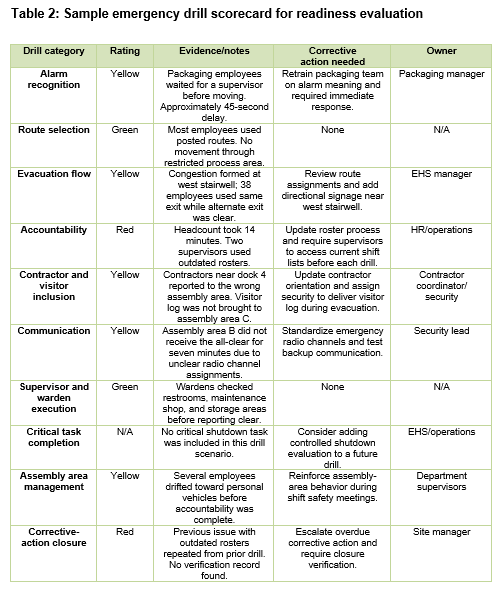
How to build a simple drill scorecard
The categories below follow the core readiness metrics identified in the outline. Use a scorecard before, during and after the drill (see Figure 2).
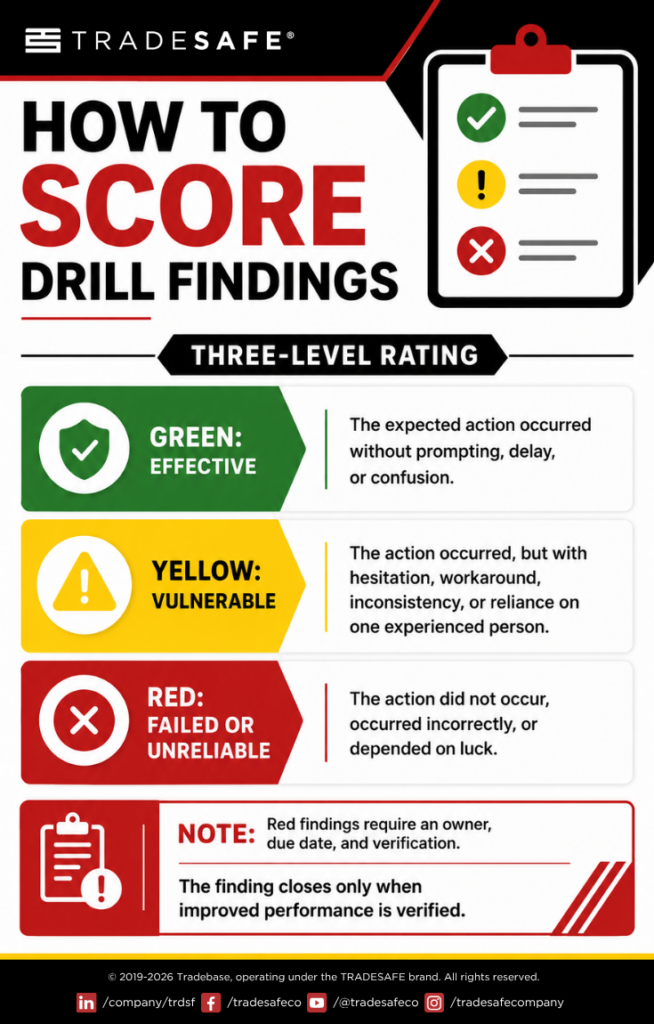
Red findings require direct ownership, a due date and verification. They should not be closed by saying the topic was “reviewed with employees.” Review may be part of the fix, but the finding is not closed until improved performance is verified.
Turning drill data into corrective actions
Federal Emergency Management Agency’s Exercise Guidance uses after-action reporting and improvement planning to document strengths, areas for improvement, performance issues and corrective actions. The same discipline applies to industrial drills: every meaningful finding needs an owner, a deadline and a verification method.
A strong corrective action includes:
- Observed gap
- Risk created
- Affected area, shift or group
- Corrective action
- Owner
- Due date
- Verification method
- Follow-up drill or spot check
For example, if two supervisors used outdated rosters during accountability, the corrective action is not simply “remind supervisors to use current rosters.” The plant should define where current rosters are accessed, who maintains them, how supervisors retrieve them during an alarm and how the process will be tested.
Closure occurs when a follow-up drill or spot check confirms that supervisors can reconcile the headcount accurately with the current roster.
The real value of a drill
Emergency drills are not valuable because they satisfy a schedule. They are valuable because they expose the exact points where a real incident would become slower, less controlled or more dangerous.
A strong drill program measures recognition, movement, route selection, supervision, communication, accountability, contractor inclusion, shutdown behavior and corrective-action closure. It tests the emergency action plan against actual people, actual noise, actual staffing patterns, actual contractors and actual physical constraints.
A drill should end with evidence: what worked, what failed, who owns the fix and how the site will verify improvement before the next emergency.