Learning objectives
- Understand the primary limitations and pain points of current sensor packages used in autonomous mobile robots (AMRs) for safety functions.
- Identify how acoustic detection and ranging (ADAR) addresses the shortcomings of traditional AMR sensor systems by offering enhanced 3D safety coverage that can detect previously missed obstacles.
Robot insights
- The article highlights that despite their benefits, autonomous mobile robots (AMRs) face significant challenges with current expensive, complex and 2D sensor packages, particularly 2D LiDAR and 3D cameras.
- This can result in safety gaps and blind spots and introduces a 3D ultrasonic sensor.
Over the past decade, autonomous mobile robots (AMRs) have revolutionized industrial processes by providing increased efficiency and reducing labor costs. Despite their benefits and their stunning rise from niche to mainstream, mobile robots are not without their limitations. This is especially true when it comes to the expensive, complex and often clunky sensor packages used to provide safety functions like obstacle detection.
Typical robot sensor packages
AMRs rely on a combination of sensors for safety and navigation. The most common sensor packages include light detection and ranging (LiDAR) and cameras, both of which have their own strengths and weaknesses.
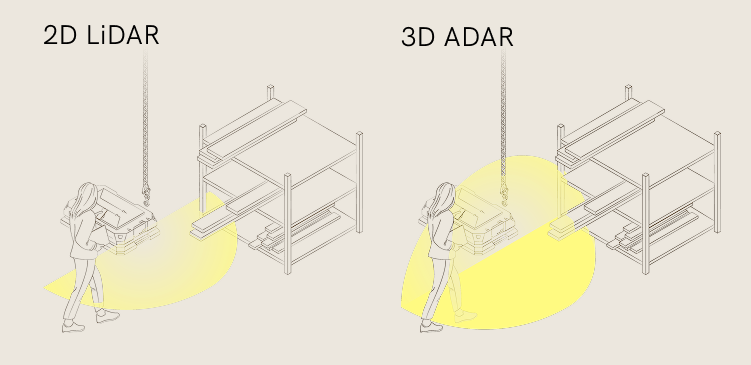
LiDAR sensors are widely used for their ability to create detailed 2D maps of the environment. They are excellent at detecting objects in a 2D plane but struggle with overhangs, protrusions and transparent objects. LiDAR also has limited field of view, which narrows its ability to provide safety across all scenarios and can lead to blind spots and missed obstacles. For example, it might detect the arms of a human working on the ground, but it won’t see that there’s a head connected to those arms.
Most of the safety issues around AMRs these days happen because LiDAR has failed to detect an overhanging or underhanging object. And this can lead to some dangerous and unexpected scenarios.
For example, if an AMR’s LiDAR fails to detect a pallet on the ground, it could end up pushing that pallet around creating all sorts of potential risk to people and property.
2D LiDAR is typically mounted on the AMR at an 8-inch height. That means it won’t be able to detect feet, so you must add the distance of a foot to your safety. Moreover, there’s a chance that someone could step over 8 inches toward a robot and the robot won’t detect anything before the foot steps down into the zone again.
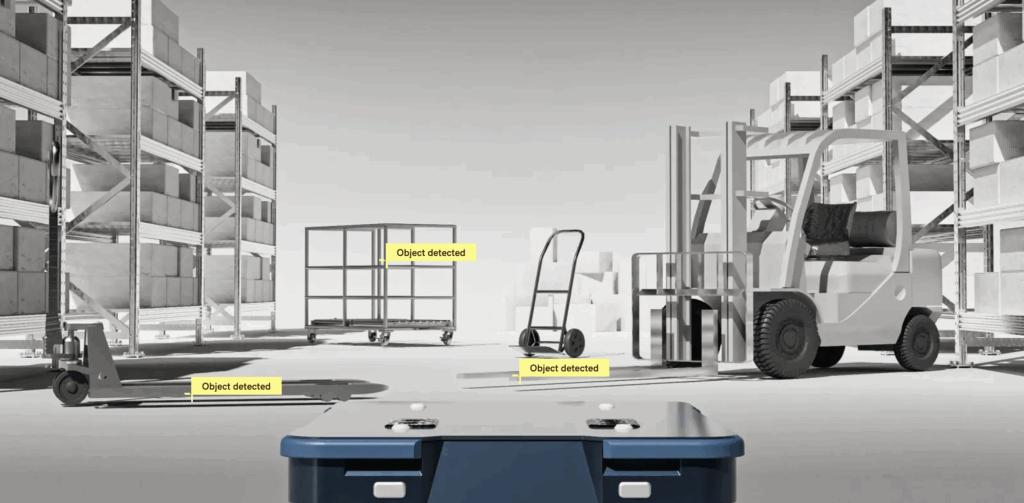
Similarly, multiple safety scenarios have occurred where a forklift has been left in the wrong location or with its forks raised, leading to AMRs and their goods becoming impaled on the misplaced vehicle.
It’s fair to say that today’s approaches to obstacle detection on AMRs are a little too 2D.
Handling robotic limitations
3D cameras are frequently used on AMRs to provide a workaround for those limitations and to enhance safety performance. While these expensive cameras provide rich visual information and often supplement LiDAR data, they are not safety certified. Moreover, cameras can be affected by reflections and varying lighting conditions, leading to unreliable data.
AMRs may also incorporate proximity sensors as part of their overall sensor systems. Like the parking sensors used on cars these are ultrasonic sensors, but that type of ultrasonic sensor can only provide one-dimensional distance information — not enough to close the safety gaps in today’s AMR sensor packages.
All these expensive and complex sensors — including the workarounds — end up contributing massively to the cost of AMRs, pushing prices up for end users and AMR builders. And they need regular maintenance too from wiping dust from the lens every day to dealing with the latest software updates. From the AMR builder’s perspective, integrating complex sensors accounts for a big chunk of their time. And yet, most AMRs today tend to take a similar approach — incorporating a clunky combination of 2D and 3D LiDAR and 3D cameras.
If AMR builders appear locked into a 2D LiDAR-based approach, it’s because LiDAR has achieved safety certification, more or less obliging companies to embrace the technology despite its limitations.
Sensor technology advances
A different approach to sensing and obstacle detection is set to change how AMR builders approach safety and obstacle detection, with the promise of enhanced, 360-degree safety and obstacle detection at a lower price point than current sensor packages.
Dubbed acoustic detection and ranging (ADAR), the sensor uses beam-forming — a processing technique widely deployed in sonar, radar and medical ultrasound imaging — to enable in-air ultrasonic applications. The technology has omnidirectional depth perception, enabling it to “hear” its surroundings by analyzing information from airborne sound waves.
This 3D ultrasonic sensor has potentially massive implications for AMR design and safety. A single ADAR sensor can provide a 180×180-degree field of view and a 16.4-foot range for safety functions. Unlike traditional 2D LiDAR sensors, ADAR-based sensors can detect overhangs, protrusions and low-lying obstacles effectively. ADAR doesn’t struggle with transparent surfaces. In effect, the sensor establishes a 3D safety shield for obstacle detection around any mobile robot.
Despite enhancing safety by being more capable than LiDAR when it comes to obstacle detection, ADAR is cheaper than both LiDAR and camera-based obstacle detection. This provides AMR makers with an opportunity to lower costs for end users.
Robots that share spaces with humans will always need a combination of sensors to ensure safe human-robot interactions across multiple applications and environments. None of this is to claim that ADAR is “one sensor for every application.”
However, for AMR builders, ADAR is a powerful addition to their toolkit; a cost-effective, small form factor, easy-to-integrate alternative to complex camera and LiDAR setups. It also provides AMR manufacturers with an opportunity to stay competitive in a rapidly evolving AMR market by providing enhanced safety at a lower price point.
For end users, it means greater peace of mind when sharing busy facilities with fleets of AMRs, knowing that the robots are kitted out with safety sensors that provide full 360-degree, 3D coverage — and that the robot trundling by with $500,000 of product on board is not going to impale itself on a forklift anytime soon.