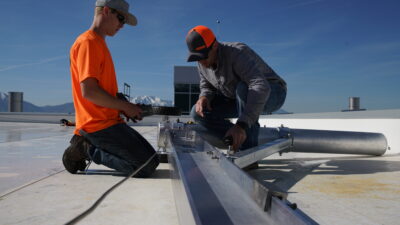
Spills can be mitigated when employees understand safety, containment, reporting or escalation responsibilities.
Learning objectives
- Understand why spill response begins with protecting people and assessing hazards before attempting to stop or contain a release.
- Learn how stop-contain-report supports faster, safer decisions during the first critical minutes of a spill.
- Know how preparedness activities, such as training, drills, spill kit readiness, documentation, maintenance and escalation planning, can reduce risk and improve response outcomes.
Spill disaster insights
- This article explains how the stop-contain-report framework can help facilities protect people, control release quickly and strengthen preparedness before the next spill occurs.
- Preparing for spill disaster response and containment takes preparation and requires a planned response.
Spills rarely happen at a convenient time. They happen during loading and unloading, in aging pipe runs, around tank farms, near drains, inside production areas or at the worst possible location — close to water or at an infrastructure that cannot easily be shut down. In the first minute, the quality of a facility’s spill response can determine whether the event remains manageable or becomes a safety, environmental, operational and compliance problem.
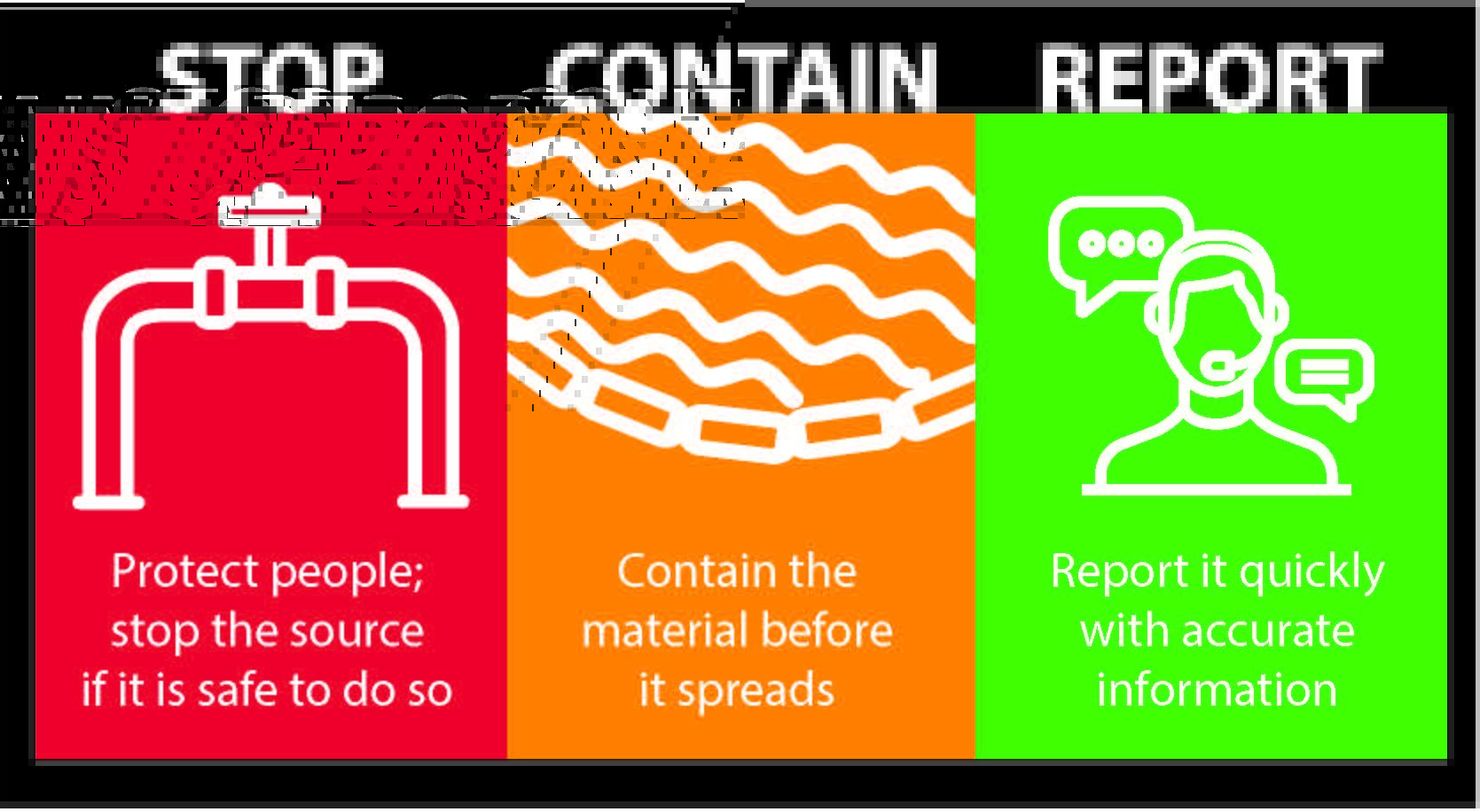
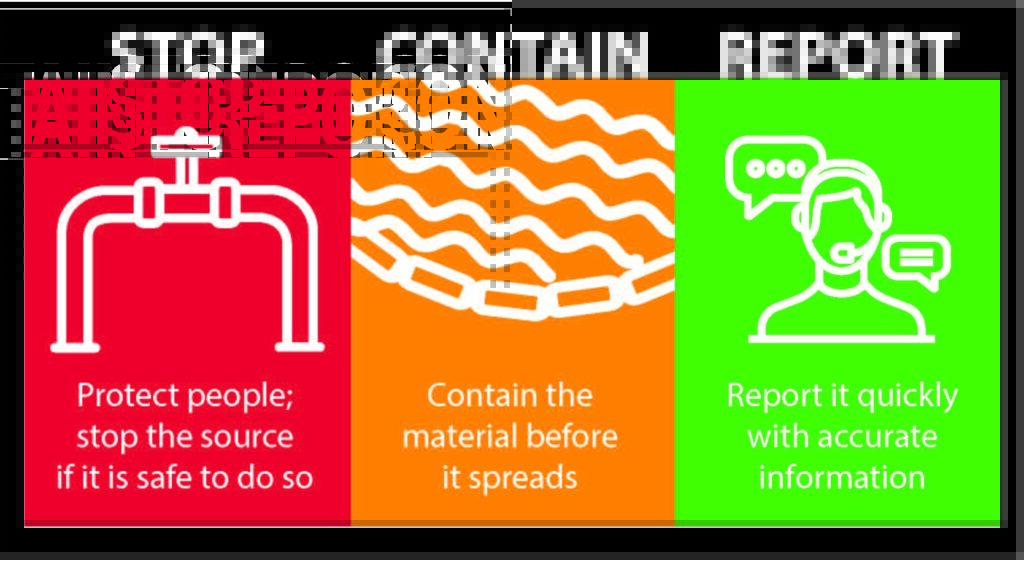
The stop-contain-report framework gives employees a simple sequence to follow under pressure. It does not replace a facility’s written emergency action plan, spill prevention plan, safety data sheets (SDS) or regulatory reporting obligations. Instead, it translates those requirements into a practical field response: protect people, stop the source if it is safe to do so, contain the material before it spreads and report the incident quickly with accurate information.
Why spill disaster response starts before the spill
Many manufacturing facilities handle oils, lubricants, fuels, coolants, solvents, additives or other specialty fluids. The most common spill sources are often not dramatic failures; they can include worn piping, deteriorated hoses, open valves, leaking tanks, transfer errors, overfills, failed gaskets or maintenance issues in older infrastructure. When preventative maintenance is underfunded or inspection routines are informal, small warning signs can become large releases.
Preparedness matters because a spill creates urgency and confusion. If employees are unsure who is in charge, where spill kits are located, which personal protective equipment (PPE) is required, how to isolate equipment, whether the release is incidental or requires escalation or who needs to be notified, the response can become improvised. That improvisation can delay containment, expose workers, increase cleanup costs and create gaps in documentation.
The first priority: protect people
Before employees try to stop or contain anything, they should make sure people are safe. The safe responder at the scene should quickly assess whether there is an immediate life safety hazard: fire, explosion, risk, corrosive exposure, slip hazard, electrical hazard, confined space involvement or a release moving toward busy areas. If a situation is unsafe, employees should move away, warn others and activate the facility’s emergency response process.
Step 1: Stop the source, only if it is safe: “Stop” means preventing additional material from being released. In practice, this may include closing a valve, shutting down a pump, stopping a transfer, uprighting a container, isolating a leaking line, placing a damaged drum into overpack, activating an emergency stop or securing equipment. The objective is to stop the flow before the spill grows.
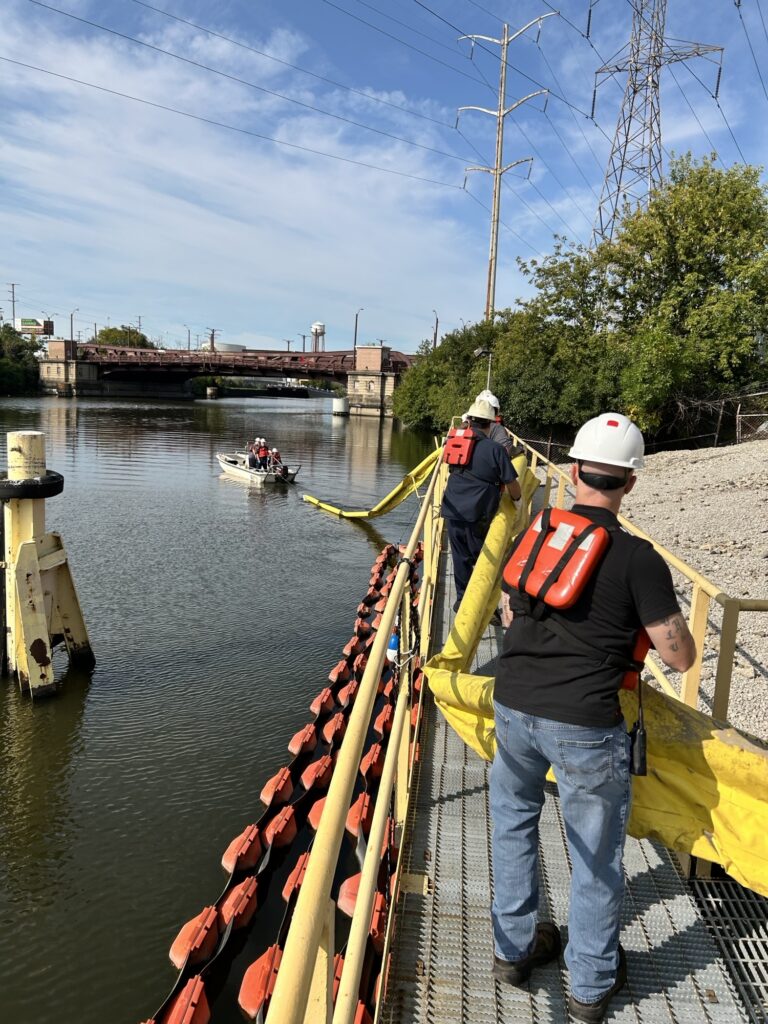
Step 2: Contain the spill before it spreads: Once the source is stopped or while trained personnel are working to stop it, the next priority is containment. “Contain” means keeping the materials from spreading to people, equipment, drains, soil, waterways, traffic paths, ignition sources or other processes. Timely response is important because a spill that reaches a drain, canal, river, stormwater system, wastewater treatment process or unprotected floor joint can become much more difficult and expensive to control.
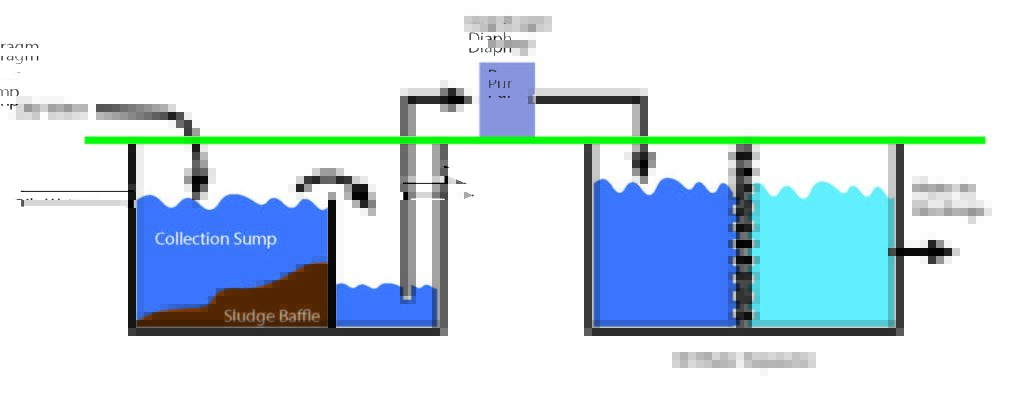
Secondary containment, if available, can dramatically reduce risk. A site designed so spilled oil or product flows into an oil-water separator, controlled collection pit or contained process area has more time to respond and fewer pathways to the environment. Facilities without secondary containment should identify the most likely flow paths and stage spill materials at those locations.
Step 3. Report quickly and accurately: “Report” means notifying the right people internally and externally with enough information to make decisions. Internal reporting should happen immediately through the facility’s chain of command: supervisor; emergency response team; environmental, health and safety (EHS); operations leadership; corporate management; security; maintenance; or incident command, depending on the site’s structure.
External reporting depends on the material, quantity, location, pathway and applicable regulations. The U.S. Environmental Protection Agency (EPA) National Response Center (NRC) is the federal point of contact for reporting oil, chemical, radiological, biological and etiological discharges into the environment in the United States. Reports to the NRC can trigger the National Contingency Plan and federal response notifications.
The EPA guidance also notes that the Spill Prevention, Control and Countermeasure and Facility Response Plan rules are designed to help facilities prevent, prepare for and respond to oil discharges. Facilities should not wait until cleanup is complete to begin reporting; escalate if needed. Reporting obligations vary based on jurisdiction, material, quantity, pathway, permits and applicable law.
Once people are protected and the scene is under control, responders can move into the practical sequence that guides the rest of the response.
Putting the framework into action
The following are examples of considerations CITGO has found useful when adapting the stop-contain-report framework to site-specific response plans during the first critical minutes of a spill.
- Confirm the scene is safe. Make sure employees are protected, the area is isolated and no one is exposed to vapors, fire risks, electrical hazards or unknown chemicals.
- Identify the product. Check labels, process knowledge, shipping papers or the SDS. Confirm hazards and PPE before approaching.
- Stop the source if safe. Close valves, stop pumps, shut down transfers, secure equipment or isolate the release within the worker’s training and authority.
- Contain the spread. Block the drains, protect waterways and keep the material within a contained area.
- Report Internally. Notify supervisors, EHS, emergency response team members, maintenance, operations and leadership according to site plan.
- Escalate externally when required. Contact outside responders or regulatory agencies if the spill is beyond site capability or threatens the environment.
- Document and clean up safely. Record what happened, preserve photos, use compatible materials and dispose of it properly.
- Review and improve. Identify root causes, assign corrective actions, update training, verify corrective actions.
When to handle in-house and when to escalate
Not every spill requires a specialized response team, but every facility should define the line clearly depending on its site conditions. A spill may be handled in-house only when employees are trained, the material is known, hazards are understood, PPE is available, the release is small and controlled, there is no serious exposure risk and cleanup can be completed safely using routine procedures.
Escalate when the material is unknown, the spill is uncontrolled, the material is highly toxic, the spill enters or threatens water or drains, evacuation may be needed, fire or explosion is possible, the release exceeds facility response capabilityor responders would need to enter a hazardous area to stop the flow. One of the most dangerous assumptions is that the spill size alone determines seriousness. A few ounces of the wrong chemical in the wrong place can require more urgent action than hundreds of gallons contained inside a protected area. Decision-making should be based on hazard, exposure, pathway and capability.
Lessons learned from spill preparedness
Even well-intentioned teams can make errors when a spill creates pressure, confusion or concern about downtime. Facilities can often benefit from the following lessons learned and identifying them in advance can help facilities train employees to slow down, protect themselves and make safer decisions during the first critical minutes of a spill response.
Identify proper PPE: Employees may grab the nearest gloves or absorbents without checking whether the material requires chemical-resistant gloves, face protection, respiratory protection or other controls. SDS provide critical information about hazards, protective measures, emergency controls and safe handling. Facilities should train employees to use SDS information quickly, not just store the documents for compliance.
Clean before documenting: In the urgency to restore the area, teams may forget to take photos, record the source, identify the flow path or collect employee statements. Documentation supports root-cause analysis, regulatory reporting, insurance review and corrective action. If it is safe, photos should be taken before cleanup changes the scene.
Do not let spill kits become decoration: Spill supplies are only useful if they are stocked, visible, accessible, compatible with site materials and located where spills are more likely to occur. Kits blocked by objects, missing drain covers or stocked with the wrong absorbents slow down response.
Do not assume drains are protected: Employees should know where floor drains, storm drains, trenches and outfalls lead. Drain protection may be a critical consideration depending on site conditions.
Train and practice: Without preventive training and regular drills, teams may be unsure of safety protocols, notification order, equipment locations or role assignments. During an actual incident, that uncertainty can quickly turn into delay.
How to improve spill preparedness
Preparedness improves when spill response is treated as an everyday operational responsibility, not just an emergency procedure. The steps before give teams a practical way to strengthen readiness before the next accident occurs.
- Build a clear response plan. The plan should define roles, notification steps, evacuation criteria, escalation triggers, spill kit locations, PPE requirements, waste handling, documentation forms and agency reporting contacts. Preventive training should be built into this plan. Facilities should train employees not only on emergency response steps, but also on how to prevent releases through pre-use inspections, careful transfer procedures, housekeeping, valve verification, container labeling, drain awareness and early reporting of leaks and near misses.
- Make product knowledge part of preparedness. Employees should be trained on the specific products used at the facility, including common names, labels, hazards, required PPE, spill behavior, incompatible materials, disposal requirements and environmental risks. A worker who knows the product can respond faster, report more clearly and avoid using the wrong neutralizer or cleanup method.
- Practice realistic drills. A tabletop exercise is useful, and it’s also important that facilities also run field drills. Practice a leaking transfer hose, an overfilled tank, a release near a drain, a spill at a loading rack or a waterfront scenario. Measure how long it takes to recognize the event, notify leadership, select PPE, stop the source, block drains, deploy absorbents, document and report the incident.
- Connect maintenance to spill prevention. Preventive maintenance is spill prevention. Inspect aging piping, hoses, valves, tank connections, pumps, secondary containment, overfill protection and transfer equipment. Track near misses and small leaks as leading indicators, not housekeeping problems.
- Make documentation easy. Use a one-page spill report form that captures time discovered, material, estimated quantity, source, location, responders, PPE used, stop actions, containment actions, notifications, photos, disposal path, root cause, correction actions and verification.
- Review every incident and near miss. The goal is not to blame; it is about learning. Ask what failed, what worked, whether employees had the right supplies, whether reporting was timely, whether PPE was correct and what permanent control would prevent recurrence.
Short-term preparedness activities
Facilities looking for immediate improvement can start with three high-impact actions.
- First, inspect every spill kit, drain cover and PPE cabinet. Replace missing supplies and move kits closer to likely spill points.
- Second, conduct a short drill on one realistic scenario and evaluate response time, communication and role clarity.
- Third, review the top chemicals or products handled on site and confirm that employees know what PPE is required and when to escalate.
Maintenance should also review recent leaks, drops, valve errors, overfills, transfer issues and near misses. Patterns often reveal the next likely spill location. If the same pipe section, hose, pump or operator task keeps appearing, corrective action should be prioritized before a larger spill occurs.
Disclaimer: This article is provided for general informational purposes only and reflects CITGO’s experience with the Stop-Contain-Report framework in the context of its own operations. It is not intended to serve as a comprehensive guide, standard operating procedure, emergency response plan, legal opinion, or substitute for site-specific training, professional judgment, or regulatory compliance review. Spill response practices must be evaluated, adapted, and implemented by each facility, operator, or organization based on its specific operations, materials handled, hazards, workforce capabilities, equipment, location, applicable permits, and legal, regulatory and practical requirements. Readers should consult their own environmental, health and safety, operations, legal and emergency response professionals before adopting or modifying any spill response practices.