Electrical safety is key within various manufacturing and industrial plants.

Learning objectives
- Learn to differentiate between different electrical safety hazards.
- Know how to perform a risk assessment to determine the proper PPE.
- Assess how to wear proper PPE and maintain wearing it correctly.
Electrical safety insights
- This article explores how aligning OSHA and NFPA 70E fosters a safer work environment by improving electrical safety through proactive hazard management.
- Employers must provide a safe workplace for employees and therefore are responsible for addressing electrical safety.
Electrical safety in the workplace is a critical concern that demands adherence to established standards to protect workers from potentially life-threatening hazards. The Occupational Health and Safety Administration (OSHA) and NFPA 70E: Standard for Electrical Safety in the Workplace provide complementary guidelines that address hazard identification, risk assessment and the use of personal protective equipment (PPE).
Electrical hazards in the workplace pose significant risks to workers, ranging from immediate physical injuries to long-term health effects. Identifying and differentiating between these hazards is the foundational step in any electrical safety program, as emphasized by both OSHA and NFPA 70E.
OSHA identifies electricity as a serious workplace hazard that can lead to electric shock, electrocution, fires and explosions. Similarly, NFPA 70E focuses on protecting employees from shock, electrocution, arc flash and arc blast. By categorizing these hazards, employers can tailor their safety strategies to specific scenarios, thereby reducing the likelihood of incidents.

Electric shock
One primary category is electric shock, which occurs when electrical current passes through the body because of contact with energized parts. This hazard is prevalent in tasks involving live wiring or faulty equipment. According to OSHA, common causes include contact with power lines, lack of ground-fault protection and improper use of extension cords.
NFPA 70E defines electric shock as a dangerous condition where contact with or failure of equipment results in current flow through the body, potentially causing burns, muscle contractions or cardiac arrest. Differentiation here involves assessing voltage levels; for instance, low-voltage shocks (less than 50 volts [V]) may cause minor discomfort, while high-voltage exposures (more than 600 V) can be fatal.
Workplaces must be inspected for shock hazards via visual inspections and voltage testing, thus ensuring workers maintain safe distances defined by approach boundaries in NFPA 70E.
Arc flash
Another distinct hazard is arc flash, an explosive release of energy caused by a short circuit or fault in electrical equipment. This differs from shock because it involves radiant heat, intense light and pressure waves rather than direct current flow.
OSHA guidance recognizes arc flash as a key risk, noting that it can cause severe burns and can even ignite clothing. NFPA 70E provides detailed definitions, describing arc flash as a source of possible injury from thermal burns or blasts, with incident energy measured in calories per square centimeter (cal/cm²).
For example, in switchgear maintenance, an arc flash might be caused by tool slippage or dust accumulation, releasing energy equivalent to several sticks of dynamite. Differentiating arc flash from arc blast — the pressure wave accompanying the flash — is crucial; arc blast can propel shrapnel and cause hearing damage or concussions.
Electrocution
Electrocution, often a fatal outcome of electric shock, is differentiated by its severity and is a leading cause of workplace deaths. OSHA reports that many workers are unaware of hazards like discontinuous paths to ground or equipment misuse. NFPA 70E aligns by requiring de-energization of equipment (unless justified) to prevent such outcomes. Additional hazards include fires and explosions from overheated wiring or sparks igniting flammable materials. These are thermal hazards, distinct from shock or arc events and are addressed in OSHA’s Subpart S by mandating grounding and overcurrent protection.
To differentiate effectively, workplaces should conduct hazard analyses that consider factors such as equipment condition, environmental conditions (e.g., wet areas increasing conductivity) and task specifics.
For instance, overhead power line work presents unique shock and fall hazards, while confined spaces may amplify arc flash risks due to limited escape routes. Training programs, mandated by both standards, should include real-world examples, such as case studies from OSHA inspections where failure to recognize hazards led to incidents.
By aligning OSHA’s broad regulatory requirements with NFPA 70E’s detailed hazard classifications, organizations can create comprehensive safety audits that identify and prioritize risks, ultimately preventing injuries and promoting a safer work environment.
Five steps to electrical safety risk assessment
Performing a risk assessment is crucial for electrical safety; the process determines the appropriate PPE based on identified hazards. NFPA 70E outlines a structured risk assessment procedure in Article 130.5, which integrates with OSHA’s emphasis on hazard recognition and control. This alignment ensures that assessments are not only compliant but also effective in minimizing exposure. The process involves systematic steps to evaluate shock and arc flash risks, determining PPE that matches the hazard severity.
1. The first step is to identify the tasks and equipment involved — this includes reviewing work scopes, such as troubleshooting circuits or installing panels and cataloging potential hazards, such as energized conductors. OSHA requires employers to assess workplaces for hazards that necessitate PPE, per 29 CFR 1910.132. NFPA 70E identifies shock hazards according to voltage and arc flash by fault current and clearing times.
For example, inside a manufacturing plant, assessing a 480-V motor control center would involve checking labels for incident energy levels.
2. The second step is to conduct a hazard analysis to determine the likelihood and severity of risks. This step uses the hierarchy of risk controls, elimination (de-energizing), substitution, engineering controls (e.g., barriers), administrative controls (training) and PPE as a last resort (see Figure 2).

NFPA 70E requires that risks be assessed via table method or calculations, such as IEEE 1584-2018: Guide for Performing Arc-Flash Hazard Calculations. Severity is quantified; for arc flash, incident energy that typically exceeds 40 cal/cm² indicates extreme risk with the concussive shockwave risk associated with a high-level arc flash. Other likelihood considerations are equipment maintenance and testing history — poorly maintained gear increases fault probability.
3. The third step is to calculate or estimate specific risk metrics; doing so begins with the proper boundaries. For shock risk, define approach boundaries — limited (unqualified persons keep distance) and restricted (qualified only with PPE). These shock boundaries are determined by voltage level.
For example, a 480-V panel has a limited approach boundary of 3 feet 6 inches and the restricted boundary is 1 foot. The arc flash boundary and incident energy are calculated using the incident energy calculation method noted in NFPA 70E 130.5(G). Arc flash assessments may use software to model scenarios, ensuring conservative estimates if data are unavailable. OSHA aligns by requiring assessments to include non-electrical hazards, like falls during elevated work.
4. The fourth step, based on the assessment, is to select PPE. The PPE tables are different depending on which method is used to calculate incident energy and the boundaries. If the incident energy method NFPA 70E 130.5G is used, then the corresponding PPE tables are in Sections 130.5(E) and 130.5(G). If the arc flash PPE Category Method NFPA 70E 130.7(c)(15) is used, then consult the PPE tables located in 130.7(c)(15)(b) and 130.7(c)(15)(a). The category method categorizes PPE from 1 to 4, while the incident energy method breaks the PPE into two levels.
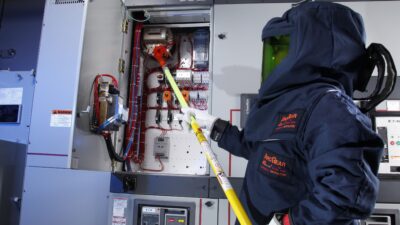
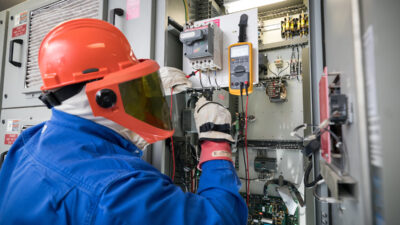
PPE consists of arc-rated clothing, hearing protection, safety glasses, arc-rated gloves with protectors, arc-rated face shield and balaclava or the arc-rated arc flash suit and hood for higher levels; refer to the tables to appropriately address PPE needs. Document the assessment, including justifications for live work and review it annually or after changes, as per NFPA 70E.
5. The final step is to implement and train according to the findings. This includes obtaining an energized electrical work permit for live tasks that exceed 50 V. OSHA enforces this through inspections, citing failures in risk assessment as violations. Case studies, such as arc flash incidents from underestimated risks, underscore the importance of thorough processes.
By following these steps, workplaces align OSHA’s legal mandates with NFPA 70E’s practical guidance, ensuring PPE is appropriately determined and risks are effectively managed.
Wearing, maintaining PPE for electrical safety
Wearing and maintaining proper PPE is essential for sustaining electrical safety, as it serves as the final barrier against hazards when other controls are insufficient. Both OSHA and NFPA 70E provide detailed requirements to ensure PPE is used correctly and remains effective over time. Proper usage involves selecting, donning and doffing equipment in a manner that maximizes protection, while maintenance prevents degradation that could compromise safety.
To wear PPE properly, workers must first ensure it fits correctly and covers all exposed areas. NFPA 70E mandates arc-rated clothing worn as outer layers, with no conductive items, such as jewelry. For shock protection, insulated gloves must be worn with protectors, rated for the voltage (e.g., Class 0 for up to 1,000 V).
OSHA requires training on how to wear PPE, including adjustments for comfort without reducing efficacy, per 29 CFR 1910.132. In practice, for arc flash tasks, this means layering in a specific order: base nonmelting undergarments, arc-rated coveralls, balaclava, face shield and hard hat. Workers should inspect PPE before each use, checking for defects such as tears or contamination.

Maintenance is equally critical, involving regular inspections, testing and storage. NFPA 70E requires visual inspections before each use and additional periodic testing (e.g., dielectric testing for gloves every 6 months). OSHA echoes this in its PPE standards, mandating care, useful life assessment and disposal of damaged items.
Storage should be in clean dry areas to avoid ultraviolet damage or moisture. For arc-rated clothing, laundering must follow manufacturer guidelines to preserve ratings. Improper laundering, including the use of chlorine bleach or other prohibited chemicals, can significantly degrade the arc-rating performance of electrical PPE garments.
Training reinforces these practices, with OSHA requiring instruction on limitations (e.g., PPE does not eliminate hazards but mitigates them). NFPA 70E integrates maintenance into the electrical safety program, requiring records of inspections. Common pitfalls include wearing compromised PPE, thus leading to injuries; statistics show not wearing PPE during assumed de-energized work is a top cause of arc flash fatalities.
By adhering to these guidelines, workplaces can maintain PPE integrity, aligning with OSHA’s enforcement and NFPA 70E’s consensus standards to promote sustained safety.
Aligning OSHA and NFPA 70E requirements creates a robust framework for electrical safety, emphasizing hazard differentiation, risk assessment and PPE management. By implementing these practices, workplaces not only comply with regulations but also protect lives, fostering a culture of safety and accountability.