Operational technology (OT) data fabric provides the connected, contextualized data foundation manufacturers need to harmonize systems, enable AI and accelerate enterprise-wide digital transformation.
Data fabric insights
- Understand how a unified namespace (UNS) functions within an OT data fabric to organize, contextualize, and standardize manufacturing data across the enterprise.
- Identify how OT data fabric enables interoperability and harmonization among manufacturing software platforms, including SCADA, MES, historians, and connected worker applications.
- Explain why OT data fabric is critical for AI readiness, enterprise-wide data monitoring, and sustained digital transformation in manufacturing operations.
Unified namespace (UNS) and operational technology (OT) data fabric are hot topics in industry today. UNS is defined as a structured, real-time data layer that organizes and exposes the current state of manufacturing systems in a consistent, accessible hierarchy. OT data fabric is a data integration and management platform connecting shop floor operations to enterprise and cloud systems, reshaping OT environments and providing connectivity and aggregated, contextualized data for digitalization initiatives. Based on these definitions, UNS is a component of OT data fabric.
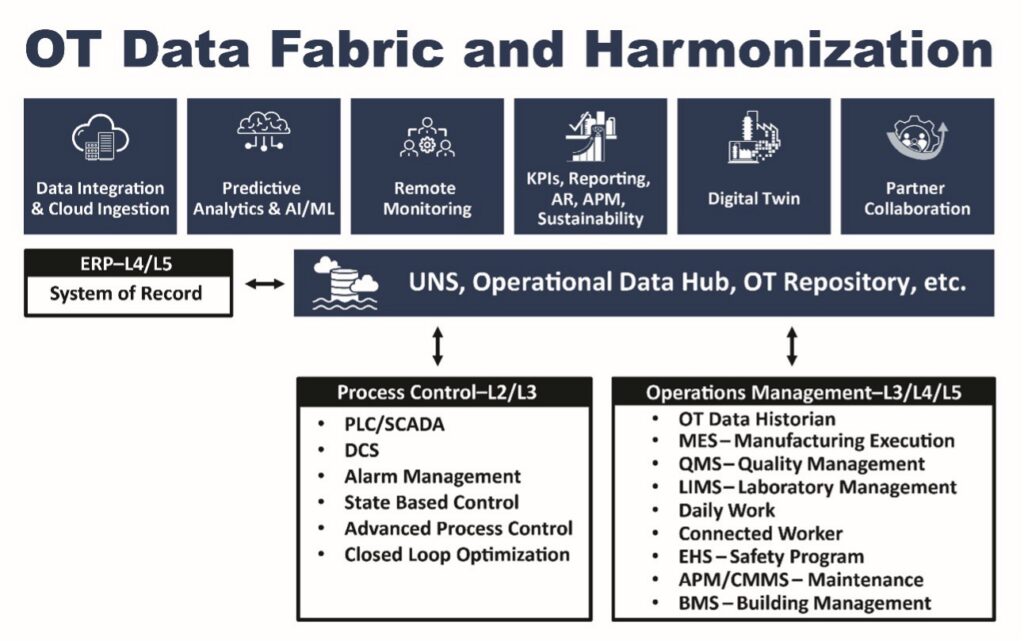
Companies often focus on UNS and its ability to provide context to OT data, enabling more relevant and enhanced visualization of manufacturing data at both the site and Enterprise level. UNS strategically provides an ISA-95 Enterprise/Control System Integration or similar framework for all OT data types (from every available OT data source) across manufacturing sites. This is what makes UNS valuable.
The race to further automate and digitalize will not slow down as manufacturers explore every possible pathway to optimize yield, remove manufacturing cost/waste, sustain/increase overall equipment effectiveness (OEE), reduce energy consumption, and leverage all their available data to make decisions more quickly and accurately. There are other ways OT data fabric provides an invaluable foundation for manufacturing performance by:
- Harmonization across all OT manufacturing software platforms and systems of record.
- A necessary element for AI readiness and robustness.
- Enterprise-wide diagnostic and security monitoring of every data connection and all data movement.
OT data fabric for harmonization of manufacturing software platforms
As an OT software stack proliferates, so does the need for OT data fabric. There has been an explosion of daily work and connected worker deployments across all industries. These platforms work in concert with other OT systems. Common examples include the need for data from an OT data historian to be visualized in a daily work platform, for a supervisory control and data acquisition (SCADA) to interoperate with a manufacturing execution system (MES), and for distributed control systems (DCS) to interoperate with field operations (connected worker).
A challenge is all OT platform types are built with their own data structure and naming conventions. OT data fabric comes to the rescue, enabling the creation of a modular, robust data integrations such that all of these systems freely interoperate, allowing data to be contextualized as needed to allow daily work, connected worker, manufacturing execution systems (MES) and other workflow platforms to make visible all work and issues that need to be addressed. This enables a step change in communication, collaboration and accountability across all teams.
Regardless of which workflow platforms are being leveraged, data fabric solutions enable robust interoperability by offering the following embedded functionality:
- ISA-95 framework (UNS)
- Distributed containerized architecture
- Telemetry through a wide variety of OT and IT protocols and connectivity options
- Scripting environment to allow for contextualization and logic creation
- Data persistence if/as required
- Bi-directional data movement
- Embedded data recovery options when any platform moves to offline/unavailable
- Redundancy options to ensure high availability.
OT data fabric for AI readiness
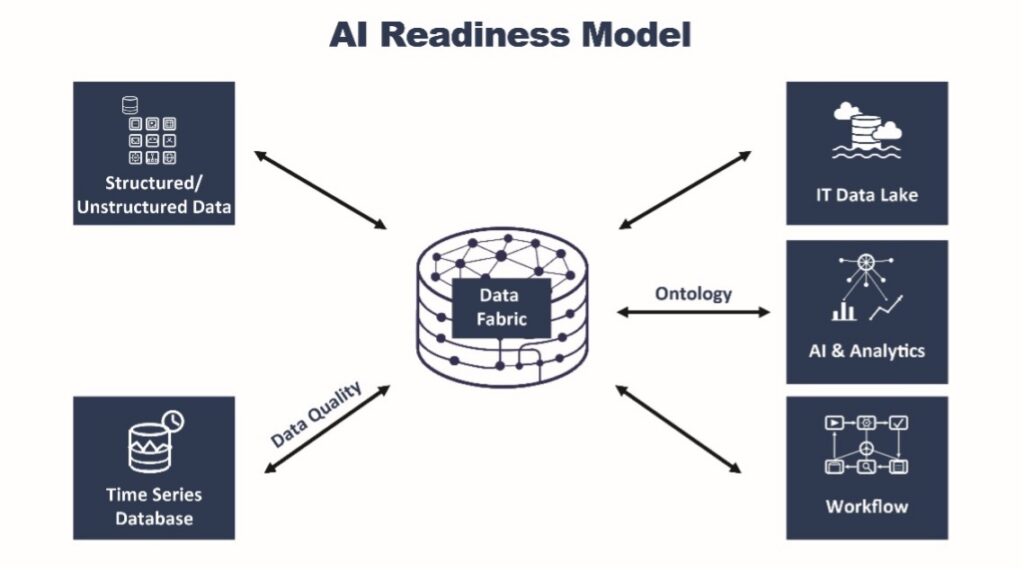
The journey to value realization from AI platforms begins with OT data fabric. As companies look to leverage large language models (LLMs) and agents for enhanced decision making and increased automation, it is crucial to provide mechanisms to teach LLMs how abstract data is related. This ultimately allows LLMs and agents to provide the best decision support possible.
OT data fabric provides the foundation and connectivity tissue that allows data quality, ontological, and analytics engines to work together in concert to help LLMs to reason and infer, doing so more quickly and reliably than humans.
OT data fabric for enterprise-wide data connectivity health monitoring
The transition from islands of automation to SCADA and/or DCS is analogous to what OT data fabric provides for the island of disparate data that typically exists throughout a manufacturing enterprise. OT data fabric not only allows the ability to see all data simultaneously, but it also allows the ability to manage and administer all data source integration, enterprise-wide, from a single location. Regardless of the mix of edge devices and servers in plants, private clouds, and any/all SaaS solutions being used, there is now an efficient way to monitor a data infrastructure from one location. It is expected that the deployed OT data fabric provides diagnostic and security monitoring of every data connection and all data movement throughout an enterprise.
The foundation for manufacturing performance
It is well known that transmitter and control valve performance are foundational for control loop performance, success with advanced process control, and ultimately optimized operator performance. In a similar manner, companies desire more from the investments they make in collecting manufacturing data. OT data fabric allows for a continued journey to fully leverage data to further automate and digitalize. All companies want to employ shiny analytics tools, LLMs, and agents to bring more value in concert with daily work, connected worker, MES, and other workflow optimization tools. OT data fabric will help to make these optimization tools effective and sustainable. How and why?
- OT data fabric delivers value beyond UNS by creating a scalable foundation for interoperability, governance, and enterprise-wide data management.
- Manufacturers cannot fully capitalize on AI, digitalization, or workflow automation without a robust OT data fabric that contextualizes and connects operational data.
- A well-designed OT data fabric transforms isolated manufacturing systems into a unified, monitorable ecosystem that improves visibility, collaboration, and decision-making.
John Hall is vice president, digital transformation, Novaspect. Edited by Tyler Wall, senior editor, Plant Engineering, [email protected].
Keywords
Unified name space (UNS), data fabric, system integration
Consider this
Does your OT data fabric contextualize and connect operational data?
You also might like
https://si.arrowfly.com/integrators/novaspect-inc
www.controleng.com/answers-examples-how-to-connect-data-with-data-fabric-software