
Air compressor boosters provide an efficient way to generate higher compressed air pressures without increasing demand on the entire air system. Oil-free technology further enhances reliability by delivering high-pressure air with zero contamination risk, making it ideal for modern industrial applications.

Compressed air is a crucial utility across the modern industry. Its versatility, cleanliness, and controllability make it essential utility across manufacturing, processing and service industries. From operating pneumatic tools and actuators to powering automation systems, material handling equipment, high‑precision testing and other industrial processes, compressed air enables reliable and efficient performance.
As industry demands higher pressures for specialized applications such as PET bottle production, aerospace component validation, leak testing and food packaging, among others, air boosters play a critical role by elevating plant air to higher pressure without requiring large high-pressure compressors.
This white paper explores the technology behind specific oil-free air boosters, their diverse application across industries and tangible benefits they deliver.
What is an Air Booster?
Air compressors are designed to take atmospheric air and compress it to certain pressure. Air boosters on other hand are designed to take pre-compressed air as inlet and compress it to higher pressure.
In short, compressor is a source of compressed air and booster is a pressure amplifier for existing compressed air.
While standard air compressors can typically deliver pressures up to 150 psig, many applications require significantly higher pressures, often exceeding 300 psig. This is where high‑pressure compressed air boosters come into play.
| Features | Air Compressor | Air Booster |
| Intake Air | Atmospheric air | Pre-Compressed Air |
| Pressure Range | Low to medium pressure (60–150 psig typical) | High to very high (300 to 5000 psig) 5000+ psig (special applications) |
| Installation | Central Plant | After Compressor or near point of use |
Key advantages of air boosters
When it comes to air booster, there are several key advantages.
Lower capital cost
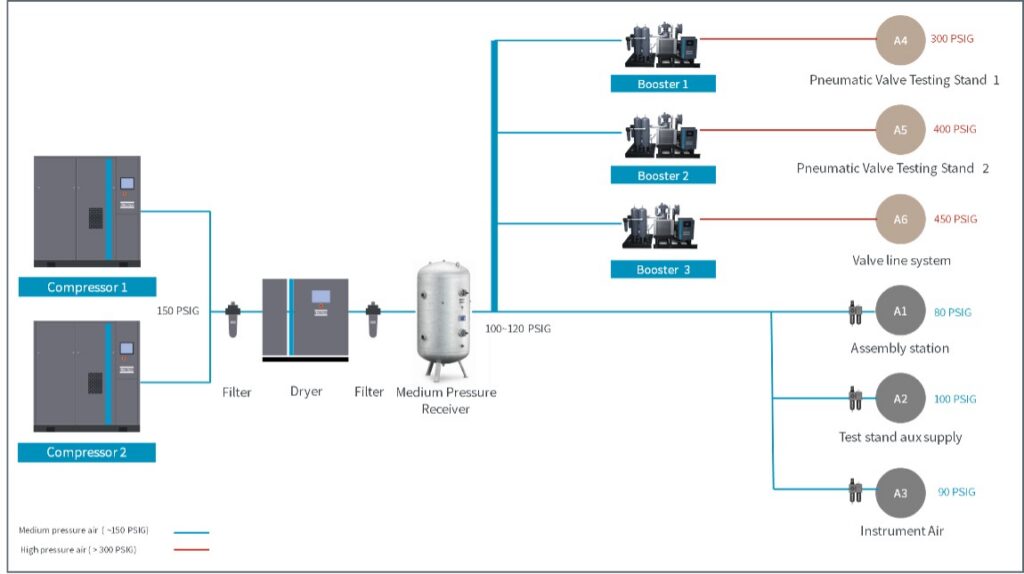
Instead of investing in a dedicated high‑pressure air system, air boosters can be installed at specific points where high pressure is required. This targeted approach significantly lowers overall CAPEX.
Energy efficiency
Plant compressed air systems are typically designed to operate at pressure up to 150 psig. As a rule of thumb, every 2-psig increase of pressure results in a 1% increase in energy consumption for a compressor operating at 100 psig. Higher pressure requires more energy and therefore more cost to compress air.
A booster-based system improves overall energy efficiency by boosting pressure only where it is needed rather than raising the pressure for the whole facility.
Return on investment
When compressing air from 0 psig to 400 psig, the compression ratio is 28.2 with single stage compressor. However, when compressing from 100 psig to 400 psig, the compression ratio is 3.6. A smaller compression ratio means relatively smaller equipment and lower operating cost.
Boosters increase productivity by providing high pressure air with optimized energy and cost of operation. This allows for quick return on investment compared to installing a higher capacity high pressure system.
Flexibility and scalability
Boosters are usually compact and require less space compared to dedicated high pressure air system. It can fit near point of use and can be decentralized as per the plant layout. Additionally, it can be easily integrated with existing medium pressure compressed air set up.

Also, multiple modular boosters can be installed depending on flow demand and load pattern.
Maintenance
Boosters have simpler maintenance routines compared to large high-pressure systems. It provides better uptime, extended service interval and less service cost. This reliability advantage ensures consistent high‑pressure delivery with fewer unplanned shutdowns, improving the overall stability and performance of the compressed air system.
| Advantage | Booster | Dedicated High Pressure System |
| Capex | Lower | Higher |
| Energy Use | Optimized | Higher* |
| Flexibility | High | Low |
| Scalability | Easy | Complex |
| Footprint | Smaller | Larger |
| Maintenance | Lower | Higher |
*If a dedicated high‑pressure compressor is used across the plant, including for medium‑pressure applications
Types of air boosters
Depending upon the oil lubrication system, boosters can be primarily categorized as: Oil-free and Oil-lubricated.
Oil-lubricated boosters can be used for higher pressures and with continuous duty. But on other hand, oil needs to be cleaned before the process, which makes it more maintenance prone.
Oil-free boosters provide clean air without risk of any contamination in the process. They can run continuously and boost air/gases to higher pressures. Usually, oil-free boosters are used to ensure clean compressed air is provided in sensitive applications such as food, pharma and electronics etc.
| Category | Oil‑Free Air Boosters | Oil-Lubricated Air Boosters |
| Air Purity | Delivers 100% oil‑free air and can meet ISO 8573‑1 Class 0 requirements for oil content | Oil carryover possible; air quality depends on filtration |
| Maintenance Requirements | Lower maintenance, Fewer consumables | Frequent maintenance, regular oil changes, oil filter replacement |
| Operating Costs | Typically, lower over lifecycle due to reduced maintenance and less filtration. | Lower upfront cost, but higher long‑term cost due to oil changes and filtration maintenance. |
| Suitable Industries | Food & beverage, pharmaceutical, medical breathing air, electronics, PET blow molding, aerospace precision testing. | General manufacturing, pneumatic tooling, mining, automotive non‑critical applications. |
The advantages of oil-free booster
Oil-free booster design eliminates the risk of oil contamination inside the compression chamber. Below image shows that crank case is oil-lubricated which provides lubrication to bearings and other moving parts. The compression end is completely separated from the oil lubricated end by the distance piece.
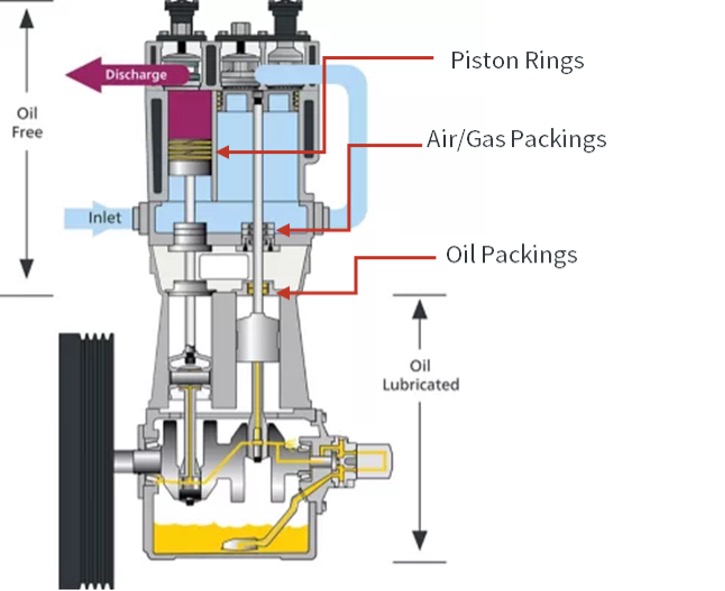
Specially designed oil packings ensure the oil stays within the crankcase. Gas packings are used to seal the air/gas in the oil-free compression zone. Gas specific piston ring materials in compression end do not require lubrication. This unique construction provides oil-free compression with 100% duty cycle for demanding applications.
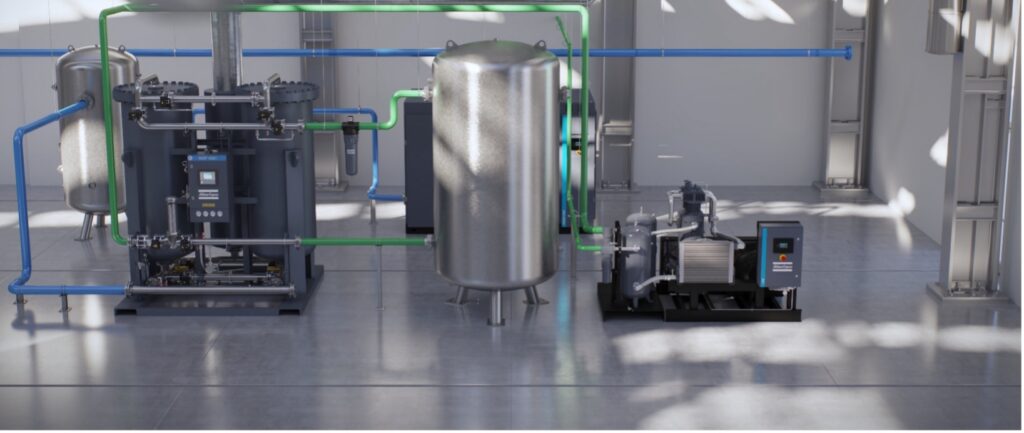
Air boosters provide a practical and effective approach to supply a high-pressure air without redesigning entire compressed air system. By delivering high pressure only where it is required, boosters help facilities adapt to specialized processes, support production flexibility and expand capability as operational needs evolve.
Oil‑free booster technology builds on these advantages by ensuring pressure amplification can be achieved without introducing contaminants into sensitive applications. This allows industries to maintain cleaner processes, streamline downstream air treatment, and meet stringent process requirements.
Air boosters, particularly with oil‑free technology, enable facilities to increase pressure capability, broaden application range, and support cleaner, more adaptable compressed air operations.