Our experts deliver must-have advice for variable frequency drives and variable speed drives.
VFD and VSD insights
- Variable frequency drives (VFDs) and variable speed drives (VSDs) can offer several advantages to the manufacturing floor.
- There are ways in which drive manufacturers are making VFDs and VSDs more plug-and-play for original equipment manufacturers (OEMs).
- VFDs can maximize efficiency and minimize energy usage in plants.
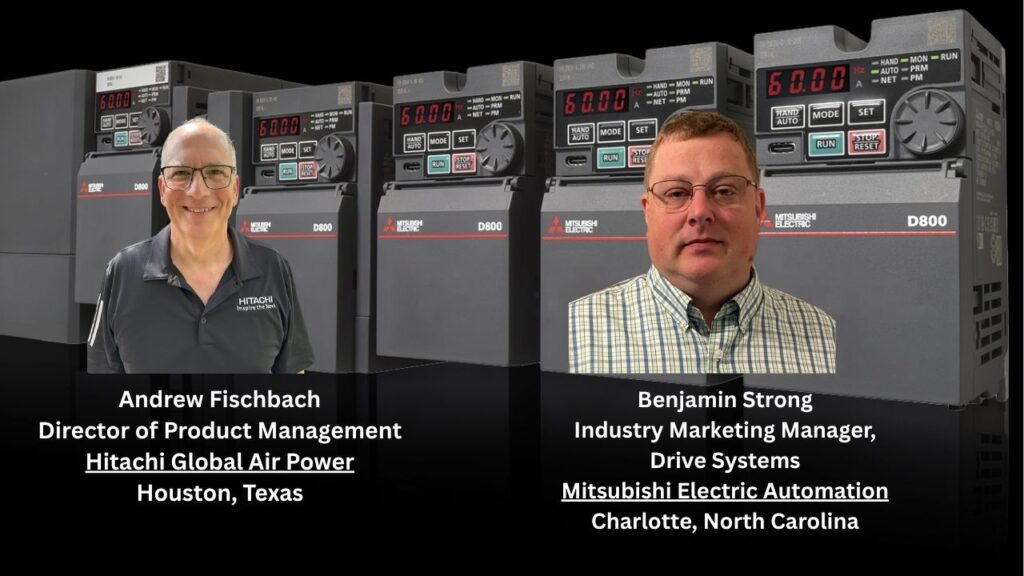
Trends in variable frequency drives (VFDs) and variable safety drives (VSDs)
What are the latest trends in variable frequency drives and variable safety drives?
Andrew Fischbach: The market is moving toward using permanent magnet motors to further drive efficiency. These are more efficient than traditional induction motors. They are becoming standard, and they require VFDs to operate.
Benjamin Strong: Expanded support for permanent magnet (PM) motors including micro drives.
What are the emerging trends you’ve seen in VFD interface and user experience (UX)?
Benjamin Strong: Internet of things (IoT) methods used to collect and display data directly from variable frequency drives (VFDs), rather than thru programmable logic controllers (PLCs). VFDs with integrated artificial intelligence (AI) are reducing time required to diagnosis VFD problems.
What advantages is your organization seeing from VFDs or VSDs?
Benjamin Strong: PM motors like electromechanical actuator (EMA) motors are replacing vector motors, accomplishing position or low-speed, high-torque applications without encoders.
Andrew Fischbach: The biggest advantage is efficiency/energy savings. Rotary screw air compressors are positive displacement machines and with added VFD technology, the compressor’s capacity is directly proportional to the speed of the air compressor. As the machine speeds up, it delivers more air and needs more power, and visa-versa. Given its flexibility to meet higher and lower desired output, in some instances, a VFD can save the end-user considerable money on their power bill.

How are new VFDs and VSDs improving motor efficiency beyond the International Electrotechnical Commission’s IE4 standards for manufacturing?
Andrew Fischbach: In certain applications, the isentropic efficiency of a compressor driven by a VFD and an IE4 motor can exceed the energy efficiency rating of a compressor that only uses an IE4 motor. A VFD will not directly improve IE4 motor efficiency, however, at part load conditions a compressor’s isentropic efficiency can be improved by using a VFD.
Benjamin Strong: Our customers are using PM motors with higher pole counts to direct drive loads like fans, eliminating gearboxes and improving system efficiency and performance.
How are drive manufacturers making VFDs more plug-and-play for OEMs?
Benjamin Strong: We are eliminating the “plug” in plug-and-play, allowing our customers to proceed directly to “play” by offering multi-Ethernet protocol drives. This eliminates the need to plug in separate field bus or network cards. Adopting CiA402 profiles on the drive side speed up implementation of VFDs on the control side.
Andrew Fischbach: Some drive manufacturers are offering an integrated drive and motor package which reduces the need for separate components and wiring. Also, the VFD manufacturers offer pre-programmed drives that allow for a faster installation and commissioning process.
How are manufacturers customizing VFDs or VSDs for specific use cases?
Andrew Fischbach: Hitachi Global Air Power selects the most effective motor and drive combination for the required pressure and flow requirements.
Benjamin Strong: Mitsubishi Electric VFDs come with many application-specific functionality built into the drives. These easily configured functions are paired with pre-built human-machine interface screens that our users quickly modify to their needs.
What’s driving the growth of VSDs in low-voltage versus medium-voltage markets?
Andrew Fischbach: Quite simply, there are far more 200 to 480V motors in use than higher voltages and therefore more companies compete in the low voltage space. In addition, there are fewer electricians qualified to work on medium voltage systems. Since fewer manufacturers offer drives above 600V, and more electricians compete at 200 to 480V, the cost of implementing the drives is higher. Very few, if any, medium-voltage inverters are available. To use a VFD on a medium-voltage supply would require a transformer.
Benjamin Strong: Low-voltage drives are easier to implement, and there is a larger number of potential suppliers.
How have VFDs contributed to reducing mechanical wear and tear on motor-driven systems?
Benjamin Strong: VFDs allow our customers to transition between unloaded to loaded states smoothly without shocks or larger disturbances to the mechanical or hydraulic systems.
Andrew Fischbach: A standard induction motor started by a full- or wye-delta starter can usually be started only six times per hour. The top causes of induction motor failure are motor bearings and windings. Every start imparts a considerable load onto the motor bearings and windings which can lead to premature failure. Conversely, a VFD motor can be started a virtually unlimited number of times, and the starts have a slower ramp up time which saves wear and tear on motor bearings and windings.
What factors do you consider when selecting a VFD for a specific application?
Andrew Fischbach: We consider many factors when selecting a VFD for an air compressor, including optimizing system efficiency, vendor technical support, ease of installation and use, warranty and cost.
How can a plant integrate PLCs or SCADA systems into VFDs for automation? What are the benefits?
Benjamin Strong: Facilities are using our solutions to minimize large VFD power consumption earn power company rebates during energy peak times.
What role do VFDs play in your facility for optimizing variable load conditions for sustainability?
Andrew Fischbach: Rotary air compressors are positive displacement machines whose capacity is directly proportional to the speed of the air compressor. As the machine speeds up, it delivers more air and needs more power, and visa-versa. Since most air compressors are used at a 70% duty-cycle, a VFD driven compressor motor can save the end-user considerable money on their power bill, thus reducing the amount of carbon needed to generate electricity. In addition, when sized and operated properly the VFD-driven air compressor can deliver a more constant pressure to the factory in a more efficient manner than a fixed speed machine that relies on a wide pressure band for control.
Sustainability Trends
How are VFDs helping manufacturers meet carbon reduction or environmental, social and governance (ESG) goals?
Benjamin Strong: Our focus is on reducing the number of times a VFD must be replaced over the life a machine, leading to a reduction of electronic waste generated. Add this to operating pumps at the best efficiency point, returning regenerative energy to the grid and reduced energy consumption at startup, and VFDs are in integral part of carbon footprint reduction.
How are electrification trends in industrial systems impacting VFD demand?
Benjamin Strong: Demand for VFDs will continue to grow, mirroring the growth of data centers in North America.
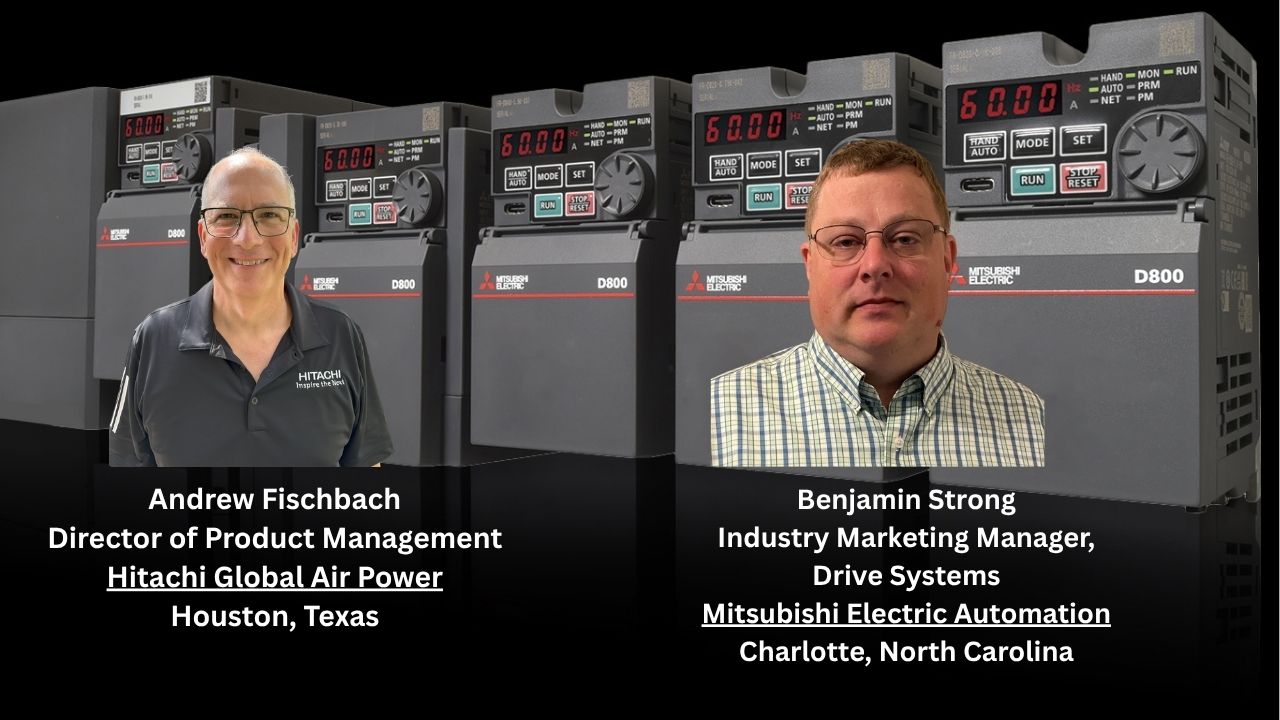
Benjamin Strong is the industry marketing manager, drive systems with Mitsubishi Electric Automation.
Andrew Fischbach is the director of product management with Hitachi Global Air Power.