
A new maintenance report reveals how gaps in preventive maintenance, technician knowledge and software adoption can undermine equipment reliability and increase unplanned downtime.

Maintenance insights
- Teams complete just 54% of scheduled preventive maintenance.
- 74% report critical assets that only one employee knows how to repair.
- Only 39% of teams consistently use their CMMS.
Manufacturers have invested in maintenance software, predictive technologies and equipment data. Yet many maintenance teams still struggle with a fundamental challenge: completing planned work consistently while preserving the knowledge needed to keep critical assets running.
Findings from Limble’s The State of Maintenance Report suggest that the biggest reliability challenges are not simply technological. They are rooted in how maintenance work is scheduled, performed, documented and shared.
The September 2026 report draws on a survey of 686 U.S. maintenance and operations professionals, including leaders, technicians and frontline employees.
Planned maintenance remains a challenge
Maintenance teams may aspire to predictive operations, but execution often falls short. Leaders surveyed estimate that their teams complete just 54% of scheduled preventive maintenance.
The consequences extend beyond deferred work. Nearly half of maintenance leaders report at least 10 hours of unplanned downtime in a typical month, while 24% report more than 20 hours. Four in 10 estimate that annual downtime costs their organizations at least $100,000.
These findings point to an opportunity for manufacturers to examine the conditions that prevent planned work from getting done, including competing priorities, approval delays, parts availability and incomplete asset information.
Technicians need more time to maintain equipment
The report also highlights how administrative and operational barriers limit hands-on work. 62% of technicians say they spend three hours or less performing maintenance during a typical shift.
Among the obstacles respondents identify are waiting for approvals (51%), incomplete or outdated asset records (41%), difficulty finding parts (40%) and software that is hard to use (35%).
For plant leaders, improving reliability may require more than adding maintenance tasks or purchasing new tools. Streamlining workflows and making accurate information accessible where work takes place can help technicians spend more time addressing equipment needs.
Critical knowledge can leave with employees
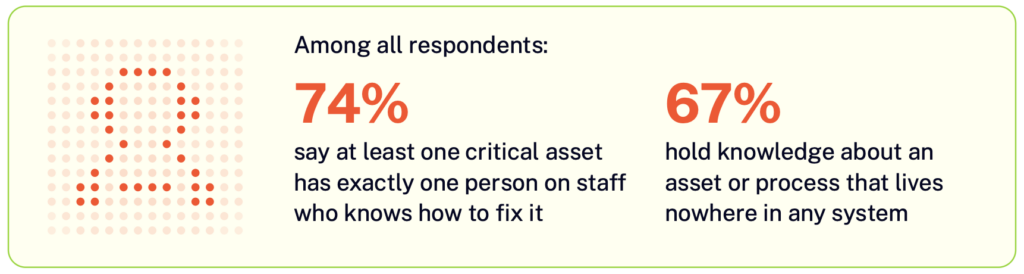
Workforce knowledge presents another risk. 74% of respondents say at least one critical asset depends on a single employee who knows how to repair it. Meanwhile, 67% say asset or process knowledge is not captured in a system, and 47% report losing maintenance knowledge when an employee leaves.
Documenting troubleshooting steps, repair history and work-order findings can reduce reliance on individual memory. It also gives newer technicians a stronger starting point as experienced employees retire or move on.
John Rimer, CFM, Vice President of Professional Services, Limble, states that “One of the biggest challenges is a lack of internal resources and expertise. Collecting accurate, comprehensive asset data takes significant time, and most maintenance teams are already stretched thin.”
Technology works only when teams use it
Although 82% of respondents say their organizations use a computerized maintenance management system (CMMS), just 39% report consistent use across the entire team.
Training gaps, limited field usability and software that takes longer than existing workarounds can undermine adoption. That matters because reliable maintenance data supports planning, performance measurement and decisions about where to focus resources.
Artificial intelligence may offer additional support: 55% of respondents say they use AI in some form. However, 92% agree that AI requires good, complete maintenance data to be effective.
Focus on execution first
For manufacturers seeking better asset performance, the findings suggest three priorities: remove barriers to completing planned work, capture equipment knowledge before it disappears, and make maintenance systems practical for technicians to use consistently.
Advanced analytics and AI may help improve decisions, but neither can compensate for missing records or inconsistent processes. Sustainable reliability begins with disciplined execution on the plant floor.
