
Artificial intelligence (AI) and machine learning (ML) are integral to industrial plant engineering, particularly in asset-intensive sectors such as power generation, chemical processing, refining and advanced manufacturing.

Learning objectives
- Attain a basic understanding of industrial artificial intelligence/machine learning (AI/ML) core concepts such as ML types and algorithms/models.
- Learn about common data sources and applications for ML.
- Understand a case study ML model application for vibration monitoring bearing failure prediction on paper machine rolls as compared with a human analyst for a seven-year vibration database with multiple recorded failures.
Industrial engineering insights
- Artificial intelligence (AI) and machine learning (ML) require special organizational and technical considerations.
- ML relies on high-quality data to perform at its best.
- ML-based systems adapt to changing feedstocks, environmental conditions and equipment states.
Industrial plant engineering has historically relied on deterministic models, first-principles analysis and human expertise to design, operate and maintain complex production systems. But these foundational approaches are being outpaced by the scale, complexity and data intensity of modern industrial facilities.
The data volume from wireless vibration sensing has exceeded the limits of manual and rule-based data analysis for decision-making. Large volumes of operational and maintenance data are generated from sensors embedded in rotating equipment, distributed control systems (DCS), process historians, computerized maintenance management systems (CMMS) and enterprise resource planning platforms. Artificial intelligence (AI) and machine learning (ML) offer mechanisms to digest and transform this data into actionable insight.
ML models are applied tools in narrow use cases that support asset reliability, process stability, energy efficiency and safety. True AI has not yet achieved the same acceptance for engineering uses, but generative AI applications in nuclear plant relicensing documentation are growing rapidly and others will follow. When properly implemented, AI and ML will augment engineering judgment, advising users through agentic AI advisors using causal analysis products that enable earlier fault detection, improved root-cause analysis and optimized operational strategies.
Integrating AI and ML into an industrial engineering setting requires practical application. Plant managers will need to understand key concepts and common algorithms to address the organizational and technical considerations required for sustainable adoption of AI and ML in heavy-asset industries.

Artificial intelligence in an industrial context
AI refers to computer systems capable of performing tasks that normally require human intelligence and is often confused with machine learning. But they have separate meanings. AI concerns reasoning, learning and autonomous decision-making, while ML is usually concerned with pattern recognition and learning. In industrial environments, AI systems typically operate within defined boundaries called guardrails and support specific engineering or operational objectives rather than exhibiting generalized intelligence.
Examples of AI capabilities in plant engineering include:
- Automated fault detection and diagnosis
- Anomaly detection in process variables
- Decision support for maintenance planning
- Optimization of control setpoints
These systems are often embedded within existing operational technology platforms, such as advanced process controllers and condition monitoring systems. Digital twins are configured from available data models of existing physical systems and may be used in design engineering or operational analysis exercises.
Machine learning as a subset of AI
Machine learning is a subset of AI focused on algorithms that learn patterns from data rather than relying solely on programming. In industrial plant engineering, ML models learn relationships between inputs such as vibration, temperature and pressure and outputs such as equipment health, product quality and energy consumption.

ML is particularly valuable in environments where:
- Physical models are incomplete or complex
- Equipment behavior changes over time due to wear or fouling
- Multivariate interactions obscure root causes
Machine learning paradigms: Supervised, unsupervised and reinforcement learning
ML can be trained under three different paradigms –– supervised learning, unsupervised learning and reinforcement learning.
Supervised learning
Supervised learning uses labeled data with historical examples (where outcomes are known) to train predictive models. In industrial settings, this often includes failure histories, maintenance records or quality outcomes.
Common applications:
- Remaining useful life estimation
- Failure mode classification
- Quality prediction
Typical algorithms:
- Linear and logistic regression
- Random forests
- Support vector machines
- Neural networks
Unsupervised learning
Unsupervised learning identifies patterns in unlabeled data. This is particularly useful in industrial environments where failure events are rare, but large volumes of normal operating data exist.
Common applications:
- Anomaly detection
- Process state clustering
- Baseline behavior modeling
Typical algorithms:
- k-means clustering
- Principal component analysis (PCA)
- Autoencoders
Reinforcement learning
Reinforcement learning involves agents that learn optimal actions through interaction with an environment, receiving rewards or penalties based on performance. While still emerging in heavy industry, RL shows promise in control and optimization problems.
Potential applications:
- Advanced process control optimization
- Energy management
- Autonomous operational decision-making
Data foundations for AI and ML in industrial plants
AI and ML performance is fundamentally constrained by data quality and contextual integrity. Industrial plants typically draw from multiple data sources:
- Sensors and instrumentation (vibration, temperature, flow, pressure, PH,)
- Control systems (DCS, PLC)
- Asset systems (CMMS, EAM)
- Laboratory reports and quality testing documents
- Operator logs and narratives
For ML models to be effective, data must be contextualized or linked to assets, operating states, process conditions and maintenance events.
Key ML applications in plant engineering
There are core areas in which ML is particularly effective in plant engineering. These include:
Predictive maintenance is one of the most mature and impactful applications of ML in industrial engineering. By analyzing condition monitoring data, ML models can detect early degradation patterns long before functional failure occurs.
Benefits include:
- Reduced unplanned downtime
- Optimized maintenance intervals
- Improved spare parts planning
- Enhanced safety
ML complements traditional reliability tools such as vibration analysis, oil analysis and thermography by identifying subtle multivariate patterns that may be invisible to single-parameter thresholds.
Process optimization and control
AI and ML models can analyze thousands of process variables simultaneously to identify optimal operating regions. Unlike static control strategies such as setpoint alarms, ML-based systems adapt to changing feedstocks, environmental conditions and equipment states.
Applications include:
- Yield optimization
- Energy efficiency improvement
- Throughput maximization
- Emissions reduction
These systems often function as advisory layers, providing recommended setpoints that operators or control systems validate before implementation.
Energy management and sustainability
Energy costs represent a significant portion of operating expenses in industrial plants. ML models can forecast energy demand, optimize load distribution and identify inefficiencies across equipment and processes.
Applications include:
- Boilers, heat recovery steam generators and turbine optimization
- Demand response strategies
- Carbon intensity tracking
Such capabilities align AI adoption with broader sustainability and decarbonization objectives.
Safety, risk and abnormal situation management
ML-based anomaly detection can identify deviations from normal operating conditions that precede safety incidents. When integrated with alarm management and operator decision support systems, AI can enhance situational awareness without overwhelming personnel with nuisance alarms.
Industrial AI models should support human engineering judgment. Subject matter expert (SME) Engineers provide contextual understanding, failure mode knowledge and ethical oversight that AI algorithms lack.
Effective AI systems:
- Provide explainable outputs
- Integrate with existing workflows
- Enable engineers to validate recommendations
Explainable AI techniques are particularly important in regulated industries, where transparency and auditability are essential.
ML implementation challenges and best practices
ML is only as good as the data provided. Therefore, it’s critical to consider certain challenges and best practices when implementing ML in industrial applications.
Poor data quality remains the primary barrier to successful AI initiatives. Sensor drift, missing data and inconsistent asset hierarchies can significantly degrade model performance.
Best practices include:
- Standardized asset taxonomies
- Robust data validation processes
- Clear ownership of data stewardship
Organizational readiness
AI adoption is as much a cultural transformation as a technical one. Engineering teams must trust the models, understand their limitations and be trained to use them effectively. Therefore, Leadership plays a critical role in:
- Setting realistic expectations
- Aligning AI initiatives with business objectives
- Investing in workforce capability development
Model life cycle management
Industrial ML models require ongoing monitoring, retraining and validation as equipment and processes evolve. Without governance, models may silently degrade, leading to inaccurate recommendations.
Advanced industrial users refine data with machine learning to segment, classify or predict results. The idea is to have the system use automated statistics to do the things that humans do not have the bandwidth to do, but at which computers excel. The overall process consists of six steps: Load data, build the model, register the model, deploy it, monitor alerts and then retrain and run new experiments.
One way to gain insight to data is to query it and today’s AI/ML systems can be trained using models that use a large language database. These models are typically trained on very large datasets, such as the entire content of the internet. These models can and do generate errors, so in our industrial case the large-language model (LLM) used is limited to the information available for the asset or system, including the failure modes and effects analysis history and documented functional failures.
By using a copilot, an AI-generated agent, one can query the model and ask for predictions and can pin the results into dashboards with real-time data updates. This allows predictive analysis on the fly with information previously unavailable in real-time. Where uses previously had to find, discover, analyze and document on their own, (a slow process) they can now use the power of pre-trained generative models constrained to a known body of knowledge about equipment, systems and processes.
ChatGPT is notation for a generative pretrained transformer, which can be queried and used by simply typing a question or statement to prompt some response from the LLM. The chat portion comes from the use of text chat style boxes for the prompt.
Imagine how efficiently the system can be implemented using piping and instrumentation diagram and other information sources for the system and how much knowledge capture can be accomplished and made available to future engineers and maintenance folks. Today’s AI/ML systems are just beginning to scratch the surface of using tools like knowledge graphs and LLMs to guide and inform people to make the right decisions at the right time.
A knowledge graph is an infinite network diagram canvas, used for rapid systems and equipment analysis and insights. Links to summary information, health scores, alerts, meta data and analytics are provided for end users.
Knowledge graphs allow users to drill down to systems or assets of interest and query, using a chat-style interface, the underlying data structures. For the example shown here the boiler feed pump (BFP) is reporting a health score of 74% based on the measurements from the instrumentation contextualized to the BFP asset. An alert has been thrown, and the next step would be to check which contributing factors are triggered, either singly or in combination, to provide an insight based on the failure mode. If a Failure Modes and Effects Analysis (FMEA) report exists, the KG can use it to generate an accurate alert with causal probability. This is a great way to capture existing tribal knowledge about the processes and machinery assets in a plant.
After repairs, the health score should rise if the correct repairs were, in fact, done. Each system user can then have a personalized dashboard of the trended data pertinent to their responsibilities.
Paper machine roll bearing vibration monitoring use case
Up to now, only single-point-value time series data has been considered. These data sets are comprised of amplitude data only, typically called a scalar value recorded over time. Vibration data is dynamic and has both amplitude and phase information, so it is a vector. This added layer of complexity adds significant cognitive load to the analysis of vibration data, which is often overlooked by analysts and simplified into single point trends of component frequencies. This use case will present 15 vibration factors from both the time and frequency domains that were used in this analysis on each measured vibration data point. The data was collected monthly, over a seven-year period, in the axial direction on several 22-foot-long paper machine rolls.
Research and testing show that machine learning and classification may be applied to relatively small real-world vibration data sets on industrial machinery, in this case a paper machine in northern Louisiana.
The data set was taken from six paper machine dryer rolls, five of which were used to train and validate the model and one was held out for testing. A total of 30 machine learning models were evaluated using the MATLAB Classification Learner (CL) app, each with five-fold validation. Five of the models (SVM Coarse Gaussian, K-Nearest Neighbors (KNN) weighted, neural network (NN) Trilayered, KNN Cubic and KNN Medium) performed well (the last four were 90% test accuracy) for their extracted feature sets. One model, the SVM Coarse Gaussian, tested at 100% accuracy with six features included and nine excluded, classifying the test data set correctly into operational and degraded classes. The reason some features are excluded is that they do not add any additional information for correct classification prediction, so to prevent over-training on the data and wasting precious computer clock cycles, it is advantageous to limit the factors to only those that result in good scores.
Classical machine learning algorithms
Artificial Neural Networks, PCA and SVM have been used for decades. These shallow machine learning methods require deep exploration of a data set and perhaps dimension reduction for extracting features. Because the knowledge base of different applications may require specialized expertise within each industry or field, garnering appropriate features and transferability of machine learning models may be challenging for generalizing to other bearing applications in other industries. For this study, many machine learning classification models are available through the MATLAB Classification Learner (CL) app. Thirty ML models were run for training, validation and test on the limited data set for paper machine dryer rolls.
Machine learning (ML) requires dense data sets, in terms of both temporal and diverse machine condition indicators. This project was conceived to determine if classifications of operational and degraded bearing condition could be properly classified from a limited data set of only one machine condition indicator, vibration data. Typical vibration data used for analysis comes from a dynamic vibration waveform digitalized at high speed. The digitized waveform is then transformed to the frequency dimension via the Fast Fourier Transform (FFT) to identify embedded sinusoidal waveforms as frequency peaks and then multiple single points of temporal data are trended, which can come from either the FFT or waveform data.
The plan for the project was to first acquire the data set, then extract the 15 identified features to be used in ML Model development (training, validation and testing) and finally to determine if a reduced set of features would perform better or worse than the full set of features on the test data set. Once the best five models were identified, they were used to generate MATLAB code for future use, modification and improvement by reliability engineers in the paper industry. The full report can be made available for interested parties.
Next, a series of 15 Features was extracted from the waveform and spectral data for use in the CL app in MATLAB version 2021b. The data was preserved in spreadsheets and imported into the CL app for training, validation and testing. A total of 86 observations were recorded, and the percentages of operational and degraded condition classes was calculated at 53% operational and 46% degraded. Ten data sets were randomly removed from the list of 86 with the same percentages, so five operational and five degraded observations were held out for testing, and the features were preserved in a separate tab in the spreadsheet. Percentage accuracy data for both the validation and testing events were examined for the 30 analytic models trained, validated and tested.
To determine the features from the waveforms and spectral data, a 2014 paper, “Remaining Useful Life Prediction of Rolling Element Bearings Based on Health State Assessment”, was presented at the annual conference of the Prognostics and Health Management Society. It specifies a statistical feature set for time-domain and frequency domain data of some 33 separate features.
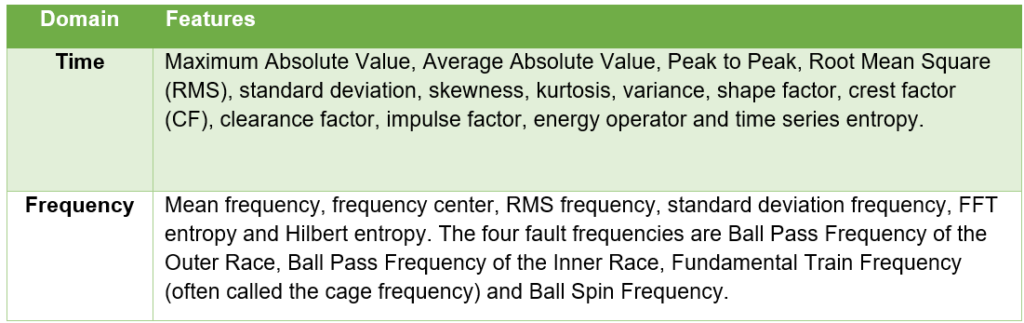
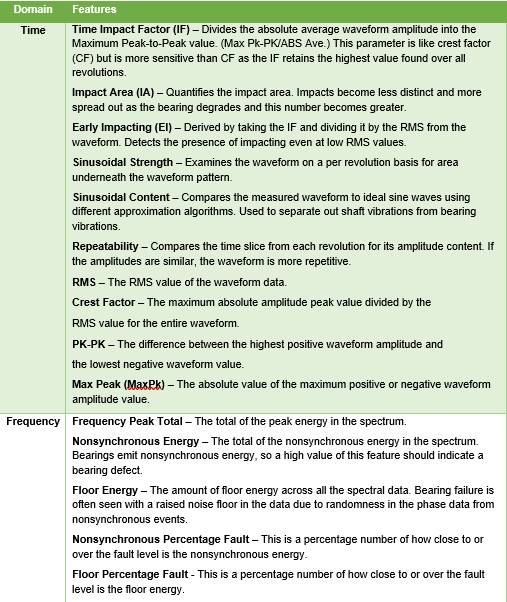
Fifteen of these features were used in this analysis and research, because not all 33 features were required for this analysis. The features used are listed below with a description of the calculations:
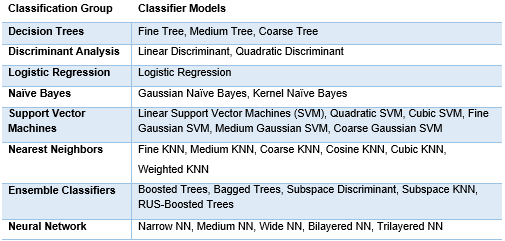
The CL app in MATLAB supports 30 different models for testing.
Thirty models were considered appropriate for this project. A convenient function of the CL App was the ability to test and evaluate all models sequentially and quickly. After training, the Receiver Operating Characteristic (ROC) and Area Under Curve graphics could be displayed for the validation and testing events for all models. Also available are confusion matrices and scatterplots for the various combinations of classes and features, respectively.
After the determination of the feature set and garnering the specific values for the fifteen individual features, the spreadsheet of the values for each feature for all six of the available paper machine rolls were loaded into the CL app, less the 10 observations held out for testing. The last column of the spreadsheet housed the two classification values, operational –– or no significant defect –– and degraded –– where a significant bearing defect was present.
In the real world, the added risk of operating a paper machine to absolute bearing failure may result in catastrophic damage to the rolls and the machine. Therefore, the ‘Failed’ classification was dropped from the analysis as a result and only two classifiers were used in the final project procedures, operational and degraded.
Five models were selected from the test results data: SVM Coarse Gaussian, KNN Medium, KNN Cubic, KNN Weighted and NN Trilayered. These models were selected because they have the highest test accuracy of all models using the fewest features.
The SVM Coarse model did not score highly on the training and validation test accuracy at 75% yet had the highest overall performance that increased to 100% test accuracy with nine removed features: Federated Learning with Rare Features (FLR), Nonsyncronous, PKTot, MaxPK, CF, sinusoidal content, early impacting and repeatability. No other model achieved a 100% test accuracy rating, but all the neural network models achieved a 90% test accuracy rating for various feature removal combinations.
For example, NN Tri-layered scored 86.8% for six removed features of Federated Long-tail Recommendation Framework, Nonsynchronous, Pharmacokinetic Tree-based Pipeline Optimization Tool (PkTPOT), Max Pharmacokinetic (MaxPK) and Pharmacokinetic to Pharmacokinetic (PK2PK) and 90% test accuracy for the same removed features in the test data set. KNN Weighted performed at the same level as NN Tri-layered, with 86.8% training set classification accuracy and 90% test data classification accuracy.
KNN Medium performed well with 82.9% validation accuracy that resulted in a 90% test data set accuracy for classification. KNN Cubic also performed consistently with 84.2% training set accuracy and 90% test data set accuracy.
These five models are compared in the following table:
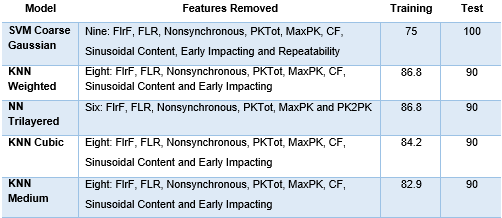
In the final analysis, the five selected models are working well for this limited data set. There is no guarantee of generalizing these models to bearing defects in other applications, but on this data set, accuracy scores over 90% are considered good and useable. In other words, there are five models that would give a 90% or greater chance of correctly classifying a bearing as operational or degraded.
The benchmark objective for this research was to match, within reason, when the human analyst called the bearing failed or degraded past normal operation, so this is an exercise in semantics only. For each roll, excellent records existed in the ‘Notes’ field for the trend, spectral and waveform data. The human analyst did a very conscientious job of recording these bearing failure progressions and while there was some variance in how long each bearing was subsequently run past the initial call, the five ML models with properly trained (not over-trained) data sets did a very respectable job in agreement with the timing for the repair decisions of the human analyst. Remember, the human analyst also has operating context that the vibration data alone does not have in the paper machine’s operation. The good news is that even with such limited data features and context, these models worked well enough to be of immense value to a human analyst.
AI and ML can enable modern industrial plants
AI and ML are powerful enablers for modern industrial plant engineering, operations and maintenance. By leveraging existing facility operations and maintenance data, AI and ML can enhance reliability, optimize processes, improve energy efficiency and strengthen safety performance. The key to the successful application of AI and ML models demands high-quality data, contextual understanding, advanced algorithms, disciplined governance and strong human-machine collaboration.
For plant engineers, operators, maintenance personnel and engineering leaders, the path forward is not to replace traditional engineering methods and operational paradigms, but to augment them. When AI and ML are integrated thoughtfully into existing reliability, maintenance and operational frameworks, they become catalysts for sustained operational excellence and long-term asset value creation.