
Through breakthrough advancements in technology, agentic AI systems are transforming worker safety by providing intelligent situational awareness and autonomous decision-making capabilities.

Learning objectives
- Understand how agentic AI systems differ from traditional safety approaches.
- Recognize the practical application of agentic AI in industrial environments for worker safety.
- Evaluate the real-world challenges and future potential of deploying agentic AI based safety systems.
Agentic AI insights
- Agentic AI architectures can fundamentally reshape safety management across energy manufacturing and grid operations.
- Dynamic safety perimeters and predictive capabilities can demonstrate measurable improvements delivering unprecedented worker protection while maintaining operational efficiency and regulatory compliance.
- As energy manufacturers and field operations workers face unprecedented risks and life-threatening hazards, it is critical to find ways to make the environment safe. This helps reduce safety incidents and save lives.
The energy sector confronts unprecedented safety challenges as workers navigate complex environments from manufacturing facilities, field operations and grid control centers to substations and distributed infrastructure. Agentic artificial intelligence (AI) systems deploy autonomous, collaborative AI agents that create intelligent safety perimeters, predict hazards before they materialize and coordinate real-time emergency responses.
The energy sector owns and operates heavy equipment, such as drilling rigs, compressors, pressure vessels, transformers, transmission lines, turbines and rotators and infrastructure that form the backbone of global industrial operations. While this heavy equipment powers energy operations across the globe, behind every piece of machinery stands a dedicated workforce working tirelessly to manufacture them. Ensuring their safety on the manufacturing factory floor is of paramount importance.
The energy sector has long grappled with one of the most challenging safety landscapes in industrial operations. From offshore platforms to nuclear facilities, from petro plants to renewable energy developments, field workers face an array of hazards that can change by the minute. Traditional safety management systems, while well-intentioned, often fall short of providing the real-time intelligence and adaptive responses needed to protect workers in these safety environments.
Technological advancements in agentic AI systems are fundamentally changing how energy companies approach worker safety. Unlike conventional AI applications that follow predetermined rules, agentic AI systems can reason through complex situation, interact with their environment and make autonomous decisions to protect human workers. These intelligent systems represent a quantum leap beyond traditional safety protocols for proactive risk mitigation.
This transformation is particularly critical given the concerning numbers in the energy industry. For example, in 2025, the Electrical Safety Foundation International (ESFI) compiled data from the U.S. Bureau of Labor Statistics (BLS) and the Occupational Safety and Health Administration (OSHA) to track electrical safety trends in the workplace. ESFI found that energy industry employees had a higher than average rate (0.1) of these fatalities per 100,000 workers. The manufacturing industry saw 355 workplace fatalities in 2024, according to data from BLS.
The role of agentic AI in industrial safety
Agentic AI systems differ fundamentally from traditional AI applications. While conventional AI models require extensive training for new scenarios, agentic systems can adapt to new situations in real-time. They function as autonomous entities that assess conditions, make decisions and execute actions with minimal human intervention that is critical in fast-changing industrial environments.
Multiagent systems — specifically multiple interacting agents — are a type of agentic system, where agentic emphasizes autonomous agency (see Figure 1).
Rather than relying on monolithic software applications or isolated monitoring systems, this architecture deploys multiple specialized AI agents each with distinct expertise, decision-making capabilities and operational autonomy that collaborate seamlessly to create a comprehensive safety ecosystem spanning manufacturing, grid operations and field services.
The architecture rests on distributed intelligence where responsibilities are distributed across specialized agents that each master a specific safety domain. Environmental monitoring agents track weather and atmospheric conditions. Equipment status agents interface with asset management systems and sensor networks. Grid operations agents monitor real-time system stability and power flows. Regulatory compliance agents ensure adherence to multiple overlapping frameworks. Emergency response agents maintain awareness of available resources and coordinate interventions.
Each agent operates semi-autonomously while maintaining constant communication with peer agents, creating a resilient network that continues functioning even if individual components experience disruptions.
Dynamic coordination occurs through a supervisor agent functioning as the orchestration layer. This supervisor analyzes incoming work orders and operational conditions, assesses overall risk profiles and delegates specific safety assessment tasks to appropriate specialist agents. Unlike simple routing systems, the supervisor synthesizes responses from multiple agents, identifies conflicting information, prioritizes critical warnings and presents field technicians and operators with coherent, actionable safety briefings (see Figure 2).

Real-time adaptability distinguishes multiagent systems from traditional rule-based approaches. Conventional safety systems operate on predetermined rules and static checklists that require manual updates when conditions change. Multiagent AI systems continuously ingest new data from weather services, equipment sensors, grid management platforms, incident reporting systems and regulatory databases. They dynamically adjust safety recommendations without requiring system reprogramming or human intervention.
These systems typically deploy multiple specialized AI agents working in sync. Each agent possesses distinct expertise, say environmental monitoring, equipment diagnostics, human behavior analysis or emergency response coordination. A supervisory agent orchestrates their activities, ensuring seamless collaboration and comprehensive safety coverage.
This collaborative architecture mirrors the strengths of human safety teams while operating at superhuman speed and scale. The result is a safety net that can process thousands of data points per second, recognize patterns humans might miss and coordinate responses across multiple systems simultaneously.
Using agentic AI in system design
Let’s walk through an example scenario and see how a multiagent system can prevent an incident from happening:
- Facility: Energy Equipment Manufacturing Plant
- Location: Industrial complex producing high-voltage transformers and turbine components
- Workforce: 847 field service technicians across three shifts
- Risk Classification: OSHA High-Hazard Category 1
One day, a senior technician with 17 years of industrial experience entered confined space zone 7-C to inspect a transformer coolant system. Three concurrent hazards converged:
- A scheduled but miscommunicated electrical maintenance window
- A structural vibration event from overhead crane operations
- An undetected sulfur hexafluoride (SF6) gas micro-leak from an adjacent bay
The technician survived but suffered severe damage from the incident. Traditional safety protocols had failed at every layer.
The energy manufacturing plant team consulted a tech company, and it designed a multiagent cloud based solution called safety agentic guard for them to work at all layers to prevent such incidents from happening in the future.
The overall goal after the event was to build an integrated, AI-driven industrial safety system that proactively prevents incidents rather than reacting after they occur. At the center of the solution is a main safety agent that coordinates a network of specialized agents responsible for adaptive perimeter control, environmental hazard detection, communication and response coordination, personal protective equipment (PPE) compliance, behavioral risk prediction, emergency response and procedure optimization.
Together, these agents are designed to improve situational awareness, reduce communication breakdowns, accelerate emergency action and strengthen compliance across the facility. The broader objective is to transform traditional safety management into a continuous, adaptive and intelligent safety ecosystem (see Figure 3).
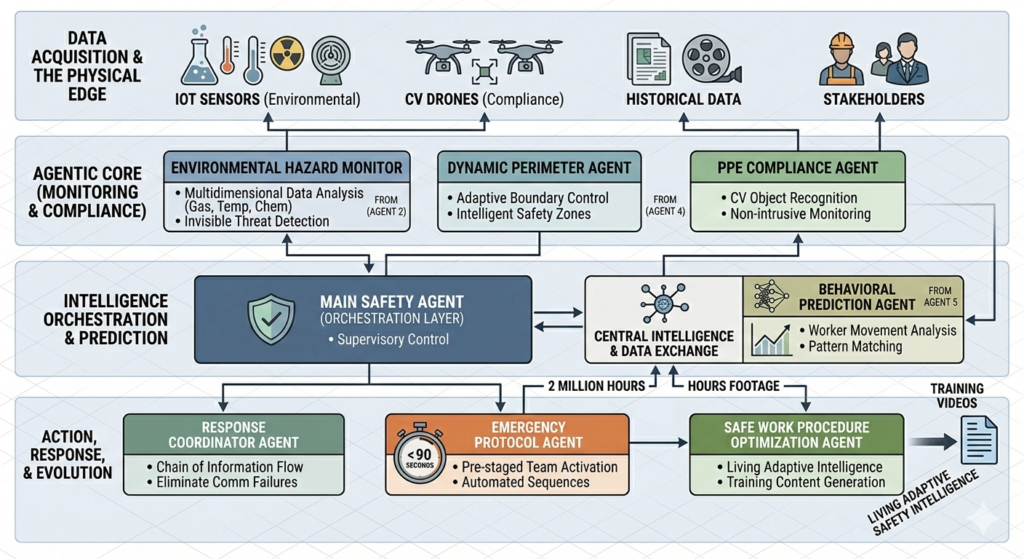
Six months after deployment, a safety agentic guard solution enabled a confined space inspection in zone 7-C to be completed safely through coordinated permit validation, environmental monitoring, PPE verification, standby emergency readiness and real-time communication.
During the task, the system detected an early SF6 increase, identified the adjacent source, confirmed that other staff could still finish within a safe operating margin and maintained continuous oversight until her safe exit with no incident. These results show that the multiagent system can proactively prevent failures, including the previously cited technician scenario, by detecting compound hazards early, enforcing lockout controls and broadcasting critical alerts to stakeholders within seconds.
Challenges to implementing AI in the real world
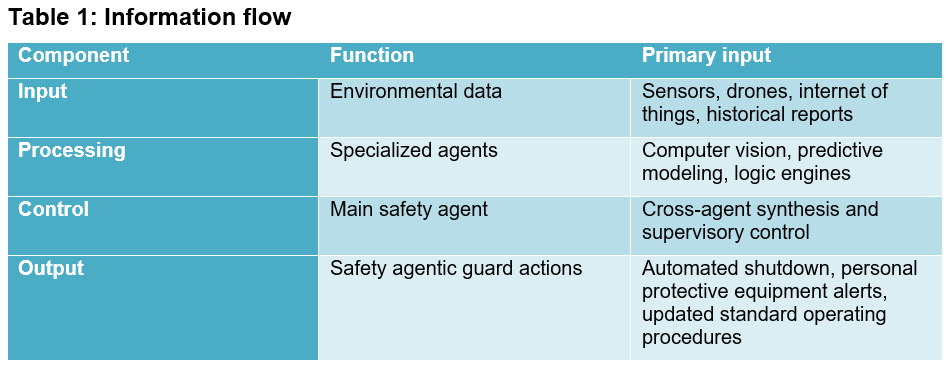
While this is exciting to have technical capabilities today to create safe environments for worker safety, there are challenges in making it real (see Table 1).
Cybersecurity challenges: The system faces critical vulnerabilities across multiple attack vectors: sensor spoofing could inject false gas readings, compromised machine learning (ML) models could produce incorrect risk assessments and unauthorized access could disable safety agents entirely. Biometric data collection for worker identification creates privacy concerns, requiring implementation of differential privacy techniques and federated learning to prevent unauthorized surveillance and ensure worker consent.
The integration of legacy systems (20-year-old safety records) introduces data quality issues and compatibility gaps that necessitate custom extract, transform and load adapters and parallel operation during migration.
Additionally, the behavioral prediction model trained on million hours of footage and years of incident data raises significant privacy and bias concerns: workers may feel under constant surveillance, requiring strict data minimization, transparency frameworks and role-based access controls. Communication system security must balance accessibility with protection: encryption is needed for all inter-agent communication, yet the emergency radio frequency (RF) system must remain air-gapped from the main network to prevent sabotage of critical alerting mechanisms.
Operational challenges: Real-world deployment demands sub-100 millisecond latency for the 90-second emergency response target, requiring edge computing via local processors for ML inference and dedicated emergency message queues to bypass normal data congestion. Drone operations in electromagnetically noisy industrial environments with steel RF-blocking structures necessitate costly indoor positioning systems, licensed spectrum for video links and 6-unit rotations for 24/7 coverage, making continuous monitoring financially intensive.
The system generates excessive false alerts initially (one alert every 30 seconds in early deployments), causing alert fatigue where workers begin ignoring critical warnings; this requires four to six weeks of threshold tuning through simulation validation and pilot programs with early adopters.
Regulatory compliance demands formal validation, simulation-based testing of hundreds of scenarios before production rollout and maintaining manual oversight to satisfy OSHA inspection auditors who question whether ML predictions alone constitute adequate “safety-critical” system design. Finally, sensor calibration drift (2% to 3% monthly degradation for SF6 detectors) and data integration from incompatible legacy systems create ongoing maintenance burdens requiring dedicated AI/ML operational engineers, certified drone pilots and continuous retraining of the workforce.
Expanding the safety envelope
As multiagent AI systems mature, their applications continue to expand into new domains that promise even greater worker protection. Augmented reality (AR) integration combines agent intelligence with AR headsets to provide real-time hazard visualization with virtual overlays showing energized equipment, safe approach boundaries superimposed on physical environment, step-by-step procedure guidance visible in worker field of view and remote expert support where experts see what field workers see without requiring travel to sites.
Autonomous safety inspections deploy robotic systems guided by AI agents for drone inspections of transmission lines and wind turbine blades, identifying damage without requiring workers to climb structures and ground robots entering confined spaces to verify atmospheric conditions and identify hazards before human entry. Predictive safety culture assessment analyzes communication patterns indicating safety culture strength, reporting behaviors showing willingness to identify hazards and organizational factors affecting safety performance, enabling proactive interventions to strengthen safety culture before weaknesses manifest as incidents.
Cross-industry learning connects agent systems across energy manufacturing, utilities, oil and gas and other high-risk industries to share safety insights and accelerate learning from incidents occurring anywhere in the broader industrial ecosystem. Grid resilience enhancement integrates safety systems with resilience planning to ensure that emergency response capabilities protect both workers and critical infrastructure during extreme weather events, black start procedures and system restoration under challenging conditions.
Agentic AI systems fundamentally transform industrial safety management by delivering real-time intelligence, predictive capabilities and autonomous response mechanisms that address longstanding worker safety challenges in energy manufacturing. Early adopters have demonstrated compelling results significant reductions in safety incidents, improved regulatory compliance and enhanced operational efficiency. This validates the transformative potential in agentic AI systems.
However, successful implementation demands comprehensive attention to technical architecture, cybersecurity, workforce integration and data quality, requiring organizations to balance technological advancement with human factors. As agentic AI continues evolving with emerging technologies like digital twins, augmented reality and natural language interfaces, the adoption question shifts from whether to implement these systems to how quickly companies can do so effectively.
Given that single incidents in energy manufacturing can result in multiple fatalities and millions of dollars in damages, agentic AI represents both a moral imperative and business necessity. Organizations that strategically embrace this transformation will not only provide more effective worker protection but also achieve competitive advantages through operational efficiency and regulatory compliance, ushering in a future where autonomous, intelligent systems fundamentally enhance safety across the industry.