
The adoption of artificial intelligence (AI) is accelerating and forward-looking teams must strengthen their data ecosystem and operational alignment today to prepare for the shift toward orchestrated, AI-enabled automation.

Learning objectives
- Understand the role of artificial intelligence (AI) in process manufacturing.
- Learn how data impacts the use of AI in process manufacturing.
- Discover the many types of AI models, data sources and agents and how they orchestrate to bring together otherwise fragmented AI capabilities.
AI orchestration insights
- Artificial intelligence (AI) will continue to proliferate in process manufacturing.
- AI will evolve from disparate software implementations to a core integration engine. This engine will connect different processes, applications and plants — converging point solutions into a holistic ecosystem that can make better use of the whole.
- Organizations must ensure they have the right data, efficient data architectures in place to keep it moving seamlessly to the people and applications that need it and contextualized it at every step of that process.
Artificial intelligence (AI) is one of the primary areas of focus in process manufacturing and for good reason. Many organizations are already implementing AI models and frameworks in their workflows.
In fact, a recent Massachusetts Institute of Technology’s Technology Review survey reported that 64% of manufacturers have already begun working with AI and of that group, approximately 35% have begun to put AI into production. Such a shift is hardly surprising given the challenges of competing in the modern marketplace.
Increased globalization, market fluctuations and regulatory uncertainty are combining with increasing demand and growing experienced workforce shortages to create a perfect storm of complexity. Maintaining competitive advantage means teams must not only achieve operational excellence but also maintain and evolve it.
As this complexity has grown, the maturity of consumer-grade AI has evolved in parallel. Large language models (LLMs) are significantly more powerful today than they were just a few years ago. Where once consumer-grade AI advisors were limited to data from 2021 and before, today’s LLMs and AI agents can orchestrate tasks, provide complex responses and search the web for updated content, feed that information into their models and generate a far more complex and reliable outcome. With this improvement, the number of use cases for AI has grown exponentially.
Like consumer-grade AI, industrial AI is also continually improving. However, operational technology’s (OT) need for uncompromising safety and availability create additional complexities for the use of AI. Despite these challenges, new industrial AI solutions — enhanced by contextualized data and protected by first principles models — will rapidly evolve, continuing to provide new opportunities for OT and driving the world toward an unimagined era of safety, reliability and autonomy.
Orchestration: pivotal for productivity and scale
Today, much of the popular AI software in use consists of isolated point solutions developed for specific tasks. In coming years, those solutions will become increasingly interconnected as multiple AI agents are applied in an OT context. To deliver peak value, however, these solutions will need orchestration, which will reduce the complexity exposed to users by providing coordinated workflow and task routing.
In OT, teams will have many different types of AI models, data sources and agents and they will need to deploy them in the right places and orchestrate them seamlessly to create as much value as possible. Orchestration will bring together otherwise fragmented AI capabilities, elevating operational intelligence to achieve autonomous operations.
Ultimately, this strategy is an evolution of something OT teams and their parent organizations have been trying to achieve for decades. Even before AI in the plant was a consideration, OT teams looked for ways to optimize the entire operation by first optimizing smaller units or pieces of equipment. Teams know they need each plant to operate as efficiently as possible independently, but also coordinated as part of a holistic, global enterprise.
This need has driven the digital transformation initiatives of the last ten years as teams looked for a way to build connectors and integrate disparate systems via a supervisory control and data acquisition (SCADA) system. However, accomplishing that goal was complex, requiring development of the right systems and extensive custom engineering.
In the years ahead, to take that interconnectivity to the next level, AI will evolve from disparate software implementations to a core integration engine. This engine will be the ultimate connector of different processes, applications and plants — converging point solutions into a holistic ecosystem that can make better use of the whole. Soon, organizations will rely on plant-level AI advisors as local orchestrators, bringing the plant information together and coordinating tasks and analysis, while enterprise-level AI advisors will coordinate with those plant-level advisors to provide end-to-end, holistic optimization.
The data foundation: generators, transformers and context
Free-flowing data across the OT space is a critical enabler of successful AI implementation. AI consumes tremendous amounts of data and that data is the primary driver to ensure accurate results and guidance are generated by AI models. Therefore, a robust and trustworthy data-generating infrastructure is needed to feed and support AI initiatives.
Smart instruments are the primary data generators, the location where the data is born in operating facilities. Flow computers, gas chromatographs, valve controllers and other field devices also play a key role as data generators by providing data about themselves and by collecting and exposing data about the process to provide insight.
There is incredible value in the highly trustworthy, highly sophisticated diagnostics and intelligence delivered by these devices. Moreover, as emerging technologies like Ethernet Advanced Physical Layer expand both the bandwidth and capabilities of these devices, the value they provide to AI solutions will only continue to increase, delivering more powerful, faster diagnostic insights into the underlying process dynamics.
Domain-specific software applications are also critical to a strong data foundation, acting as data transformers. Modern software applications like advanced process control (APC), alarm management, real-time scheduling, historians, reliability predictive analytics and other software gather data and enrich it to create information. The data transformers, in turn, work closely with local AI models to perform and enrich operational outcomes (see Figure 1).
However, raw data is not enough. To truly create a transformative AI architecture, each layer of the data foundation must also preserve context. AI models will need to work with diverse, multimodal streaming and event based operational data, so it is critical that context — the associated relationships between different pieces of data — be inherently preserved in the system, rather than requiring manual effort to generate. Contextualized, relevant, real-time data is essential for industrial AI effectiveness.
Building the AI ecosystem: layers of intelligence
Once teams have their data foundation in place, they can leverage that data to inform AI models for greater insight. And once those models are built out orchestration across disparate agents will be needed to deliver the next level of value across the wide spectrum of OT systems (see Figure 2).

For example, consider a boiler control system. The boiler operation is broken down into many control loops: pressure control, level control, steam flow and more. Once those individual loops are optimized at the local level, the OT team can implement AI-enabled adaptive process control software to automatically adapt and optimize operations to manage ever-changing plant conditions — optimizing the whole boiler system.
Ideally the same control software will be used on other assets across the plant, creating many optimized individual systems. At that point, the team can implement AI-enabled planning, scheduling and advanced process control software to tell each facet of the control system what to do, driving plant-level orchestration.
Once each plant is optimized organizations will continue improvement with enterprise-level orchestration tools to integrate scheduling, optimization and global coordination. Such systems will be connected through seamless mobility of contextualized data, empowering AI agents at each level to communicate and automate workflows effectively and providing OT users with a single, intuitive natural language interface to manage the system from the top down.
The AI advisor: From augmentation to autonomy
Much of the future of industrial AI for OT applications might seem like science fiction. The AI advisors used in process manufacturing today are powerful — providing guidance, decision support and insight to augment operators’, engineers’ and system architects’ existing workflows –– but they are not yet ready to deliver a holistic orchestrated AI ecosystem (see Figure 3).
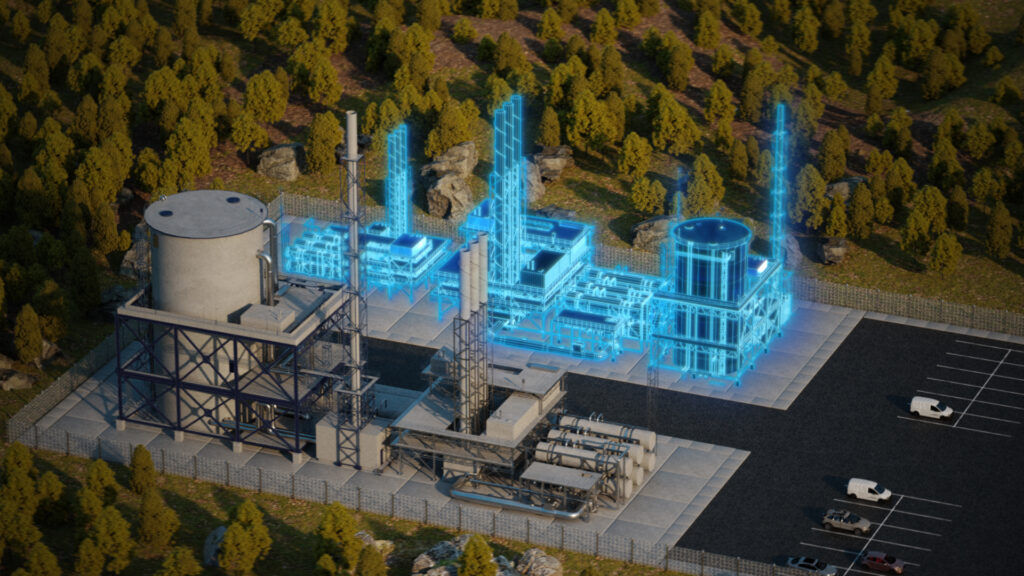
For example, modern AI advisors can provide control room operators experiencing a transient state or unknown condition an easy way to ask, “Current operations are abnormal, what is going on?” Instead of having to flip through manuals and try to determine a corrective action, operators have a natural language prompt that can guide them to action in real time — augmenting their expertise to make them the best, most knowledgeable person they can be for any given task. This capability provides powerful functionality, but it is not yet proven to orchestrate enterprise operation.
It would be a mistake, however, to assume that those orchestration capabilities are many years away. Today’s OT AI advisors are early-stage tools, akin to consumer generative AI tools in their infancy. It is easy to see how those same AI advisors will soon be able to start coordinating individual AI deployments and integrating them with knowledge in the form of a fine-tuned, multi-agent network. As they are further trained on facility-specific details, they can continue to leverage all their collected data to monitor, interpret and coordinate across models. This vision — one of a software-defined, AI-driven enterprise operations platform (EOP) — is on the horizon (see Figure 4).
Manufacturing often follows a prescriptive deployment of technology because OT solutions must always be ruggedized, both for use in challenging environments and, more importantly, to eliminate the possibility of mistakes and fabrications. Industrial AI will always need to be more predictable and deterministic than generic AI.
A good predictor of when a technology will find its way into industrial applications is when it becomes ubiquitous in normal life — and AI is ubiquitous today. People experience AI interactions every day, whether it is in auto translation, software that can predict the next words a user will type or search engines providing summaries of the most useful content. These capabilities are integrated into the tools people already use and sometimes it is not obvious they have been added. They just become a normal part of everyday products.
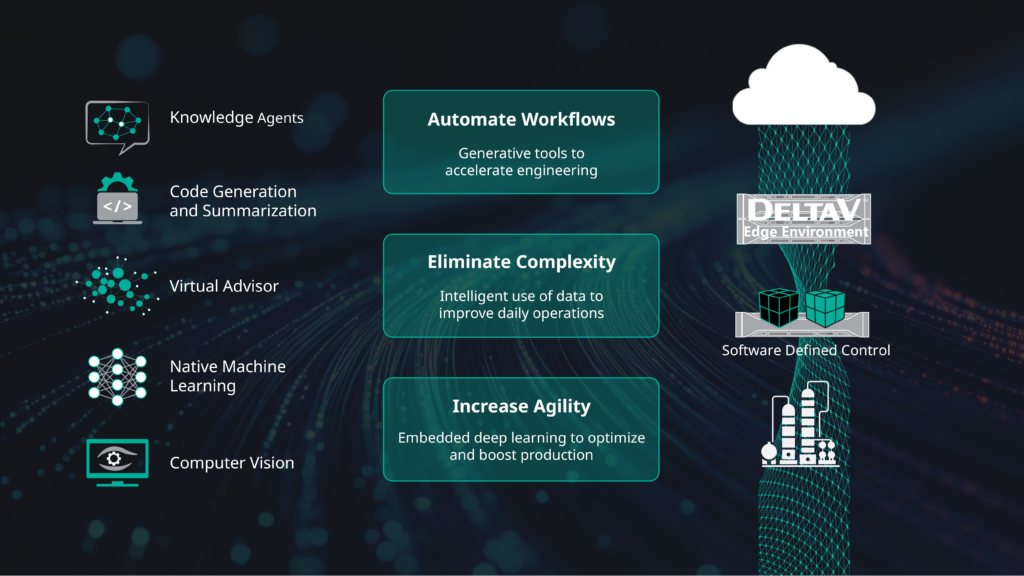
The same thing is happening with manufacturing tools. Not every AI application — perhaps not even most AI applications — will be something OT teams overlay on existing solutions and must train people to use. Instead, many of these applications are now being delivered as feature advancements in the software users already trust and will appear incrementally, making them easier to adopt and leverage to drive increased operational excellence.
Preparing for tomorrow’s AI ecosystem today
Preparing for the paradigm shift of AI-empowered operation via an EOP means ensuring support for the three critical elements that drive industrial AI: data, context and first principles. Organizations first must ensure they have the right data, have efficient data architectures in place to keep it moving seamlessly to the people and applications that need it and can keep it contextualized at every step of that process.
These needs will become even more critical as AI begins to evaluate data in real time. For example, if data in one part of the process reports a significant temperature drop, but data from another area does not support that information, OT teams will need a way to validate their data. Today, validation can be performed manually by human analysts, but it will need to happen much faster than humans can handle if the data is to be used by AI to support real-time operations.
Ultimately, teams will likely need AI-driven data validation layers to compare the data against the context. This, in turn, will require seamless interconnectivity provided by orchestrated AI across the plant and enterprise.
In addition, OT-specific AI also needs first principles grounding — fundamental physics and chemistry constraints — built in to keep it from making mistakes or fabrications. First and foremost, OT teams should select models from automation solution providers with decades of experience in their industry. Those providers will have industrial AI solutions that can be deployed either on the cloud or on premises using an automation tuned LLM as a general framework. That LLM can then be fed specific OT data to customize it to a given use case.
When that industry-specific, local LLM is deployed at the facility, it can be further trained with organization-specific systems and procedures, so the OT team has a model fully customized to their unique operations — trained on two layers of proprietary data from automation systems and users.
The orchestrated AI future is just over the horizon
Pervasive AI in process manufacturing is not only inevitable, but also closer than most would think. The consumer-grade AI models once limited by expired data and a strong tendency to hallucinate have grown in power, capability, flexibility and reliability as frontier models are released in weeks rather than years apart. They have also increasingly become ubiquitous parts of everyday life.
The same will happen in the OT space and, once again, on a much shorter timeline than anticipated. Now is the time to begin building a data foundation, as well as training, learning and building trust for the new tools that will shape the future of manufacturing.