The 2026 Plant Engineering Salary Survey showcases some variations in data over the last study.

Salary survey insights
- The 2026 Plant Engineering Salary Survey shows that most respondents report higher salary levels and strong job satisfaction, reflecting a highly experienced, well-compensated and secure workforce with modest expected salary growth.
- At the same time, uneven salary shifts by education, experience, age and region underscore deeper risks, including a weakening talent pipeline and concern over technological disruption as veteran workers near retirement.
The 2026 Plant Engineering Salary Survey results were no surprise: Participants made more money (mostly) and were happy with their jobs. Beyond that, it’s a mixed story.
Based on respondents’ responses, the survey depicts a manufacturing and engineering workforce that is highly experienced, well-compensated and secure, yet facing a looming demographic crisis and technological uncertainty.
Demographics and compensation
The respondents represent a mature, educated cohort. The workforce is predominantly male (88%) and aging, with 72% of respondents aged 50 or older. Education levels are high, with 66% holding at least a bachelor’s degree. This seniority translates into strong financial standing; 54% of respondents earn a base annual salary of more than $100,000, with 22% earning $150,000 or more.

Compensation appears stable rather than volatile. For 2026, more than half of professionals (57%) expect modest base salary increases of 1% to 3%, while bonuses are primarily tied to company profitability (52%) and personal performance (49%) rather than sales or stock metrics.
Job satisfaction and security
Despite the pressures of the industry, sentiment is overwhelmingly positive. Half of the respondents state they “love going to work every day,” and an additional 41% describe their job as “OK” or good. This satisfaction is driven less by money and more by intrinsic rewards; “feeling of accomplishment” is the top factor influencing satisfaction (16%), followed by relationships with colleagues and technical challenges.
Financial compensation ranks fourth in importance. Consequently, retention is high: 50% are not looking for a new job and 76% view manufacturing as a secure career path.
The talent and tech gap
A cross-analysis of the demographic data and reported business challenges reveals a critical vulnerability. The industry is heavily reliant on a generation nearing retirement — 11% plan to retire soon.
However, the No. 1 business challenge cited is “not enough junior team members to prepare for the future” (34%). This suggests a broken talent pipeline where knowledge transfer from the experienced (60 and older) demographic to a younger generation is stalling.
Technologically, the workforce is wary. While traditional engineering skills remain the most prized asset for advancement (28%), “artificial intelligence replacing human decision-making” is cited as a significant threat by 36% of respondents, second only to political and economic changes.
In the immediate future, practical tools like advanced programmable logic controllers, supervisory control and data acquisition systems and digital lockout/tagout systems are prioritized over more abstract concepts like blockchain or the metaverse.
The data presents the manufacturing engineering sector has a solid foundation of experienced veterans who feel safe and well-rewarded.
However, there are two challenges that show up for this industry, along with many other industries: a lack of new recruits as the veterans retire and the rapid encroachment of new technologies (AI) that threaten to alter the very structure of the work they enjoy.
Salary survey defines how much you are worth
Significant volatility occurred across education levels, with some categories seeing massive salary reductions while others saw substantial gains. Comparing year-over-year salary data, there were some shifts based on education:
- High school diploma: The average base annual salary dropped precipitously by approximately 34.6%, falling from $128,689 in 2024 to $84,179 in 2025. Nonsalary compensation for this group also decreased by more than 59%.
- Dual bachelor’s degree: This category saw a massive increase in base salary of roughly 46.7%, rising from $75,733 in 2024 to $111,146 in 2025. Furthermore, nonsalary compensation for dual bachelor’s degree holders jumped from $1,833 to $14,400.
- Master’s degree: Base salaries increased by roughly 16.4%, moving from $110,734 to $128,905.
- Doctoral degree: Base salaries increased by roughly 13.4% ($117,000 to $132,678), though nonsalary compensation dropped by approximately 34%.
- Associate’s degree: While the base salary saw a modest increase, nonsalary compensation plummeted by nearly 68%, dropping from $15,550 in 2024 to $4,909 in 2025.
Industry experience
Data regarding tenure and experience revealed several inversions where less experienced workers saw gains while mid-level brackets saw drops.
- Industry experience (5 to 9 years): This group experienced a sharp decline in base salary of roughly 31%, falling from $99,978 in 2024 to $68,675 in 2025. However, their nonsalary compensation more than doubled, rising from $6,481 to $16,301.
- Industry experience (less than 5 years): Conversely, entry-level industry workers saw their base salary rise by roughly 36%, from $65,164 to $88,691.
- Tenure with employer (40 or more years): Long-tenured employees saw a base salary increase of nearly 35%, rising from $105,425 in 2024 to $142,069 in 2025.
- Tenure with employer (15 to 19 years): Base salary increased by approximately 17%, going from $91,539 to $107,056.
- Tenure with employer (less than 5 years): New hires saw a base salary decrease of roughly 14%, dropping from $114,901 to $98,324.
Age demographics
While middle-age brackets remained relatively stable, the oldest and youngest demographics experienced notable shifts.
- 70 years old or older: The average base salary for this group increased by roughly 14%, from $110,500 in 2024 to $125,999 in 2025. However, their nonsalary compensation dropped by approximately 50%.
- 40 to 49 years old: Nonsalary compensation decreased by roughly 14% for this age bracket.
Regional salary differences
Geographic data shows a cooling trend in several eastern regions, contrasting with growth in the West North Central region.
- East South Central: Base salaries dropped by nearly 18%, falling from $125,168 in 2024 to $102,875 in 2025.
- New England: Base salaries decreased by roughly 15.7%, dropping from $119,250 to $100,445.
- South Atlantic: While base salaries decreased by roughly 10% ($121,475 to $108,919), nonsalary compensation more than doubled, rising from $10,014 to $20,904.
- West North Central: This region saw a base salary increase of roughly 12.4%, rising from $98,486 to $110,751.
Discipline
Several specific job functions and disciplines saw decreases in base pay exceeding 10%.
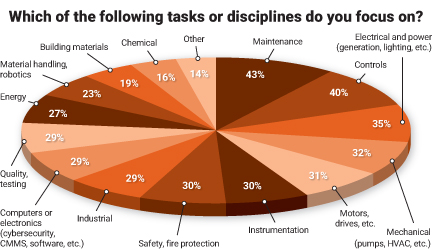
- Building materials: Base salary dropped by approximately 15.8%, from $114,460 in 2024 to $96,392 in 2025.
- Chemical: Base salary fell by roughly 13%, from $122,884 to $106,708.
Salary survey methodology
The 2026 Plant Engineering Salary Survey was completed in November 2025. There were 168 complete responses with a margin of error of +/-6.9% at a 95% confidence level. Download the complete 2026 Plant Engineering Salary Survey results.