Balancing traction and sanitation standards is a constant challenge in dry food, dairy and pharmaceutical facilities. Here’s what plant leaders should ask before choosing a flooring solution that can satisfy both.
By Quinn Poor, Manager of Engineering and Product Development, SLIPNOT
Falls, slips and trips are the second-leading cause of fatal workplace injuries, according to the Bureau of Labor Statistics. For plant leaders in dry food, baking, dairy and pharmaceutical manufacturing, fixing that risk has often meant creating a new one.
High-traction flooring works by cutting grooves and crevices into a surface, but that microscopic terrain traps fine powders, flour and organic dust. In wet processing environments, a daily washdown clears that debris out. But dry processing facilities restrict or eliminate water washdowns specifically to prevent moisture from introducing Listeria, Salmonella and other pathogens. That leaves fine dust sitting in the same grooves meant to prevent falls, creating harborage points that fail to meet strict Food Safety Modernization Act (FSMA) and U.S. Department of Agriculture (USDA) sanitation standards.
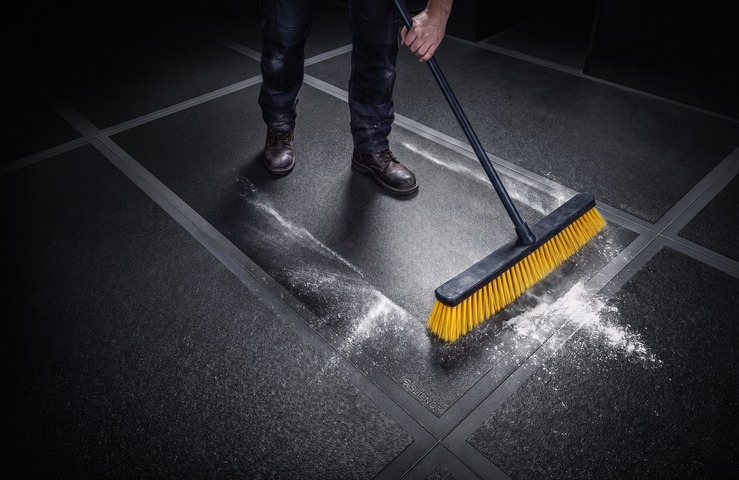
One emerging response to that compromise is a class of sweepable, high-traction stainless steel surfaces engineered specifically for dry processing facilities. Rather than cutting deep grooves, these surfaces fill the microscopic valleys of a high-friction texture while leaving millions of tool-steel-hard traction peaks exposed, so a standard push broom can clear the surface in a single pass without sacrificing grip.
Before surfaces like this existed, plants had to work around the trade-off with mixed results. Tapes, paints and grit coatings wear down quickly under foot and cart traffic, requiring constant reapplication. Dotted metal plates are often installed on the assumption that a broom can sweep debris out from around the welded beads. However, fine powder still packs in at the base of each dot, and the welded beads can loosen or snap off under heavy rolling-cart loads to expose smooth, slippery metal. Diamond plate relies on a raised metal pattern rather than true surface grip, so once it’s coated in dust or a light film of oil, it loses much of its grip. Each option addresses durability or cleanability, but rarely both.
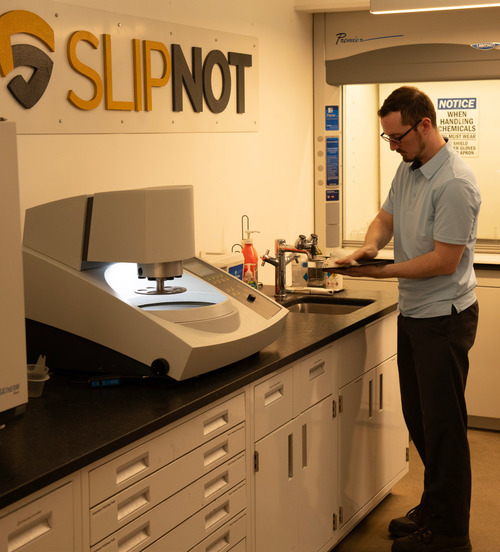
That gap reflects a metric problem as much as a material one. Plant managers evaluating flooring should look at Dynamic Coefficient of Friction (DCOF) rather than older static tests, since DCOF measures grip while someone is actively walking. This gives a more realistic picture of how slips actually occur rather than a test with someone standing still. For a dry processing zone, the number that matters most is dry DCOF measured with fine powder worked into the surface, not a clean, dust-free reading alone. Under American National Standards Institute (ANSI) A326.3 protocols, a dry DCOF above 0.80 on a clean surface indicates excellent baseline traction, while a reading above 0.60 with contamination present is considered reliable in real-world use. In-house testing of one such engineered surface recorded a clean dry DCOF of 0.97 and 0.71 with flour worked into the surface, comfortably clearing both benchmarks. Any flooring specification should require documented DCOF data under contaminated conditions, not just a clean-sample rating.
Sanitation compliance adds another layer of scrutiny. Under FSMA and USDA rules, metal flooring in food processing areas generally needs to be fully seam-welded along every edge to prevent gaps where moisture, food residue and bacteria collect. Some manufacturers pre-mask a surface’s perimeter edges before installation so field crews can complete a full-seam weld without burning or delaminating the finish. Before approving any installation, plant leaders should confirm how the perimeter will be sealed and whether the finish can tolerate that kind of weld.
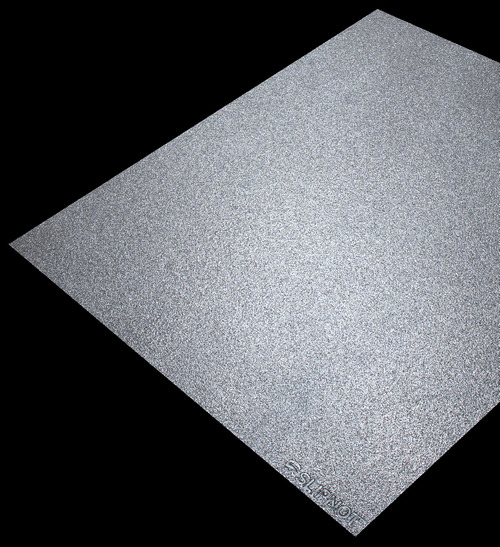
Surface sweepability deserves the same verification as traction and compliance. Comparative lab testing of five common industrial floor surfaces — using UV tracer powder to visualize particle retention before and after sweeping, alongside dry DCOF measurement — found that dotted metal and diamond-pattern surfaces marketed as “easy to clean” still retained significant debris after repeated passes, while the sweepable engineered surface came clean in far fewer passes. Plant leaders evaluating any flooring option should ask suppliers for before-and-after cleanability data rather than relying on unverified claims.
The total cost of ownership extends beyond the initial price per square foot. According to the Liberty Mutual Workplace Safety Index, overexertion injuries tied to slipping and catching one’s balance cost employers more than $13 billion a year in direct workers’ compensation costs. On the sanitation side, the math is just as concrete: in-house modeling on this type of surface found that a three-line facility running two dry cleanings a day, saving 20 minutes per line per cleaning, can recover more than 730 hours of production availability annually — a direct lift to Overall Equipment Effectiveness. Specifying the right surface during a new build or expansion is almost always cheaper than retrofitting an active line later, which makes flooring a decision worth making early rather than reactively, after an incident or a failed audit.
Before signing off on a flooring solution for a dry processing zone, plant leaders should be able to answer four questions:
1. What is the dry DCOF — both clean and with fine-powder contamination — and how was it tested?
2. How is debris actually removed, with data to back up the claim?
3. How will the perimeter be sealed to meet seam-welding requirements?
4. What does the total cost look like over five years, not just on the installation invoice?
A surface that only answers one or two of those questions is still asking a plant to choose between safety and sanitation — a compromise the industry has lived with for decades, and one that better-engineered flooring no longer requires.
Quinn Poor is Manager of Engineering and Product Development at SLIPNOT, a Detroit-based manufacturer of slip-resistant metal flooring and surface technologies. More information is available at slipnot.com.
Sponsored content by SLIPNOT