There are many factors involved when selecting appropriate light fixtures for industrial environments.

Learning objectives
- Review considerations for light fixture selection in hazardous-classified areas.
- Understand why specific light fixtures are selected for maintenance purposes.
- Learn about light fixture selection for heavy-duty/rugged environments.
Lighting insights
- After reading this article, facility managers, engineers and designers can make more informed light fixture selections to enhance safety and extend fixture service life in demanding industrial settings.
- The article explains how industrial lighting in hazardous and harsh environments must be carefully classified, designed and maintained using certified fixtures and rigorous standards to ensure safety, regulatory compliance, durability and long-term operational reliability.
Lighting systems in industrial and hazardous environments are subject to a unique set of challenges that extend beyond providing general illumination. In industrial areas, areas with accessibility restrictions and in harsh environments, lighting must be more than functional — it must be safe, reliable, durable and maintainable. Improperly selected or poorly maintained lighting can become a safety hazard and may result in early equipment failure or noncompliance with regulations.
This article is divided into three parts, each focusing on a fundamental aspect of industrial lighting in challenging environments:
- Classification of hazardous locations and explores the types of light fixtures suitable for these environments, with an emphasis on explosion protection and regulatory compliance.
- Design strategies for ensuring lighting systems can be maintained safely and efficiently, without disrupting operations or compromising worker safety.
- Critical standards and ratings used to select fixtures that can withstand extreme conditions, including ingress protection; material compatibility; and resistance to vibration, impact and temperature extremes.
Lighting systems for hazardous-classified areas
Illumination in hazardous-classified environments necessitates using specialized light fixtures engineered to mitigate the risk of ignition from flammable gases, vapors, dusts or fibers. These fixtures must conform to stringent safety standards and regulatory frameworks to ensure operational safety and compliance. The fixtures must be listed or identified for the class and division of the area where they are to be installed.
Additionally, the temperature class (T Code) of the light fixture must not exceed the autoignition temperature of the gases, vapors, dusts or fibers in the environment in which the light fixture will be installed.

Hazardous locations are categorized based on the type and likelihood of the presence of ignitable substances. The classification system as defined in NFPA 497: Recommended Practice for the Classification of Flammable Liquids, Gases or Vapors and of Hazardous (Classified) Locations for Electrical Installations in Chemical Process Areas includes:
- Class I: Areas where flammable gases or vapors are present, such as in oil refineries, chemical processing facilities or wastewater treatment plants.
- Class II: Locations with combustible dusts, commonly found in food processing plants, sludge drying processes at wastewater treatment plants or other manufacturing environments.
- Class III: Environments containing ignitable fibers or flyings, such as textile mills or industrial sawmills.
Each class is further divided into two divisions, which indicate the probability of hazardous material presence:
- Division 1: The hazardous substance is present under normal operating conditions.
- Division 2: The hazardous substance is present only under abnormal conditions, such as equipment malfunction or accidental release.
Types of lighting fixtures
To ensure safety in these hazardous-classified environments, light fixtures must be specifically designed and certified for hazardous use.

Explosion-proof fixtures are constructed to contain any internal ignition sources (e.g., sparks, heat), thereby preventing the ignition of the surrounding atmosphere. Explosion-proof housings are typically made from durable materials such as die-cast aluminum or stainless steel to provide strength, corrosion resistance and heat dissipation. They are designed to contain internal explosions caused by sparks or arcs, withstand high pressure and cool escaping gases through precision-machined threaded or flanged joints.
Intrinsically safe fixtures are engineered to operate with electrical energy levels sufficiently low to not produce a spark capable of igniting flammable gases, vapors or dusts in hazardous‑classified locations. By limiting the voltage and current within the fixture and associated wiring, these systems prevent sparks or high temperatures that could cause ignition. This approach allows the safe use of lighting even in environments where explosive atmospheres may be present continuously or intermittently.
Intrinsically safe lighting is often used in areas where explosion-proof housings may be impractical or the lighting is required to be portable, such as areas where personnel frequently perform inspections and maintenance.
Lighting system maintenance
When selecting luminaires for use in industrial installations, maintainability with minimal impact on operations is an important consideration. Without designing maintainability into a lighting system, the system will likely not be maintained, which can lead to unsafe working conditions.
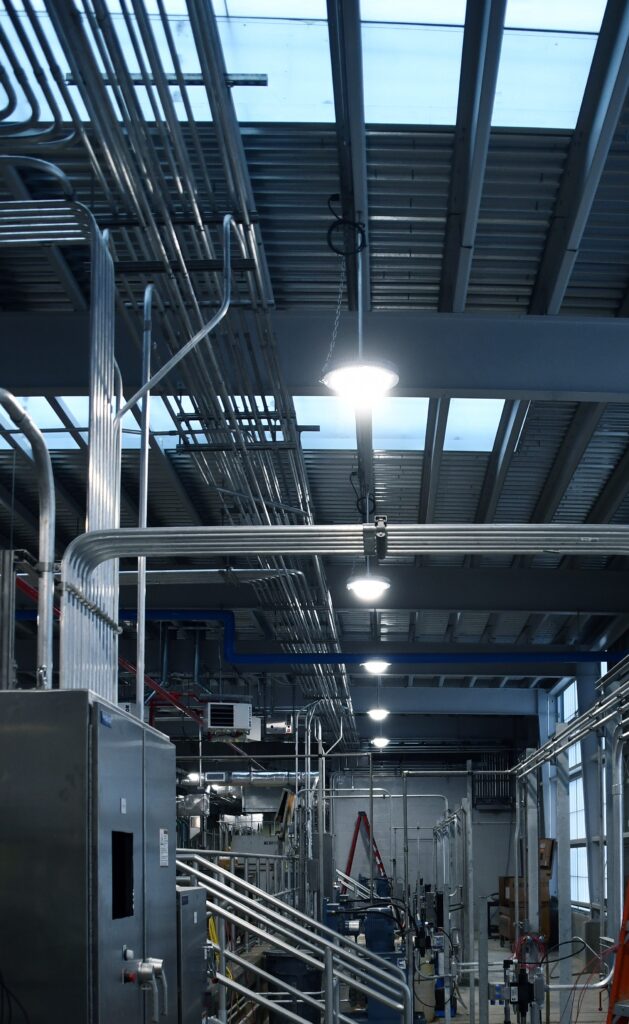
Because of requirements for the regular testing of egress and emergency lighting, the lighting system design should be configured to allow for testing while maintaining facilities in operation. Some ways to do this include:
- Using dedicated emergency lighting units, which are light fixtures dedicated to emergency and egress lighting apart from normal process lighting. This allows for easy testing and maintenance of emergency light fixtures with battery packs, apart from the normal facility light fixtures, which may be less accessible.
- Having emergency lighting systems that self-test. Some emergency lighting systems self‑test and locally indicate when there is an issue with the fixture; others can self-test and report to a central station, particularly if a lighting inverter or uninterruptible power supply is designed into the system.
Additionally, when working on top of process structures that require illumination, the designer should consider types of lighting installations that will allow the owner to safely access and replace luminaires with minimal effort. Some methods that may achieve this include:
- Mounting fixtures at heights that can be easily accessed using a standard 10-foot ladder.
- Locating light fixtures clear of tanks and equipment within industrial environments so that fixtures may be easily accessed for inspections and maintenance.
- Using light poles that hinge or swivel so that fixtures may be accessed and maintained.
- Mounting light fixtures separately from the main structure to enable maintenance using a bucket truck or winch system (for high-mast lighting), avoiding the need to access confined or hard to reach areas of outdoor structures.
- Using plug-and-cord type light fixtures for easy replacement of fixtures in hard-to-reach areas.
Because of dirt build-up and sanitation requirements, certain facilities require frequent washdown of spaces and the light fixtures within them. In these types of facilities, it is important to select light fixtures with adequate ingress protection (IP) ratings so that the fixtures may be cleaned with a hose or water jet without damaging the fixtures.
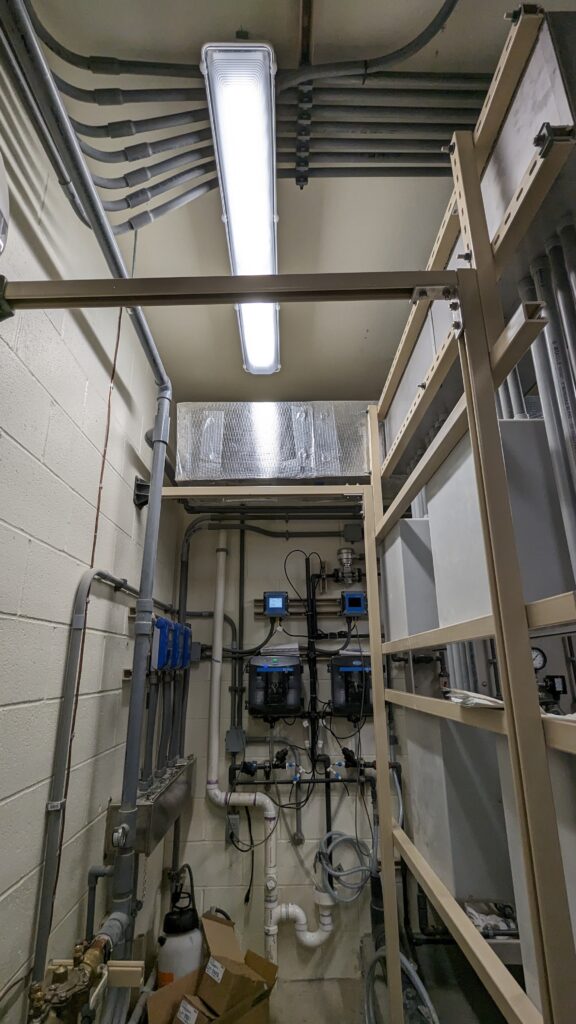
When taking this approach, the space and the equipment therein, including lighting, must be suited for washdown. Typical environments where washdown-rated fixtures are found include spaces in the food and beverage and chemical processing industries and some cleanroom environments.
In modern industrial environments, it has become standard practice to prioritize LED-based lighting over the use of traditional lamp-based fixtures. LEDs offer greater reliability, have a long operational life and are generally not subject to the frequent failures associated with conventional lamps. This translates to lower maintenance demands as the need for regular lamp replacements is greatly reduced.
Another important component in limiting maintenance and extending the service life of a lighting system is selecting a fixture rugged enough for the area in which it will be installed.
Light fixtures for heavy-duty/rugged environments
When selecting a light fixture for a harsh environment, some essential ratings and standards should be considered for almost all applications. These ratings help ensure that light fixtures will endure in even the most demanding areas. Key considerations include IP, material compatibility, impact and vibration resistance and temperature ratings.
The IP rating system and National Electrical Manufacturers Association (NEMA) 250 type ratings are standards that test the integrity of a fixture against foreign solids and liquids ingress. The IP rating system was developed by the International Electrotechnical Commission (IEC) and is defined in IEC 60529. IP ratings are typically shown as “IP” followed by two numerals (e.g., IP 65) that indicate the level of protection against foreign solids and liquids ingress, respectively.
The NEMA 250 type rating system does not have a specific identifier that corresponds to its level of protection. NEMA 250 types address some aspects of light fixtures that IP ratings do not, such as fixture construction, corrosion resistance, icing effects, gasket durability and protection from coolants. These are not part of the IP rating system and such differences should be considered when selecting light fixtures.
In addition to NEMA 250 type and IP ratings, UL — a safety organization that sets industrywide standards for new products — provides listings for light fixture resistance against water ingress. The UL listings are generally lighter duty and address installation in dry, damp and wet locations.
Many harsh-environment light fixtures will include both a NEMA 250 type rating and an IP rating. Similarly, a fixture that meets NEMA 250 type and IP ratings will often also include a UL listing according to the degree of protection provided in the fixture. Although the NEMA 250 type addresses corrosion resistance, it does not determine the specific material of the light fixture housing, lens or hardware.
Enclosure and lens materials that are not compatible with certain chemicals may experience advanced degradation and lead to early failures. For example, a NEMA 4X rated light fixture with an aluminum housing would be adequate for an area with glycol exposure but would be more susceptible to corrosion in an area with sodium hypochlorite.
Unfortunately, there is not one universally corrosion-resistant material that has good compatibility with all chemicals. The exposed portion of fixtures such as the lens, housing and hardware should be selected with respect to the chemicals and treatment processes of any given area.

Other common aspects of light fixture selection include impact and vibration protection and temperature ratings. The IEC 62262 impact rating (IK) rating system defines the degree of protection that a light fixture has against mechanical impact, with ratings ranging from IK00 (lowest) to IK11 (highest). Light fixtures at risk of damage or vandalism should be selected to have a high IK rating. ANSI C136.31: Standards for Roadway and Area Lighting Equipment tests fixtures for vibration resistance at levels of 1.5 times the force of gravity (G), at 3G or up to 5G. Light fixtures can be tested by a third party and certified to meet the ANSI requirements.
Finally, the operating temperature rating of a light fixture must suit the application. A standard indoor light fixture has an operating temperature rating of approximately 32°F to 104°F. Environments with temperature extremes, such as high bays, hot areas of manufacturing plants or other unconditioned industrial areas and cold storage and cold climate areas often have ambient temperatures that are not within a standard light fixture’s operating temperature. These areas should have light fixtures selected with appropriate ambient operating temperatures for the environment in which they will be installed.
A comprehensive lighting approach
Industrial lighting in hazardous and harsh environments demands more than just adequate light levels, it requires a comprehensive approach that prioritizes safety, suitability and maintainability. Understanding hazardous area classifications, designing for ease of maintenance and selecting fixtures rated for rugged conditions are all essential components in creating a reliable and compliant lighting system.
By applying the principles discussed across the three sections — hazardous location requirements, maintainability strategies and fixture selection standards — facility managers, engineers and designers can reduce risk, enhance operational efficiency and ensure long-term performance. Investing in the right lighting solutions not only safeguards personnel and assets but supports regulatory compliance and minimizes costly downtime across critical industrial operations.
Definitions
Class: Part of the NFPA system of classification for hazardous areas that defines the general type of hazard present.
Division: Part of the NFPA system of classification for hazardous areas that defines the likelihood of hazardous material presence.
Group: Part of the NFPA system of classification for hazardous areas that further defines the hazardous material based on the properties of the substance.
Explosion proof: Electrical equipment that can prevent an internal explosion from igniting the surrounding atmosphere.
Intrinsically safe: Electrical equipment that can prevent an explosion by being unable to release enough energy to ignite a flammable atmosphere.
Inverter: An apparatus that converts direct current into alternating current.