
Well-tuned boilers improve production consistency and energy efficiency. Poor boiler performance can increase costs, emissions, and equipment wear.
- Understand how boiler control system tuning improves steam system efficiency and reliability.
- Recognize the impact of boiler performance on production quality, compliance, and equipment life.
- Learn how Cross Process Solutions modernized and optimized a food manufacturer’s boiler system, improving steam reliability, efficiency and production performance while reducing operational risk.
A large multinational manufacturer of food flavorings and fragrances has a facility in Florida with three boilers that generate steam to provide heat for production processes. Three boilers provide redundancy and additional capacity for increased need without having to rent or add another boiler. The boilers also act as thermal oxidizers to fully decompose hazardous waste liquids and gases.
Why boiler tuning is important to performance
Each boiler is controlled by its own programmable logic controller (PLC). Equipment common to all the boilers is controlled by a balance of plant (BOP) PLC with processor redundancy. The plant can tolerate one boiler going down. However, if the whole boiler house goes down for more than a few minutes, that would cause much of their production processes to stop for lack of steam. In 2014, the customer sought to replace obsolete loop controllers to upgrade to newer technology. Shortly afterwards, we upgraded the system to a market leading control system architecture. We also integrated the three together to coordinate steam production for optimal efficiency and availability.
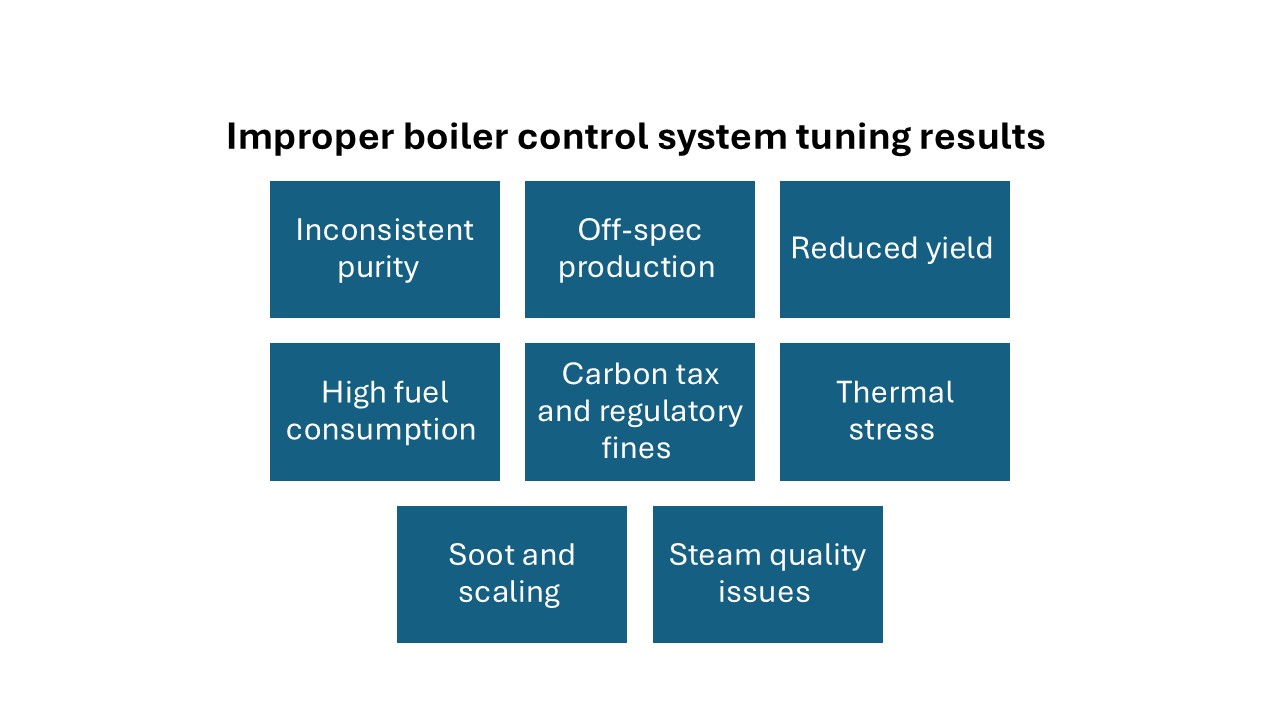
In the years since, onsite visits regularly included tuning the boiler system for optimum efficiency, as well as regulatory compliance. Without this proper boiler tuning, negative impacts like these could potentially occur:
- Inconsistent purity: Fluctuations in steam pressure or temperature (caused by “hunting” burner controls) lead to surging in the column. This can cause “carryover,” where heavier impurities end up in the top product.
- Off-spec production: If the boiler cannot maintain the precise heat required for the reboiler, the column may fail to reach the boiling point of the target component, leading to wasted batches.
- Reduced yield: Poor control often results in valuable products being lost in the “bottoms” because there wasn’t enough consistent energy to vaporize them.
- High fuel consumption: Improper fuel-to-air ratios lead to inefficient combustion. If there is too much “excess air,” you are essentially paying to heat up nitrogen that just flies out the stack.
- Carbon tax and regulatory fines: Inefficient combustion increases greenhouse gas emissions. It can also increase production of regulated pollutants such as carbon monoxide (CO) and nitrogen oxides (NOx). In many jurisdictions, this leads to higher carbon taxes or penalties for exceeding emissions permits.
- Thermal stress: Frequent cycling or “slugging” (where the boiler rapidly turns on and off) causes metal fatigue in the boiler tubes and the distillation column’s heat exchangers, which shortens their lives.
- Soot and scaling: Incomplete combustion leaves carbon deposits (soot) on the fireside of the tubes. This acts as an insulator, requiring even more fuel to achieve the same heat transfer, creating a “death spiral” of efficiency.
- Steam quality issues: An untuned boiler can cause “priming” or “carryover,” where liquid water droplets enter the steam lines. This leads to water hammer, which can rupture pipes and damage the delicate internal trays of a distillation tower.
Running your boiler at peak efficiency is essential for process consistency and to maximize the life of equipment.
Madeline Lawson is email and content specialist, Cross Process Solutions, a CSIA Certified Member. Edited by Tyler Wall, senior editor, Plant Engineering, [email protected].
Keywords
Boiler control systems, system integration, PLC modernization
Consider this
Are legacy controls preventing application optimization?
You also might like
Global System Integrator Database
