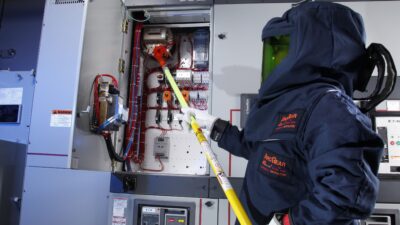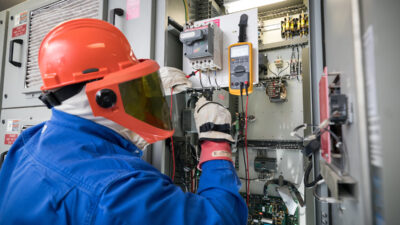
With a pressure wave similar to a hand grenade and the potential to produce heat nearly four times the temperature of the sun, arc flash hazards pose serious danger. That’s why manufacturers across all sectors of industry are implementing techniques and practices designed to reduce these hazards and help protect workers.
With a pressure wave similar to a hand grenade and the potential to produce heat nearly four times the temperature of the sun, arc flash hazards pose serious danger. That’s why manufacturers across all sectors of industry are implementing techniques and practices designed to reduce these hazards and help protect workers.
The causes of arc flash are usually accidental — for example, maybe a rodent or water accidentally enters electrical equipment or an employee accidentally forgets to tighten a connection. When this happens, an arc fault superheats the air around it, expands and creates a pressure wave within the electrical enclosure.
This arc plasma vaporizes everything it comes in contact with — copper, insulating materials, bolts and the steel enclosure — and can cause serious injury to workers. Injuries can include severe burns from the burning and vaporized materials, damaged hearing from the sound waves and impaired eyesight from the high-intensity flash.
Intensifying the focus
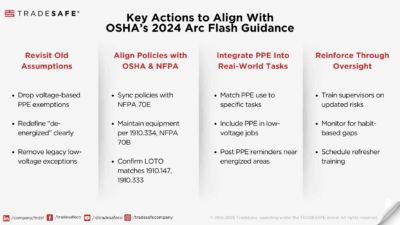
Historically, electric codes and safety standards did not directly address arc-flash hazards; they only addressed protection from fire, electrocution and shock hazard. But standards such as “NFPA 70E—Electrical Standard for Safety in the Workplace” are putting more focus on arc-flash risks and helping reduce the associated hazards in North America.
As codes and standards evolve, users are looking for leading-edge products capable of delivering higher levels of safety. Arc-resistant motor control centers and intelligent control systems are fulfilling that need in many applications. Such solutions offer improved safety features along with remote operation and monitoring capabilities.
Creating an effective design
An arc-resistant MCC is designed and built to provide a complete structural solution, with the ability to contain and redirect the arc energy away from personnel and capable of providing Type 2 accessibility. Type 2 accessibility, as defined within IEEE standard C37.20.7-2007, helps shield personnel on the front, rear and sides of an enclosure from the effects of an internal arcing fault. Core features should include:
-
Structural integrity through a solid, robust design
-
Two side sheets on every section
-
Well-isolated horizontal bus and vertical bus insulated in a nonconductive labyrinth support
-
Automatic vertical bus shutters
-
Unit isolation
-
Dedicated unit ground stab and vertical ground bus.
-
Rugged structural design and a well-supported, isolated and insulated bus system are critical for an MCC to withstand the effects of an arc-flash event. Two side sheets on every section and a robust bus support design contribute significantly to the ability of the equipment to contain and redirect the arc-flash energy.
To help isolate and protect users from potentially hazardous voltages, the MCC should employ a solid grounding system, along with a well-isolated and insulated horizontal bus and vertical bus. For added safety, spaces which accommodate plug-in units should include automatic shutters that immediately isolate stab openings when units are removed.
One of the newest features in MCC technology is the use of built-in networking and preconfigured software. By including a built-in industrial network, based on an open protocol like DeviceNet, along with MCC monitoring and configuration software, users can remotely monitor, configure and troubleshoot the MCC, minimizing the need for personnel to enter an arc-flash boundary zone.
Clearing the confusion
In considering an arc-resistant MCC, it’s important that users understand the performance criteria that must be met before the MCC can be classified as an arc-resistant design. “Arc-resistant,” as it applies to electrical equipment like low voltage MCCs, is a recognized industry term defined by IEEE C37.20.7-2007. The standard defines the test requirements that must be met and the expected performance equipment must deliver in the event of an arc flash.
Some vendors may use terms like “arc flash-resistant” to describe their product with the implication that it offers substantiated arc-resistant capabilities. However, “arc flash-resistant” is not a standard industry term and has no relevant meaning behind it.
Another area of confusion centers on the claim that keeping the doors of an MCC closed during insertion and removal of power stabs provides a lower risk, and therefore allows users to adhere to a reduced level of required PPE. The reality is no industry standard allows users to reduce the risk category of an MCC application just because the door is closed.
Diligence pays off
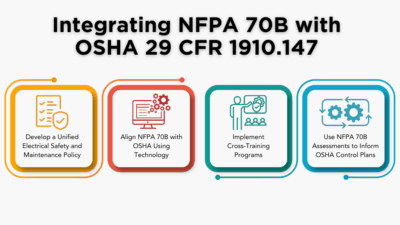
Ultimately, the best prevention against exposure to an arc flash is an in-house safety program that complies with the NFPA 70E standard. Beyond that, the most important advice is “shut it off.”
Because of high-production volumes and the use of multiple and differing automation systems in a single plant, identifying and significantly reducing potential hazards can be a complex task. This means end users and employers must be diligent in their training practices and highly selective in their technology choices to increase workplace safety.
The good news is advances in control technology make it easier with an expanded array of solutions designed to deliver improved safety, increased productivity and greater cost-savings.
Employers must be diligent in their training practices and highly selective in their technology choices to increase workplace safety.
Good maintenance practices can help lower maintenance costs by 60%.